Liu Pan, Wu Maokun, Liu Hui, Lu Feng, Wang Wei-Hua, Cho Kyeongjae
Department of Electronic Science and Engineering and Tianjin Key Laboratory of Photo-Electronic Thin Film Device and Technology, Nankai University, Tianjin 300071, China.
Department of Material Science and Engineering, The University of Texas at Dallas, Richardson 75080, USA.
Scanning. 2019 Feb 4;2019:5434935. doi: 10.1155/2019/5434935. eCollection 2019.
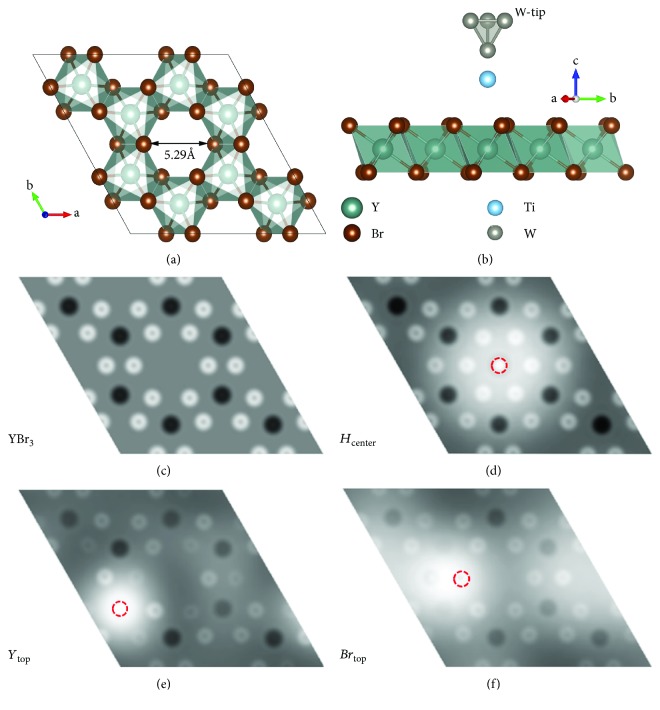
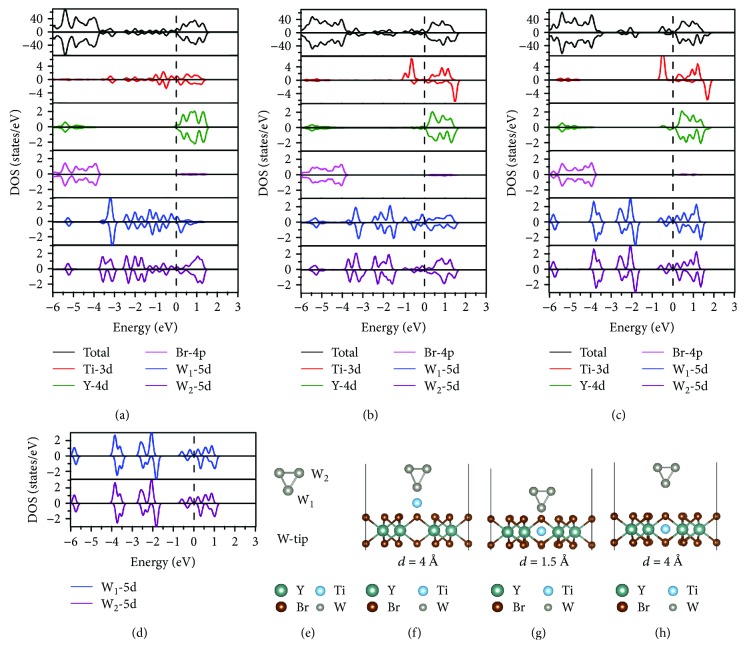
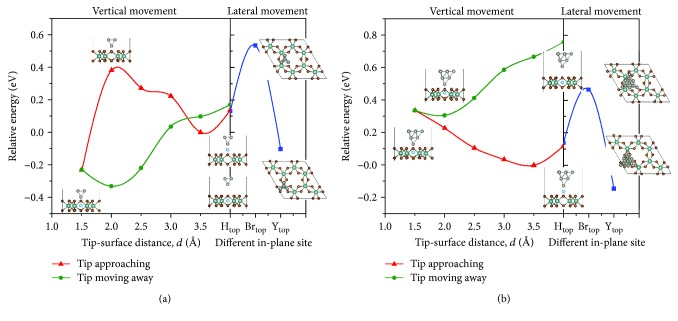
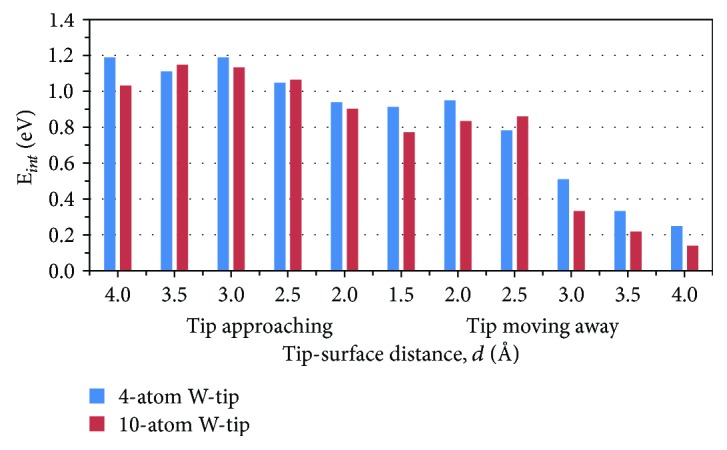
Scanning tunneling microscopy (STM) is an important tool in surface science on atomic scale characterization and manipulation. In this work, Ti adatom manipulation is theoretically simulated by using a tungsten tip (W-tip) in STM based on first-principle calculations. The results demonstrate the possibility of inserting Ti adatoms into the atomic pores of monolayer YBr, which is thermodynamically stable at room temperature. In this process, the energy barriers of vertical and lateral movements of Ti are 0.38 eV and 0.64 eV, respectively, and the Ti atoms are stably placed within YBr by >1.2 eV binding energy. These theoretical predictions provide an insight that it is experimentally promising to manipulate Ti adatom and form artificially designed 2D magnetic materials.
扫描隧道显微镜(STM)是表面科学中用于原子尺度表征和操纵的重要工具。在这项工作中,基于第一性原理计算,利用STM中的钨尖端(W尖端)对Ti吸附原子的操纵进行了理论模拟。结果表明,将Ti吸附原子插入单层YBr的原子孔中是可能的,该单层YBr在室温下是热力学稳定的。在此过程中,Ti垂直和横向移动的能垒分别为0.38 eV和0.64 eV,并且Ti原子通过大于1.2 eV的结合能稳定地置于YBr内。这些理论预测提供了一种见解,即操纵Ti吸附原子并形成人工设计的二维磁性材料在实验上是有前景的。