Unit of Orthodontics and Paediatric Dentistry, Section of Dentistry, Department of Clinical, Surgical, Diagnostic and Paediatric Sciences, University of Pavia, Pavia, Italy.
Unit of Restorative Dentistry, Section of Dentistry, Department of Clinical, Surgical, Diagnostic and Paediatric Sciences, University of Pavia, Pavia, Italy.
Biomed Res Int. 2019 Feb 4;2019:5109481. doi: 10.1155/2019/5109481. eCollection 2019.
Acidic beverages, such as soft drinks, can produce erosion of resin composites. The purpose of the present study was to investigate mechanical properties of different esthetic restorative materials after exposure to acidic drink.
Nine different composites were tested: nanofilled (Filtek Supreme XTE, 3M ESPE), microfilled hybrid (G-ænial, GC Corporation), nanohybrid Ormocer (Admira Fusion, Voco), microfilled (Gradia Direct, GC Corporation), microfilled hybrid (Essentia, GC Corporation), nanoceramic (Ceram.X Universal, Dentsply De Trey), supranano spherical hybrid (Estelite Asteria, Tokuyama Dental Corporation), flowable microfilled hybrid (Gradia Direct Flo, GC Corporation), and bulk fill flowable (SureFil SDR flow, Dentsply De Trey). Thirty specimens of each esthetic restorative material were divided into 3 subgroups (n=10): specimens of subgroup 1 were used as control, specimens of subgroup 2 were immersed in 50 ml of Coca Cola for 1 week, and specimens of subgroup 3 were immersed in 50 ml of Coca Cola for 1 month. Flexural strength and elastic modulus were measured for each material with an Instron Universal Testing Machine. Data were submitted to statistical analysis.
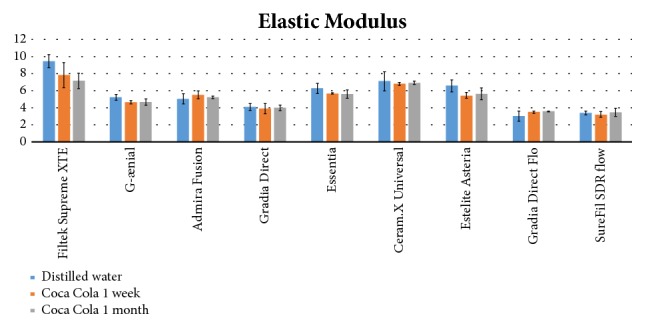
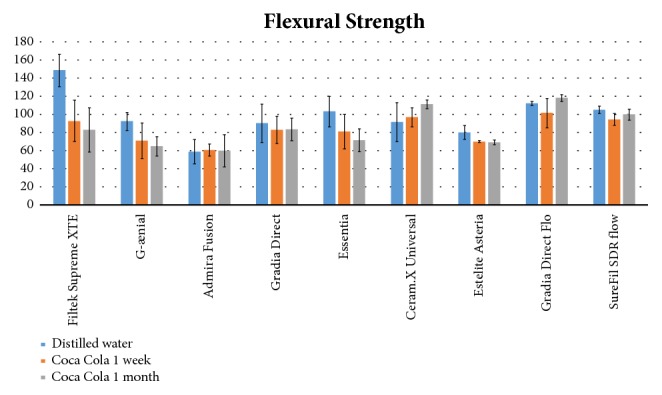
After distilled water immersion, nanofilled composite showed the highest value of both flexural strength and elastic modulus, but its flexural values decreased after acidic drink immersion. No significant differences were reported between distilled water and acidic drink immersion for all other materials tested both for flexural and for elastic modulus values.
Even if nanofilled composite showed highest results, acidic drink immersion significantly reduced flexural values.
酸性饮料,如软饮料,可能会导致树脂复合材料腐蚀。本研究的目的是研究不同美学修复材料在暴露于酸性饮料后的力学性能。
测试了 9 种不同的复合材料:纳米复合(Filtek Supreme XTE,3M ESPE)、微填充混合(G-ænial,GC 公司)、纳米复合有机硅(Admira Fusion,Voco)、微填充(Gradia Direct,GC 公司)、微填充混合(Essentia,GC 公司)、纳米陶瓷(Ceram.X Universal,Dentsply De Trey)、超纳米球形混合(Estelite Asteria,Tokuyama Dental Corporation)、流动微填充混合(Gradia Direct Flo,GC 公司)和块状填充流动(SureFil SDR flow,Dentsply De Trey)。每种美学修复材料的 30 个样本被分为 3 组(n=10):第 1 组的样本用作对照,第 2 组的样本浸入 50ml 可口可乐中 1 周,第 3 组的样本浸入 50ml 可口可乐中 1 个月。用 In stron 万能试验机测量每种材料的弯曲强度和弹性模量。数据提交给统计分析。
在蒸馏水浸泡后,纳米复合材料表现出最高的弯曲强度和弹性模量值,但在酸性饮料浸泡后其弯曲值下降。在蒸馏水和酸性饮料浸泡下,所有其他测试材料的弯曲和弹性模量值均未报告有显著差异。
即使纳米复合材料表现出最高的结果,酸性饮料浸泡也显著降低了弯曲值。