Mastroeni Silmara Salete de Barros Silva, Mastroeni Marco Fabio, Ekwaru John Paul, Setayeshgar Solmaz, Veugelers Paul J, Gonçalves Muryel de Carvalho, Rondó Patrícia Helen de Carvalho
Departamento de Educação Física, Universidade da Região de Joinville (Univille), Joinville, SC, Brasil.
Population Health Intervention Research Unit, School of Public Health, University of Alberta, Edmonton, Alberta, Canada.
Arch Endocrinol Metab. 2019 Feb;63(1):30-39. doi: 10.20945/2359-3997000000100.
To identify which anthropometric measurement would be the best predictor of metabolic syndrome (MetS) in Brazilian adolescents.
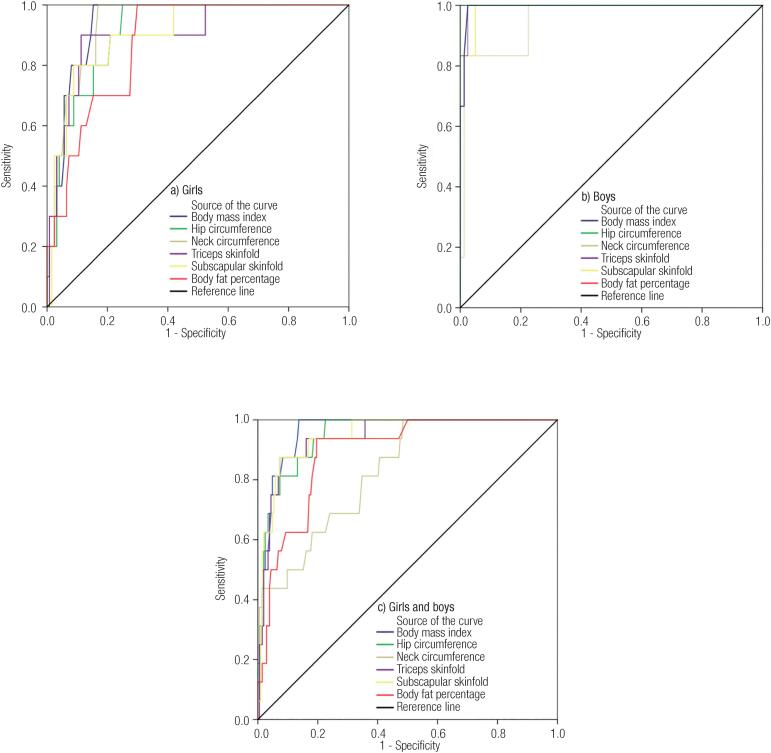
Cross-sectional study conducted on 222 adolescents (15-17 years) from a city in southern Brazil. Anthropometric, physical activity, blood pressure and biochemical parameters were investigated. MetS criteria were transformed into a continuous variable (MetS score). Linear regression analyses were performed to assess the associations of BMI, hip circumference, neck circumference (NC), triceps skinfold, subscapular skinfold and body fat percentage with MetS score. ROC curves were constructed to determine the cutoff for each anthropometric measurement.
The prevalence of MetS was 7.2%. Each anthropometric measurement was significantly (p < 0.001) associated with MetS score. After adjusting for potential confounding variables (age, sex, physical activity, and maternal education), the standardized coefficients of NC and body fat percentage appeared to have the strongest association (beta = 0.69 standard deviation) with MetS score. The regression of BMI provided the best model fit (adjusted R2 = 0.31). BMI predicted MetS with high sensitivity (100.0%) and specificity (86.4%).
Our results suggest that BMI and NC are effective screening tools for MetS in adolescents. The early diagnosis of MetS combined with targeted lifestyle interventions in adolescence may help reduce the burden of cardiovascular diseases and diabetes in adulthood.
确定哪种人体测量指标是巴西青少年代谢综合征(MetS)的最佳预测指标。
对巴西南部一个城市的222名青少年(15 - 17岁)进行横断面研究。调查了人体测量、身体活动、血压和生化参数。将MetS标准转化为连续变量(MetS评分)。进行线性回归分析以评估体重指数(BMI)、臀围、颈围(NC)、肱三头肌皮褶厚度、肩胛下皮褶厚度和体脂百分比与MetS评分之间的关联。构建ROC曲线以确定每种人体测量指标的临界值。
MetS的患病率为7.2%。每种人体测量指标均与MetS评分显著相关(p < 0.001)。在对潜在混杂变量(年龄、性别、身体活动和母亲教育程度)进行调整后,NC和体脂百分比的标准化系数与MetS评分的关联似乎最强(β = 0.69标准差)。BMI的回归提供了最佳的模型拟合(调整后R2 = 0.31)。BMI预测MetS具有高敏感性(100.0%)和特异性(86.4%)。
我们的结果表明,BMI和NC是青少年MetS的有效筛查工具。在青少年期对MetS进行早期诊断并结合有针对性的生活方式干预可能有助于减轻成年后患心血管疾病和糖尿病的负担。