Clinica Medica "A. Murri", Department of Biomedical Sciences and Human Oncology, University of Bari Aldo Moro, Bari 70124, Italy.
Department of Soil, Plant and Food Sciences, University of Bari Aldo Moro, Bari 70124, Italy.
Nutrients. 2020 Feb 21;12(2):564. doi: 10.3390/nu12020564.
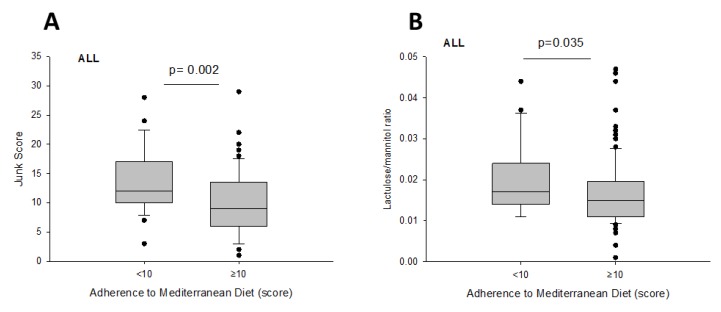
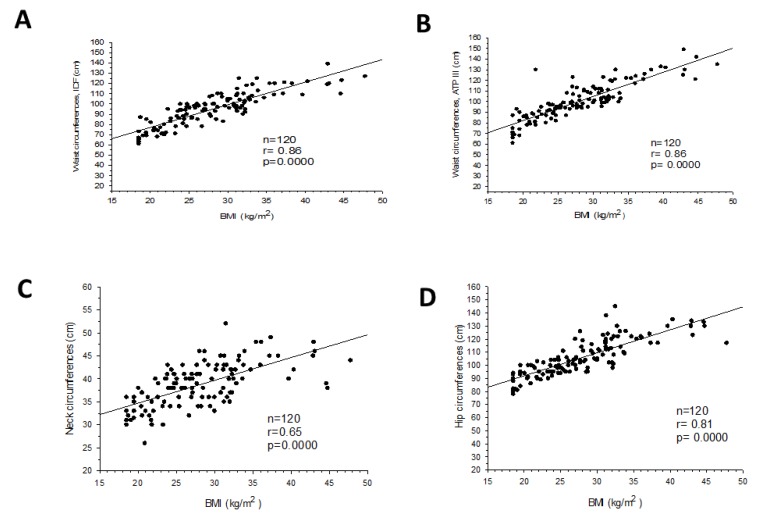
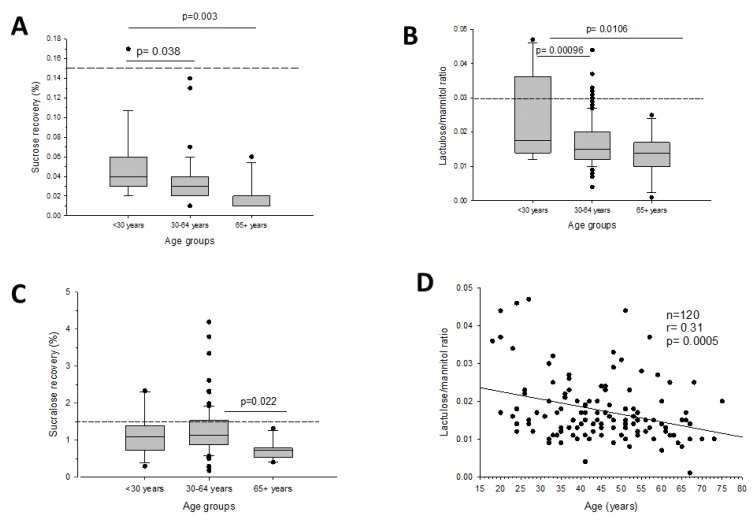
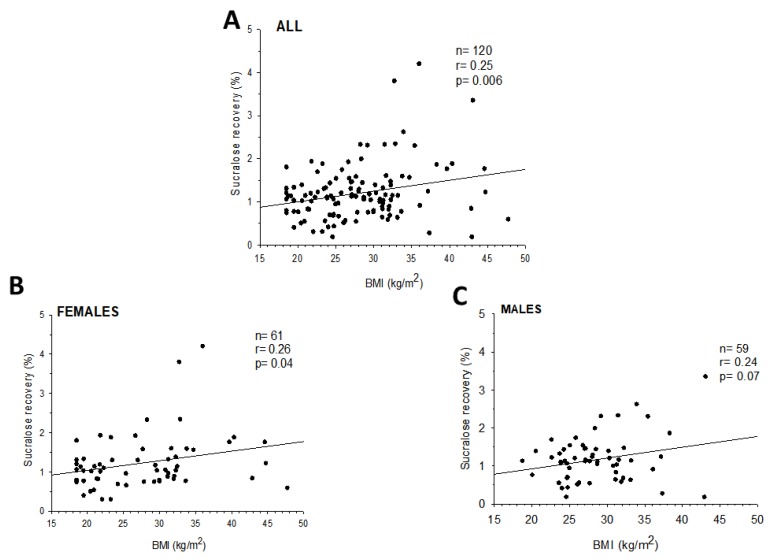
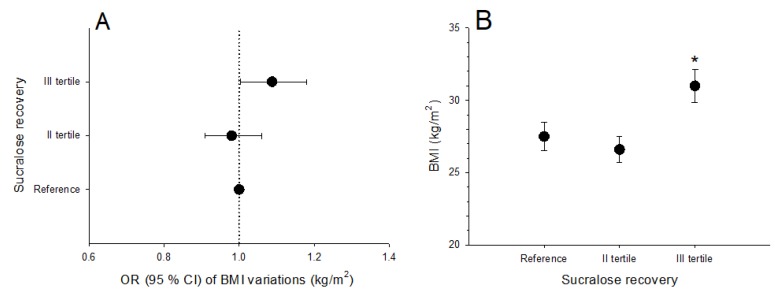
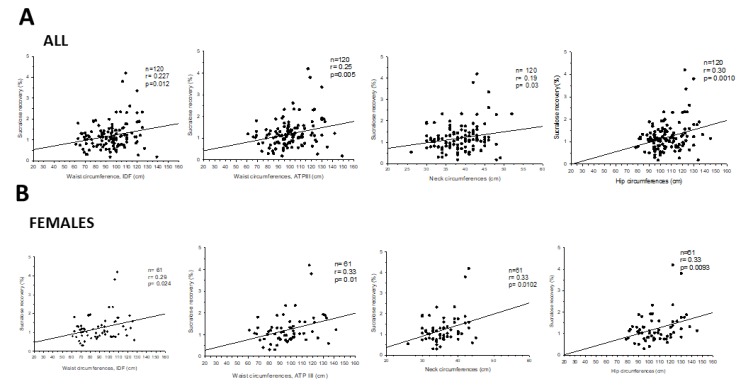
Intestinal permeability (IP) is essential in maintaining gut-metabolic functions in health. An unequivocal evaluation of IP, as marker of intestinal barrier integrity, however, is missing in health and in several diseases. We aimed to assess IP in the whole gastrointestinal tract according to body mass index (BMI) and liver steatosis. In 120 patients (61F:59M; mean age 45 ± SEM 1.2 years, range: 18-75), IP was distinctively studied by urine recovery of orally administered sucrose (SO, stomach), lactulose/mannitol ratio (LA/MA, small intestine), and sucralose (SA, colon). By triple quadrupole mass-spectrometry and high-performance liquid chromatography, we measured urinary recovery of saccharide probes. Subjects were stratified according to BMI as normal weight, overweight, and obesity, and answered questionnaires regarding dietary habits and adherence to the Mediterranean Diet. Liver steatosis was assessed by ultrasonography. IP at every gastrointestinal tract was similar in both sexes and decreased with age. Stomach and small intestinal permeability did not differ according to BMI. Colonic permeability increased with BMI, waist, neck, and hip circumferences and was significantly higher in obese than in lean subjects. As determined by logistic regression, the odds ratio (OR) of BMI increment was significantly higher in subjects in the highest tertile of sucralose excretion, also after adjusting for age and consumption of junk food. The presence of liver steatosis was associated with increased colonic permeability. Patients with lower score of adherence to Mediterranean diet had a higher score of 'junk food'. Intestinal permeability tended to increase in subjects with a lower adherence to Mediterranean diet. In conclusion, colonic (but not stomach and small intestinal) permeability seems to be linked to obesity and liver steatosis independently from dietary habits, age, and physical activity. The exact role of these last factors, however, requires specific studies focusing on intestinal permeability. Results should pave the way to both primary prevention measures and new therapeutic strategies in metabolic and liver diseases.
肠道通透性(IP)对于维持肠道代谢功能至关重要。然而,在健康状态和多种疾病中,都缺乏对肠道屏障完整性标志物 IP 的明确评估。我们旨在根据体重指数(BMI)和肝脂肪变性评估整个胃肠道的 IP。在 120 名患者(61 名女性:59 名男性;平均年龄 45 ± SEM 1.2 岁,范围:18-75 岁)中,通过口服给予蔗糖(SO,胃)、乳果糖/甘露醇比值(LA/MA,小肠)和三氯蔗糖(SA,结肠)后尿液回收来分别研究 IP。通过三重四极杆质谱法和高效液相色谱法,我们测量了尿液中糖探针的回收量。根据 BMI 将受试者分为正常体重、超重和肥胖,并回答了有关饮食习惯和地中海饮食依从性的问卷。通过超声评估肝脂肪变性。两性的胃肠道各部位 IP 相似,且随年龄增长而降低。BMI 不影响胃和小肠通透性。BMI、腰围、颈围和臀围越大,结肠通透性越高,肥胖者的结肠通透性显著高于消瘦者。通过逻辑回归确定,与低浓度三氯蔗糖排泄组相比,高浓度三氯蔗糖排泄组的 BMI 增加的比值比(OR)显著更高,且校正年龄和垃圾食品摄入后,结果仍有统计学意义。存在肝脂肪变性与结肠通透性增加相关。地中海饮食依从性评分较低的患者,垃圾食品摄入量较高。地中海饮食依从性较低的患者,肠道通透性有增高趋势。结论:结肠(而非胃和小肠)通透性似乎与肥胖和肝脂肪变性独立相关,而与饮食习惯、年龄和体力活动无关。然而,这些因素的确切作用需要针对肠道通透性的具体研究。这些结果将为代谢和肝脏疾病的一级预防措施和新的治疗策略铺平道路。