Infectious Disease Surveillance Center, National Institute of Infectious Diseases, Tokyo 162-8640, Japan.
Department of Chemistry, Faculty of Science, Tokyo University of Science, Tokyo 162-8601, Japan.
Viruses. 2019 Mar 7;11(3):228. doi: 10.3390/v11030228.
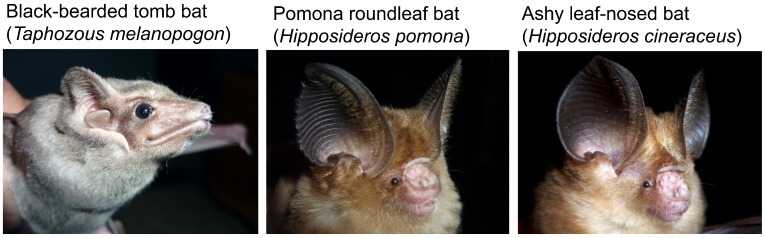
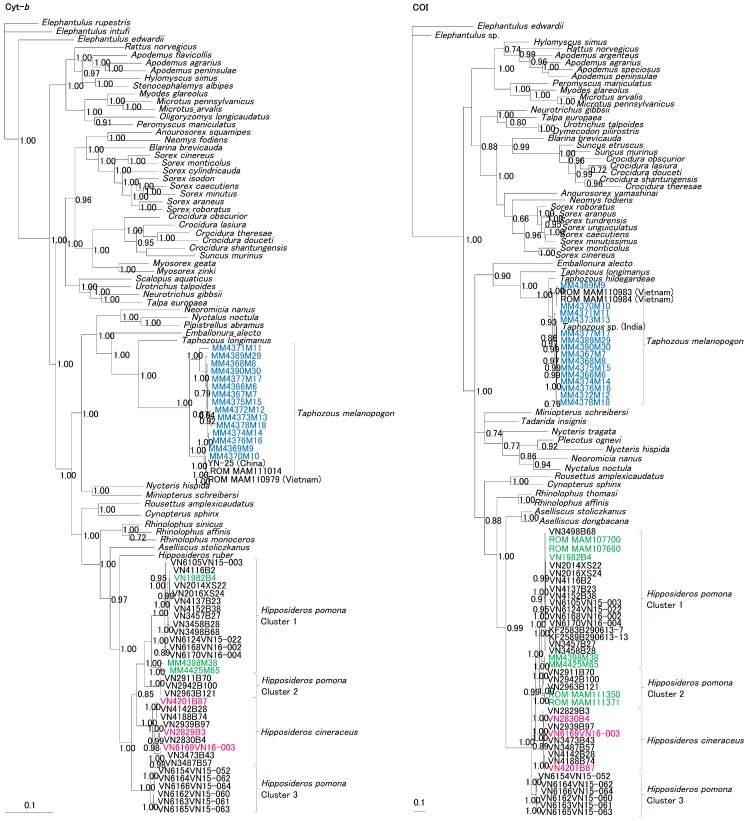
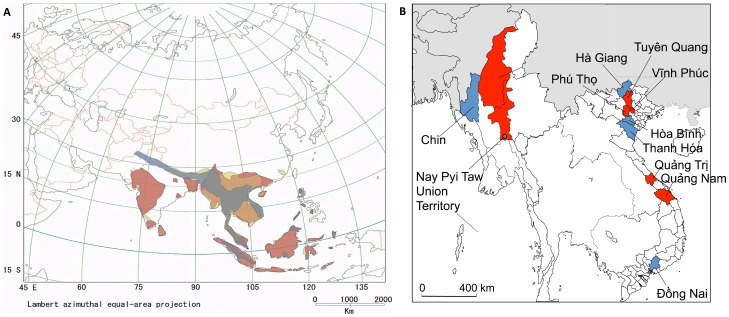
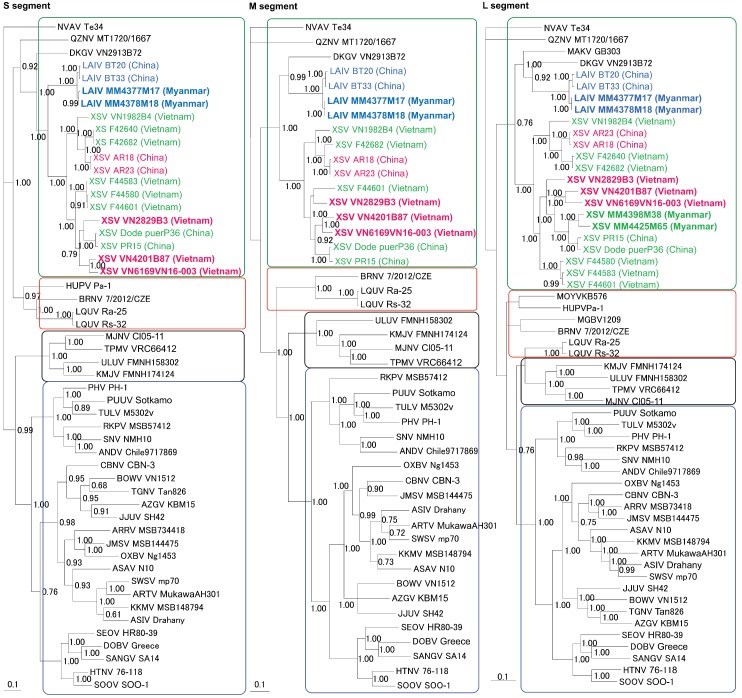
The discovery of highly divergent lineages of hantaviruses (family ) in shrews, moles, and bats of multiple species raises the possibility that non-rodent hosts may have played a significant role in their evolutionary history. To further investigate this prospect, total RNA was extracted from RNAlater-preserved lung tissues of 277 bats (representing five families, 14 genera and 40 species), captured in Myanmar and Vietnam during 2013⁻2016. Hantavirus RNA was detected in two of 15 black-bearded tomb bats () and two of 26 Pomona roundleaf bats () in Myanmar, and in three of six ashy leaf-nosed bats () in Vietnam. Pair-wise alignment and comparison of coding regions of the S, M, and L segments of hantaviruses from and bats revealed high nucleotide and amino acid sequence similarities to prototype Láibīn virus (LAIV) and Xuân Sơn virus (XSV), respectively. Phylogenetic analyses, generated by maximum-likelihood and Bayesian methods, showed a geographic clustering of LAIV strains from China and Myanmar, but not of XSV strains from China and Vietnam. These findings confirm that the black-bearded tomb bat is the natural reservoir of LAIV, and that more than one species of bats can host XSV.
在多种物种的鼩鼱、鼹鼠和蝙蝠中发现了高度分化的汉坦病毒(科)谱系,这增加了非啮齿动物宿主可能在其进化历史中发挥重要作用的可能性。为了进一步研究这一前景,从 2013 年至 2016 年在缅甸和越南捕获的 277 只蝙蝠(代表五个科、14 属和 40 种)的 RNAlater 保存的肺组织中提取了总 RNA。在缅甸的 15 只黑须墓蝠()和 26 只波莫纳圆叶蝠()中检测到两种汉坦病毒 RNA,在越南的 6 只灰叶鼻蝠()中检测到三种。来自和蝙蝠的汉坦病毒 S、M 和 L 片段编码区的两两比对和比较显示,核苷酸和氨基酸序列与原型拉宾病毒(LAIV)和 Xuan Sơn 病毒(XSV)高度相似。最大似然法和贝叶斯法生成的系统发育分析显示,来自中国和缅甸的 LAIV 株具有地理聚类,但来自中国和越南的 XSV 株则没有。这些发现证实了黑须墓蝠是 LAIV 的自然宿主,并且不止一种蝙蝠可以携带 XSV。