USDA-ARS Plant Germplasm Introduction & Testing Research, Washington State University, Pullman, WA, 99164, USA.
USDA-ARS Grain Legume Genetics & Physiology Research, 24106 N. Bunn Road, Prosser, WA, 99350, USA.
BMC Plant Biol. 2019 Mar 12;19(1):98. doi: 10.1186/s12870-019-1699-9.
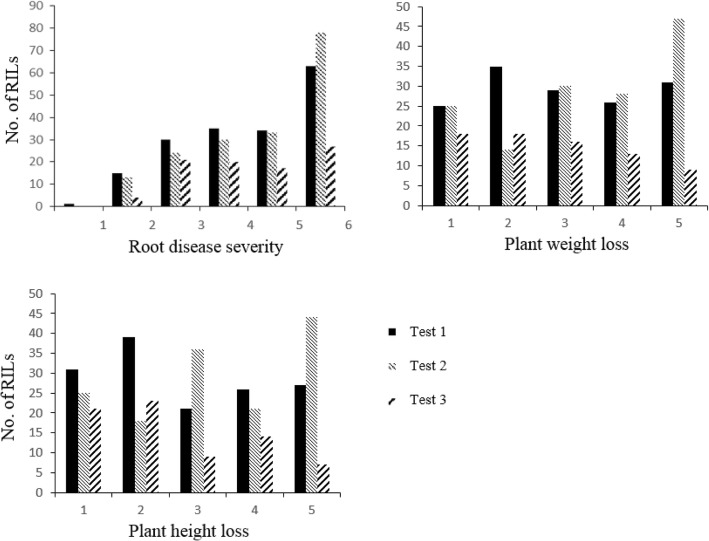
Dry pea production has increased substantially in North America over the last few decades. With this expansion, significant yield losses have been attributed to an escalation in Fusarium root rots in pea fields. Among the most significant rot rotting pathogenic fungal species, Fusarium solani fsp. pisi (Fsp) is one of the main causal agents of root rot of pea. High levels of partial resistance to Fsp has been identified in plant genetic resources. Genetic resistance offers one of the best solutions to control this root rotting fungus. A recombinant inbred population segregating for high levels of partial resistance, previously single nucleotide polymorphism (SNP) genotyped using genotyping-by-sequencing, was phenotyped for disease reaction in replicated and repeated greenhouse trials. Composite interval mapping was deployed to identify resistance-associated quantitative trait loci (QTL).
Three QTL were identified using three disease reaction criteria: root disease severity, ratios of diseased vs. healthy shoot heights and dry plant weights under controlled conditions using pure cultures of Fusarium solani fsp. pisi. One QTL Fsp-Ps 2.1 explains 44.4-53.4% of the variance with a narrow confidence interval of 1.2 cM. The second and third QTL Fsp-Ps3.2 and Fsp-Ps3.3 are closely linked and explain only 3.6-4.6% of the variance. All of the alleles are contributed by the resistant parent PI 180693.
With the confirmation of Fsp-Ps 2.1 now in two RIL populations, SNPs associated with this region make a good target for marker-assisted selection in pea breeding programs to obtain high levels of partial resistance to Fusarium root rot caused by Fusarium solani fsp. pisi.
在过去几十年中,北美地区的干豌豆产量大幅增加。随着这种扩张,豌豆田中的根腐病 Fusarium 导致了显著的产量损失。在最严重的腐烂致病真菌物种中,腐皮镰刀菌 f.sp. 豌豆(Fsp)是豌豆根腐病的主要病原体之一。在植物遗传资源中,已鉴定出对 Fsp 的高水平部分抗性。遗传抗性是控制这种根腐真菌的最佳解决方案之一。以前使用测序基因分型对高水平部分抗性进行单核苷酸多态性(SNP)基因分型的分离重组自交系群体,在重复和重复温室试验中对疾病反应进行了表型分析。复合区间作图被用来鉴定与抗性相关的数量性状基因座(QTL)。
使用三种疾病反应标准(根腐病严重程度、患病与健康茎高的比例以及在纯培养的腐皮镰刀菌 f.sp. 豌豆条件下的干植物重量),鉴定了三个 QTL。Fsp-Ps 2.1 解释了 44.4-53.4%的方差,置信区间狭窄为 1.2cM。第二个和第三个 QTL Fsp-Ps3.2 和 Fsp-Ps3.3 紧密连锁,仅解释了 3.6-4.6%的方差。所有等位基因均由抗性亲本 PI 180693 贡献。
随着在两个 RIL 群体中对 Fsp-Ps 2.1 的确认,与该区域相关的 SNPs 为豌豆育种计划中的标记辅助选择提供了一个很好的目标,以获得对由腐皮镰刀菌 f.sp. 豌豆引起的 Fusarium 根腐病的高水平部分抗性。