Carisch Lea, Stirn Martina, Hatt Jean Michel, Federer Karin, Hofmann-Lehmann Regina, Riond Barbara
Clinical Laboratory, Vetsuisse Faculty, University of Zurich, Zurich, Switzerland.
Clinic for Zoo Animals, Exotic Pets, and Wildlife, Vetsuisse Faculty, University of Zurich, Zurich, Switzerland.
BMC Vet Res. 2019 Mar 14;15(1):93. doi: 10.1186/s12917-019-1834-8.
To conduct a hematological analysis of avian blood samples, standard automated cell counting is unreliable because all avian blood cells are nucleated. Therefore, quantitative white blood cell counting in birds is still performed manually, whereby the Natt-Herrick method is widely used in veterinary laboratories. The aim of this study was to evaluate a new commercially available single test system for avian white blood cell counting, the Natt-Herricks-Tic®, which would allow easy in-house analysis by clinicians or technicians. A total of 40 avian ethylenediaminetetraacetic acid (EDTA) blood samples from 24 different species were included in the study. To assess method agreement, each blood sample was analyzed for total white blood cell count with the test method and the Natt-Herrick reference method. To determine the imprecision of the reference method and the Natt-Herricks-Tic® method, the noncorrected white blood cell count was determined ten consecutive times from one avian EDTA blood sample for each method.
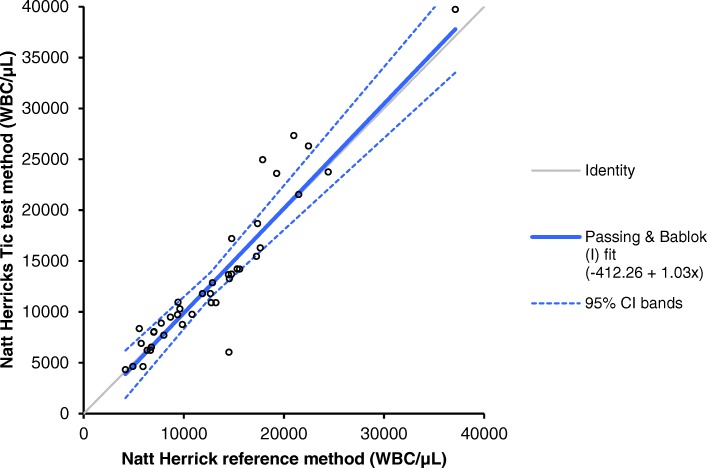
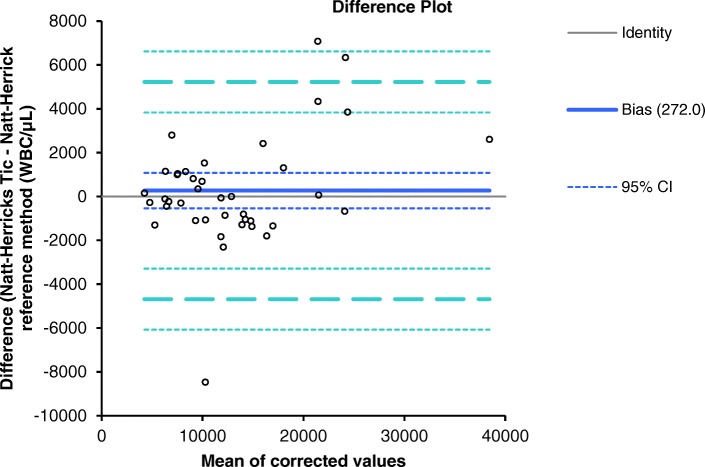
The Natt-Herricks-Tic® method performed well concerning staining quality and countability of the granulocytes by the hemocytometer. In the agreement study, the Natt-Herricks-Tic® method showed a small proportional systematic error with a small positive mean bias of 282 white blood cells/μL but had wide 95% limits of agreement (- 4683 cells/μL to 5227 cells/μL), indicating random error. The precision study resulted in a coefficient of variation of 16% for the Natt-Herricks-Tic® method (the mean ± standard deviation: 9.7 × 10/μL ± 1.5 × 10/μL) and 23% (the mean ± standard deviation: 7.9 × 10/μL ± 1.8 × 10/μL) for the reference method.
The Natt-Herricks-Tic® method showed acceptable precision for a manual method and demonstrated good agreement with the reference method. It can be recommended as a reliable and suitable method for determining white blood cell counts in avian EDTA blood if nonstatistical quality control measures are used in the daily routine. The application of individual reference intervals for the interpretation of white blood cell counts in birds may improve the diagnostic performance of this important analyte in a clinical setting.
由于所有鸟类血细胞都有细胞核,因此进行鸟类血液样本的血液学分析时,标准的自动细胞计数不可靠。所以,鸟类白细胞的定量计数仍需人工操作,其中纳特-赫里克法在兽医实验室中广泛应用。本研究的目的是评估一种新的市售鸟类白细胞计数单测试系统——Natt-Herricks-Tic®,该系统能让临床医生或技术人员在机构内部轻松进行分析。本研究共纳入了来自24个不同物种的40份鸟类乙二胺四乙酸(EDTA)血液样本。为评估方法的一致性,每种血液样本均采用该测试方法和纳特-赫里克参考方法分析白细胞总数。为确定参考方法和Natt-Herricks-Tic®方法的不精密度,对一份鸟类EDTA血液样本每种方法连续测定10次未校正的白细胞计数。
Natt-Herricks-Tic®方法在血细胞计数仪上对粒细胞的染色质量和可计数性方面表现良好。在一致性研究中,Natt-Herricks-Tic®方法显示出较小的比例系统误差,平均偏差为正282个白细胞/微升,但一致性界限较宽(-4683个细胞/微升至5227个细胞/微升),表明存在随机误差。精密度研究结果显示,Natt-Herricks-Tic®方法的变异系数为16%(平均值±标准差:9.7×10/微升±1.5×10/微升),参考方法的变异系数为23%(平均值±标准差:7.9×10/微升±1.8×10/微升)。
Natt-Herricks-Tic®方法对手动方法而言显示出可接受的精密度,并且与参考方法具有良好的一致性。如果在日常工作中采用非统计质量控制措施,推荐将其作为一种可靠且合适的方法用于测定鸟类EDTA血液中的白细胞计数。应用个体参考区间来解释鸟类白细胞计数可能会提高这一重要分析物在临床环境中的诊断性能。