Asklund Ina, Samuelsson Eva, Hamberg Katarina, Umefjord Göran, Sjöström Malin
Department of Public Health and Clinical Medicine, Family Medicine, Umeå University, Umeå, Sweden.
J Med Internet Res. 2019 Mar 14;21(3):e11296. doi: 10.2196/11296.
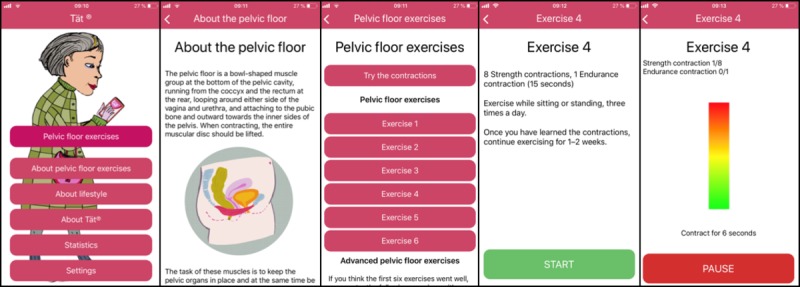
Stress urinary incontinence (SUI) affects 10%-39% of women. Its first-line treatment consists of lifestyle interventions and pelvic floor muscle training (PFMT), which can be performed supervised or unsupervised. Health apps are increasing in number and can be used to improve adherence to treatments. We developed the Tät app, which provides a 3-month treatment program with a focus on PFMT for women with SUI. The app treatment was evaluated in a randomized controlled trial, which demonstrated efficacy for improving incontinence symptoms and quality of life. In this qualitative interview study, we investigated participant experiences of the app-based treatment.
This study aimed to explore women's experiences of using an app-based treatment program for SUI.
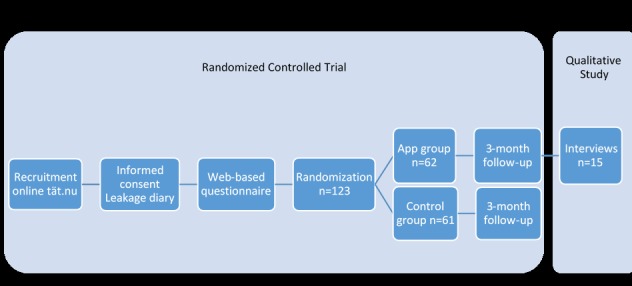
This qualitative study is based on telephone interviews with 15 selected women, with a mean age of 47 years, who had used the app in the previous randomized controlled trial. A semistructured interview guide with open-ended questions was used, and the interviews were transcribed verbatim. Data were analyzed according to the grounded theory.
The results were grouped into three categories: "Something new!" "Keeping motivation up!" and "Good enough?" A core category, "Enabling my independence," was identified. The participants appreciated having a new and modern way to access a treatment program for SUI. The use of new technology seemed to make incontinence treatment feel more prioritized and less embarrassing for the subjects. The closeness to their mobile phone and app features like reminders and visual graphs helped support and motivate the women to carry through the PFMT. The participants felt confident that they could perform the treatment program on their own, even though they expressed some uncertainty about whether they were doing the pelvic floor muscle contractions correctly. They felt that the app-based treatment increased their self-confidence and enabled them to take responsibility for their treatment.
Use of the app-based treatment program for SUI empowered the women in this study and helped them self-manage their incontinence treatment. They appreciated the app as a new tool for supporting their motivation to carry through a slightly challenging PFMT program.
ClinicalTrials.gov NCT01848938; https://clinicaltrials.gov/ct2/show/NCT01848938 (Archived by WebCite at https://clinicaltrials.gov/ct2/show/NCT01848938).
压力性尿失禁(SUI)影响10% - 39%的女性。其一线治疗包括生活方式干预和盆底肌训练(PFMT),可在有监督或无监督的情况下进行。健康应用程序的数量在不断增加,可用于提高治疗依从性。我们开发了Tät应用程序,它为患有SUI的女性提供了一个为期3个月的以PFMT为重点的治疗方案。该应用程序治疗在一项随机对照试验中进行了评估,试验证明其在改善尿失禁症状和生活质量方面具有疗效。在这项定性访谈研究中,我们调查了基于应用程序治疗的参与者体验。
本研究旨在探索女性使用基于应用程序的SUI治疗方案的体验。
这项定性研究基于对15名选定女性的电话访谈,她们的平均年龄为47岁,曾在之前的随机对照试验中使用过该应用程序。使用了一份带有开放式问题的半结构化访谈指南,访谈内容逐字记录。数据根据扎根理论进行分析。
结果分为三类:“新事物!”“保持动力!”和“足够好?”确定了一个核心类别“赋予我独立性”。参与者赞赏有了一种全新且现代的方式来获取SUI治疗方案。新技术的使用似乎让尿失禁治疗对受试者来说感觉更受重视且不那么尴尬。与手机的亲近以及提醒和视觉图表等应用功能有助于支持和激励女性坚持进行PFMT。参与者相信自己能够独自完成治疗方案,尽管她们对自己是否正确进行盆底肌收缩表示有些不确定。她们觉得基于应用程序的治疗增强了她们的自信心,并使她们能够对自己的治疗负责。
使用基于应用程序的SUI治疗方案使本研究中的女性获得了自主权,并帮助她们自我管理尿失禁治疗。她们赞赏该应用程序是一种新工具,有助于支持她们坚持完成一项略有挑战性的PFMT方案的动力。
ClinicalTrials.gov NCT01848938;https://clinicaltrials.gov/ct2/show/NCT01848938(由WebCite存档于https://clinicaltrials.gov/ct2/show/NCT01848938)。