Lei Wenliang, Li Wen, Ge Longjiao, Chen Gong
Guangdong-Hong Kong-Macau Institute of CNS Regeneration, Jinan University, Guangzhou, China.
Kunming Institute of Zoology, Chinese Academy of Sciences, Kunming, China.
Front Neurosci. 2019 Feb 21;13:131. doi: 10.3389/fnins.2019.00131. eCollection 2019.
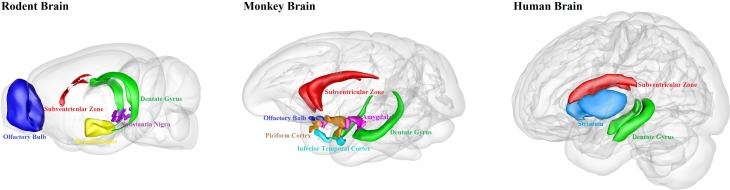
Adult neurogenesis has been extensively studied in rodent animals, with distinct niches found in the hippocampus and subventricular zone (SVZ). In non-human primates and human postmortem samples, there has been heated debate regarding adult neurogenesis, but it is largely agreed that the rate of adult neurogenesis is much reduced comparing to rodents. The limited adult neurogenesis may partly explain why human brains do not have self-repair capability after injury or disease. A new technology called " cell conversion" has been invented to convert brain internal glial cells in the injury areas directly into functional new neurons to replenish the lost neurons. Because glial cells are abundant throughout the brain and spinal cord, such engineered glia-to-neuron conversion technology can be applied throughout the central nervous system (CNS) to regenerate new neurons. Thus, compared to cell transplantation or the non-engineered adult neurogenesis, engineered neuroregeneration technology can provide a large number of functional new neurons to repair damaged brain and spinal cord.
成年神经发生在啮齿动物中已得到广泛研究,在海马体和脑室下区(SVZ)发现了不同的神经干细胞微环境。在非人类灵长类动物和人类尸检样本中,关于成年神经发生存在激烈争论,但人们普遍认为,与啮齿动物相比,成年神经发生的速率大大降低。有限的成年神经发生可能部分解释了为什么人类大脑在受伤或患病后没有自我修复能力。一种名为“细胞转化”的新技术已被发明,可将损伤区域的脑内胶质细胞直接转化为功能性新神经元,以补充丢失的神经元。由于胶质细胞在整个大脑和脊髓中都很丰富,这种工程化的胶质细胞向神经元的转化技术可应用于整个中枢神经系统(CNS)以再生新神经元。因此,与细胞移植或非工程化的成年神经发生相比,工程化神经再生技术可以提供大量功能性新神经元来修复受损的大脑和脊髓。