Department of Psychology, Pennsylvania State University.
Department of Psychology, University of California, Davis.
J Exp Psychol Learn Mem Cogn. 2019 Nov;45(11):2010-2035. doi: 10.1037/xlm0000694. Epub 2019 Mar 18.
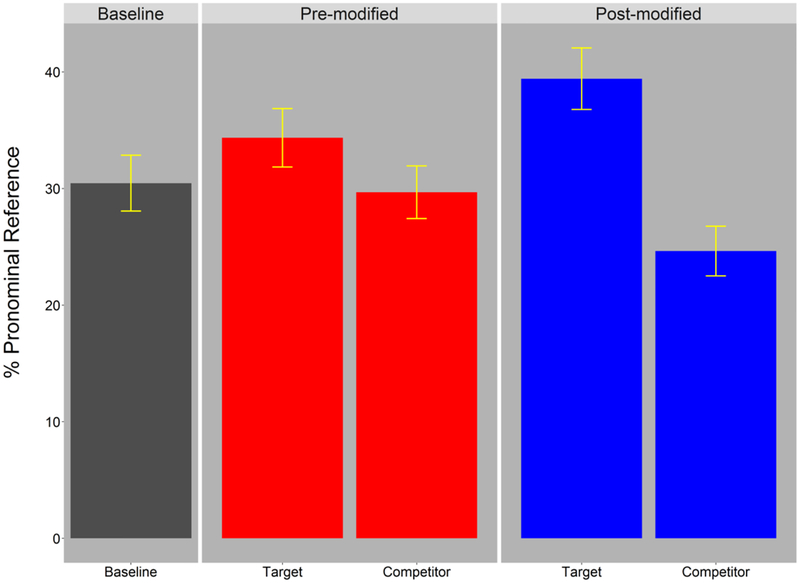
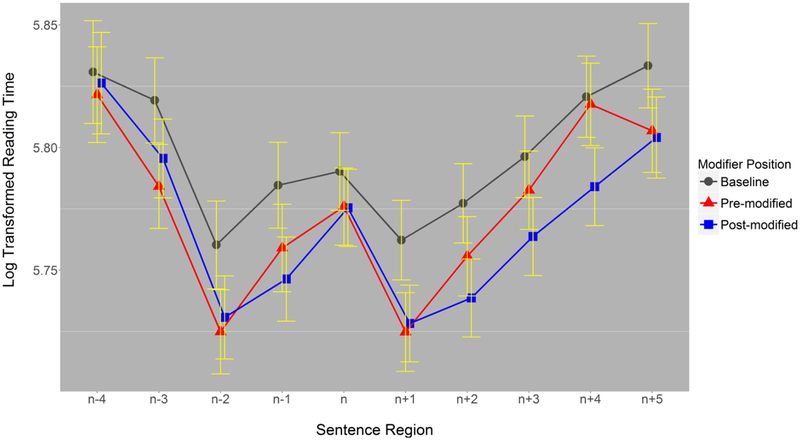
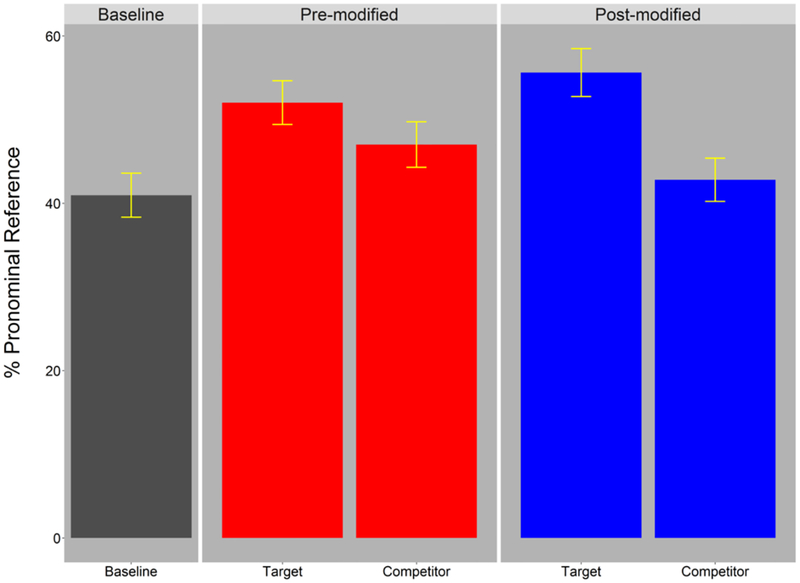
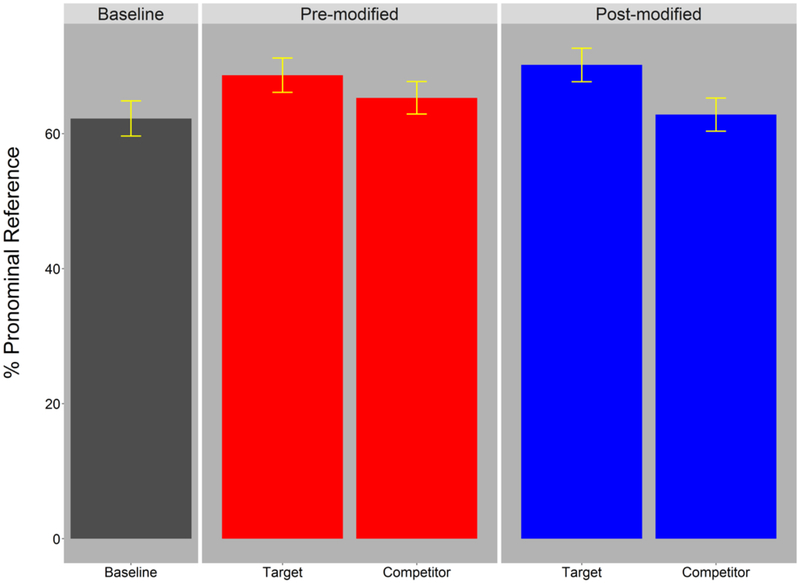
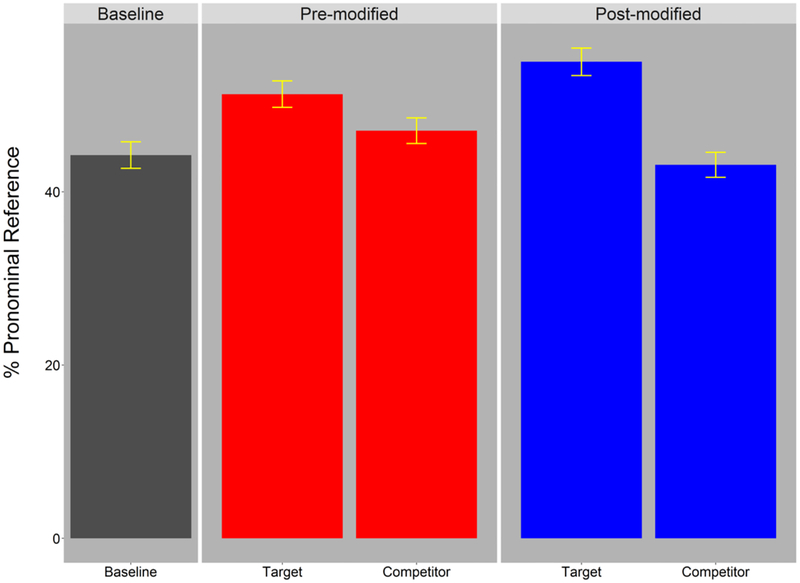
We examined whether the position of modifiers in English influences how words are encoded and subsequently retrieved from memory. Compared with premodifiers, postmodifiers might confer more perceptual significance to the associated head nouns, are more consistent with the "given-before-new" information structure, and might also be easier to integrate because the head noun is available before the modifications are encountered. In 4 experiments, we investigated whether premodified (the cruel and merciless king), and postmodified (the king who was cruel and merciless) noun phrases (henceforth, NPs) could induce variations in ease of subsequent retrieval. In Experiments 1, 2, and 3, participants used more pronouns (he), as opposed to full descriptions (the king) to refer to postmodified NPs than to unmodified competitors, but pronominal reference to premodified NPs and unmodified competitors did not differ, suggesting that postmodified NPs are more accessible in memory. When the data from all 3 experiments were combined, we also observed significantly more pronominal reference to post- than to premodified NPs, as well as a greater increase in pronominal reference rates between postmodified NPs and unmodified competitors than between premodified NPs and unmodified competitors. In Experiment 4, words following critical pronouns were read faster when the pronouns referred to modified than to unmodified NPs, and also when the pronouns referred to post- rather than premodified NPs. Taken together, our results show enhanced retrieval facilitation for postmodified NPs compared with premodified NPs. These results are the first to demonstrate that the linear position of modifications results in measurable processing cost at a subsequent point. The results have important implications for memory-based theories of language processing, and also for theories assigning a central role for discourse status and information structure during sentence processing. (PsycINFO Database Record (c) 2019 APA, all rights reserved).
我们考察了英语中修饰语的位置是否会影响单词的编码方式以及随后从记忆中检索出来的方式。与前置修饰语相比,后置修饰语可能会使相关的中心名词更具有感知意义,更符合“先给出后新”的信息结构,而且也更容易整合,因为在遇到修饰语之前就可以获得中心名词。在 4 项实验中,我们研究了前置修饰(残酷无情的国王)和后置修饰(残酷无情的国王)名词短语(以下简称 NPs)是否会导致随后检索的难易程度发生变化。在实验 1、2 和 3 中,与未修饰的对照组相比,参与者使用更多代词(he)来指代后置修饰的 NPs,而不是完整的描述(the king),但前置修饰的 NPs 和未修饰的对照组之间的代词指代并没有差异,这表明后置修饰的 NPs 在记忆中更容易被访问。当将所有 3 项实验的数据结合起来时,我们还观察到,与前置修饰的 NPs 和未修饰的对照组相比,后置修饰的 NPs 更倾向于使用代词指代,并且后置修饰的 NPs 和未修饰的对照组之间的代词指代率增加也比前置修饰的 NPs 和未修饰的对照组之间的增加更大。在实验 4 中,当代词指代修饰过的 NPs 而不是未修饰的 NPs 时,以及当代词指代后置修饰的 NPs 而不是前置修饰的 NPs 时,关键代词后面的单词阅读速度会更快。总的来说,与前置修饰的 NPs 相比,后置修饰的 NPs 的检索促进作用更强。这些结果首次证明,修饰语的线性位置会在后续的某个点导致可测量的处理成本。这些结果对基于记忆的语言处理理论具有重要意义,也对在句子处理过程中赋予语篇地位和信息结构核心作用的理论具有重要意义。(PsycINFO 数据库记录(c)2019 APA,保留所有权利)。