Université Clermont Auvergne, CHU Clermont-Ferrand, Service de Psychiatrie de l'Adulte A et Psychologie Médicale, Centre Mémoire de Ressources et de Recherche, Clermont-Ferrand, France.
CHU Clermont-Ferrand, Service de Santé Publique, Clermont-Ferrand, France.
PLoS One. 2019 Mar 19;14(3):e0213907. doi: 10.1371/journal.pone.0213907. eCollection 2019.
Few studies have addressed health-related quality of life in community-dwelling individuals aged 80 years and above and very few self-assessment quality of life questionnaires have been formally validated in these populations. This study aimed to validate a French version of the LEIPAD, a self-administered questionnaire assessing the health-related quality of life of people aged 80 years and over.
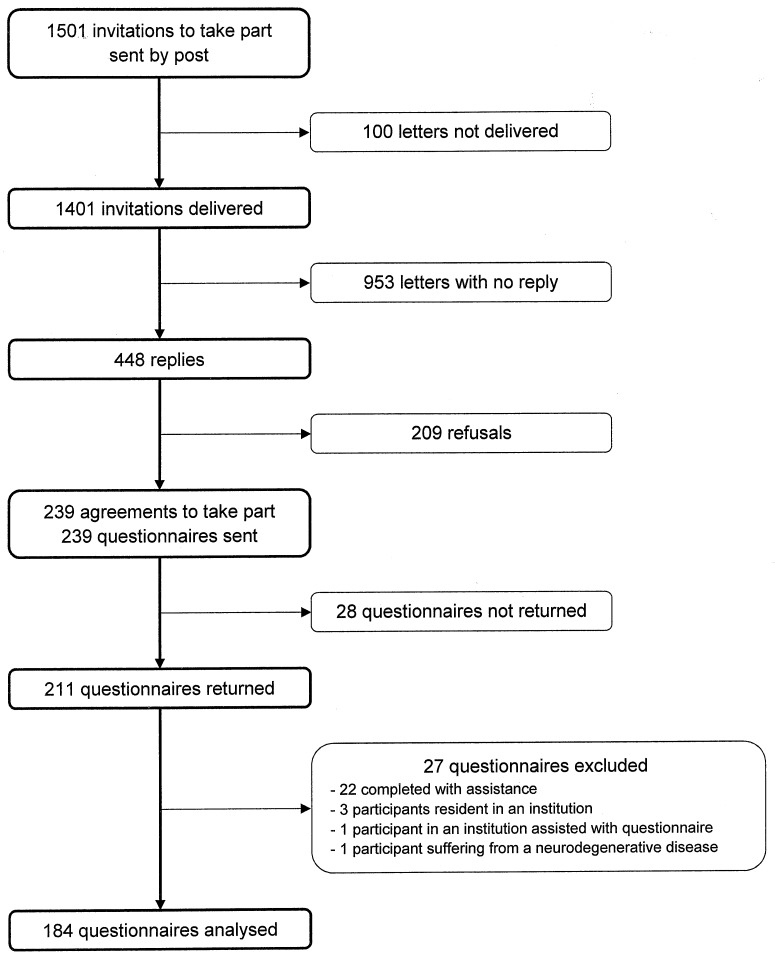
A cross-sectional study of people aged 80 years and over living at home in France was conducted. All subjects recruited were sent a letter explaining the study and requesting their consent to take part. Those who accepted then received the questionnaires, including the LEIPAD, which assesses health-related quality of life in the subjects aged 65 years and above. We assessed its psychometric properties: data completeness, score distribution, floor and ceiling effects, internal consistency, item-total correlations, inter-scale correlations, reliability and convergent validity with the Medical Outcome Study Short-Form 36 (SF-36).
The results obtained from 184 older people (mean age of 83.9 years, standard deviation 3.3) showed very good acceptability (missing data between 1.1% and 11.4% for LEIPAD scales) Factor analysis of the instrument confirmed the multi-dimensional structure in seven independent scales similar to the original version. Good internal consistency (Cronbach's alpha ranging from 0.68 to 0.87) and strong test-retest reliability of the LEIPAD scales (intraclass correlation coefficients ranging from 0.77 to 0.95) were found. Convergent validity with the SF-36 showed moderate to strong correlations, consistent with the hypotheses stated.
The validation of this specific questionnaire will make it possible to investigate individually the health-related quality of life of French older people living at home and will enable French-speaking investigators to contribute to national and international research projects.
很少有研究涉及 80 岁及以上社区居民的健康相关生活质量,很少有自我评估生活质量问卷在这些人群中得到正式验证。本研究旨在验证 LEIPAD 的法语版本,这是一种自我管理的问卷,用于评估 80 岁及以上人群的健康相关生活质量。
在法国进行了一项针对 80 岁及以上居住在家中的人群的横断面研究。所有招募的受试者都收到了一封信,解释了研究并请求他们同意参加。那些接受的人随后收到了问卷,包括 LEIPAD,用于评估 65 岁及以上人群的健康相关生活质量。我们评估了其心理测量特性:数据完整性、分数分布、地板和天花板效应、内部一致性、项目总分相关性、量表间相关性、可靠性和与医疗结局研究短式 36 项健康调查(SF-36)的收敛效度。
从 184 名老年人(平均年龄 83.9 岁,标准差 3.3)获得的结果显示出非常好的可接受性(LEIPAD 量表的缺失数据在 1.1%至 11.4%之间)。该工具的因子分析证实了与原始版本相似的七个独立量表的多维结构。LEIPAD 量表具有良好的内部一致性(Cronbach's alpha 范围为 0.68 至 0.87)和较强的重测信度(内部一致性系数范围为 0.77 至 0.95)。与 SF-36 的收敛效度显示出中度至高度相关性,与假设一致。
该特定问卷的验证将使我们能够单独研究居住在法国的老年人的健康相关生活质量,并使讲法语的研究人员能够为国家和国际研究项目做出贡献。