Department of Physiology, Emory University, Atlanta, GA, 30322, United States.
Neuroscience Institute, Georgia State University, Atlanta, GA, 30308, United States.
Peptides. 2019 May;115:51-58. doi: 10.1016/j.peptides.2019.01.003. Epub 2019 Mar 16.
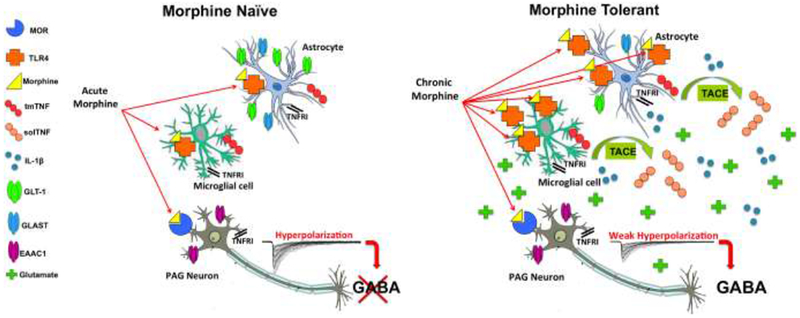
Each year, over 50 million Americans suffer from persistent pain, including debilitating headaches, joint pain, and severe back pain. Although morphine is amongst the most effective analgesics available for the management of severe pain, prolonged morphine treatment results in decreased analgesic efficacy (i.e., tolerance). Despite significant headway in the field, the mechanisms underlying the development of morphine tolerance are not well understood. The midbrain ventrolateral periaqueductal gray (vlPAG) is a primary neural substrate for the analgesic effects of morphine, as well as for the development of morphine tolerance. A growing body of literature indicates that activated glia (i.e., microglia and astrocytes) facilitate pain transmission and oppose morphine analgesia, making these cells important potential targets in the treatment of chronic pain. Morphine affects glia by binding to the innate immune receptor toll-like receptor 4 (TLR4), leading to the release of proinflammatory cytokines and opposition of morphine analgesia. Despite the established role of the vlPAG as an integral locus for the development of morphine tolerance, most studies have examined the role of glia activation within the spinal cord. Additionally, the role of TLR4 in the development of tolerance has not been elucidated. This review attempts to summarize what is known regarding the role of vlPAG glia and TLR4 in the development of morphine tolerance. These data, together, provide information about the mechanism by which central nervous system glia regulate morphine tolerance, and identify a potential therapeutic target for the enhancement of analgesic efficacy in the clinical treatment of chronic pain.
每年,超过 5000 万美国人患有持续性疼痛,包括使人虚弱的头痛、关节痛和严重的背痛。尽管吗啡是治疗严重疼痛最有效的镇痛药之一,但长期使用吗啡会导致镇痛效果降低(即耐受)。尽管在该领域取得了重大进展,但吗啡耐受发展的机制仍不清楚。中脑腹外侧导水管周围灰质(vlPAG)是吗啡镇痛作用以及吗啡耐受发展的主要神经基质。越来越多的文献表明,激活的神经胶质(即小胶质细胞和星形胶质细胞)促进疼痛传递并反对吗啡镇痛,使这些细胞成为治疗慢性疼痛的重要潜在靶点。吗啡通过与先天免疫受体 toll 样受体 4(TLR4)结合来影响神经胶质,导致促炎细胞因子的释放和吗啡镇痛作用的拮抗。尽管 vlPAG 作为吗啡耐受发展的一个重要部位已经得到确立,但大多数研究都检查了脊髓内神经胶质激活的作用。此外,TLR4 在耐受发展中的作用尚未阐明。本综述试图总结 vlPAG 神经胶质和 TLR4 在吗啡耐受发展中的作用。这些数据共同提供了有关中枢神经系统神经胶质调节吗啡耐受的机制的信息,并确定了一个潜在的治疗靶点,以增强慢性疼痛临床治疗中的镇痛效果。