Department of Nuclear Medicine, Xiangya Hospital, Central South University, Changsha, China.
The Russell H. Morgan Department of Radiology and Radiological Science, Johns Hopkins School of Medicine, Baltimore, Maryland, United States of America.
PLoS One. 2019 Mar 20;14(3):e0212573. doi: 10.1371/journal.pone.0212573. eCollection 2019.
Pulmonary hypertension (PH) is a known complication of HCM and is a strong predictor of mortality. We aim to investigate the relationship between microvascular dysfunction measured by quantitative PET and PH in HCM patients.
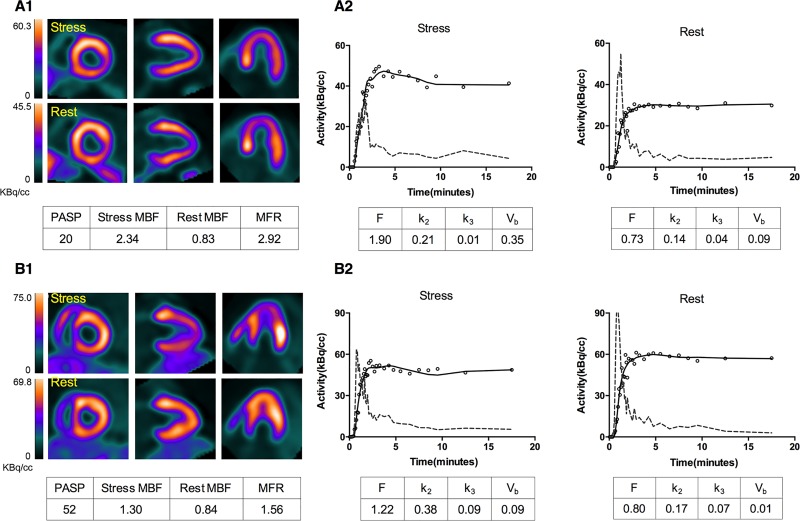
Eighty-nine symptomatic HCM patients were included in the study. Each patient underwent two 20-min 13N-NH3 dynamic PET scans for rest and stress conditions, respectively. A 2-tissue irreversible compartmental model was used to fit the segments time activity curves for estimating segmental and global myocardial blood flow (MBF) and myocardial flow reserve (MFR). Echocardiographic derived PASP was utilized to estimate PH.
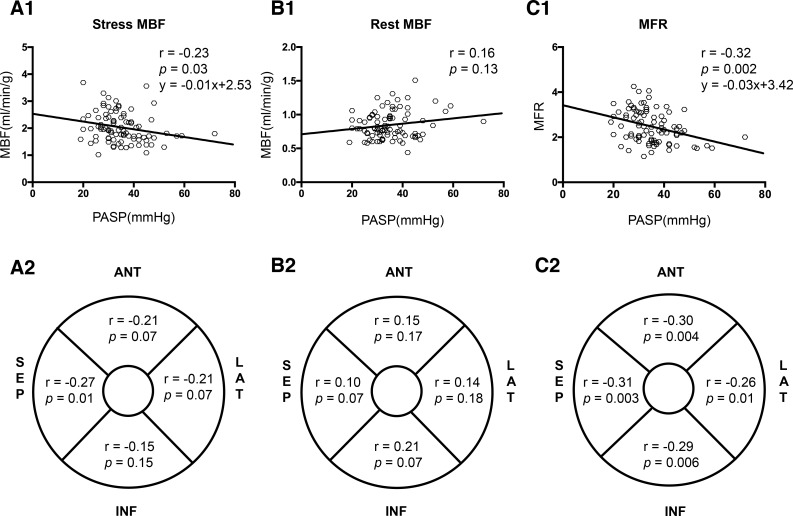
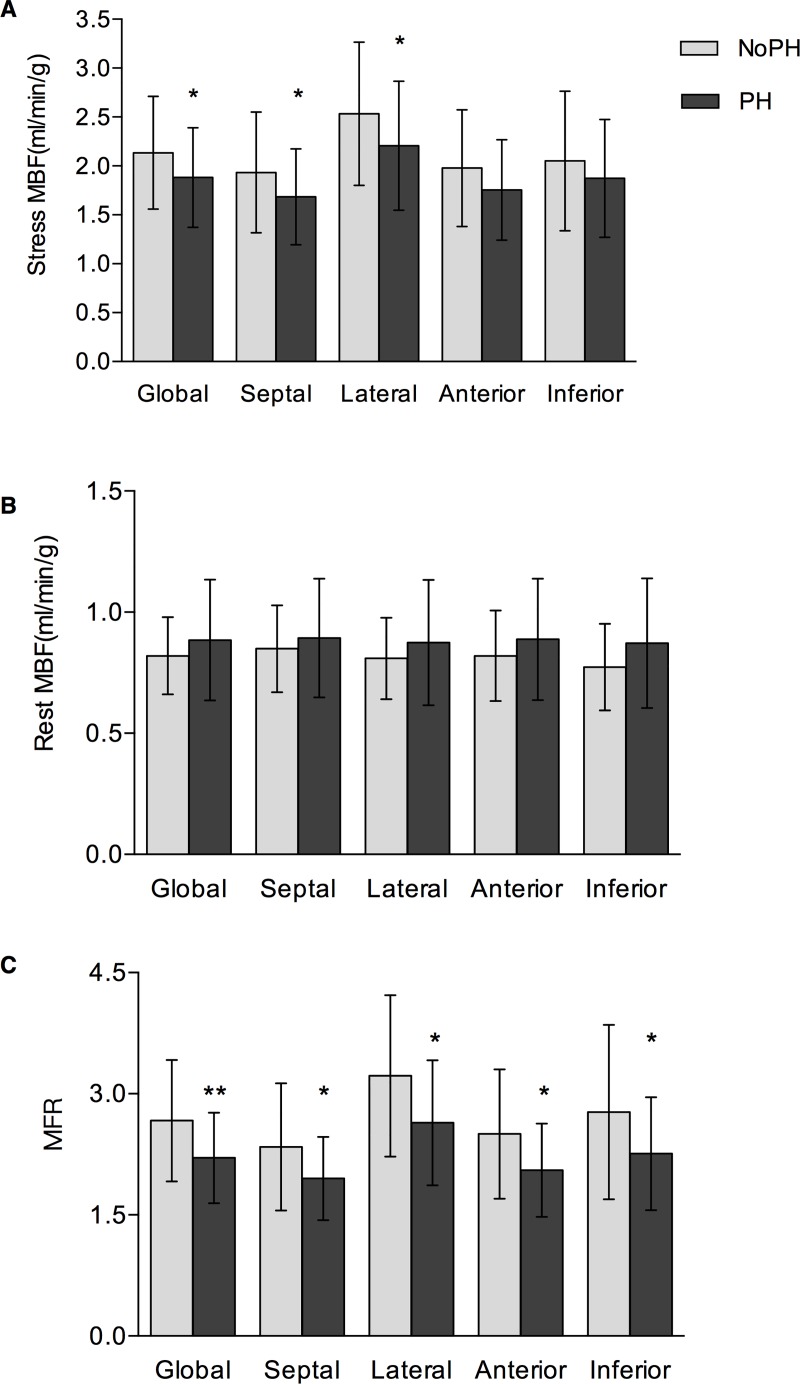
Patients were categorized into two groups across PASP: PH (PASP > 36 mmHg) and no-PH (PASP ≤ 36 mmHg). patients with PH had larger left atrium, ratio of higher inflow early diastole (E) and atrial contraction (A) waves, E/A, and ratio of inflow and peak early diastolic waves, E/e', significantly reduced global stress MBF (1.85 ± 0.52 vs. 2.13 ± 0.56 ml/min/g; p = 0.024) and MFR (2.21 ± 0.57 vs. 2.62 ± 0.75; p = 0.005), while the MBFs at rest between the two groups were similar. There were significant negative correlations between global stress MBF/MFR and PASP (stress MBF: r = -0.23, p = 0.03; MFR: r = -0.32, p = 0.002); for regional MBF and MFR measurements, the highest linear correlation coefficients were observed in the septal wall (stress MBF: r = -0.27, p = 0.01; MFR: r = -0.31, p = 0.003). Global MFR was identified to be independent predictor for PH in multivariate regression analysis.
Echocardiography-derived PASP is negatively correlated with global MFR measured by 13N-NH3 dynamic PET. Global MFR is suggested to be an index of PH in HCM patients.
肺动脉高压(PH)是肥厚型心肌病(HCM)的已知并发症,也是死亡率的强有力预测指标。我们旨在研究通过定量 PET 测量的微血管功能障碍与 HCM 患者 PH 之间的关系。
研究纳入 89 例有症状的 HCM 患者。每位患者分别进行两次 20 分钟 13N-NH3 动态 PET 扫描,分别用于静息和应激条件。使用 2 组织不可逆房室模型拟合节段时间活动曲线,以估计节段和整体心肌血流(MBF)和心肌血流储备(MFR)。超声心动图衍生的 PASP 用于估计 PH。
患者根据 PASP 分为两组:PH(PASP > 36mmHg)和非 PH(PASP ≤ 36mmHg)。PH 患者的左心房较大,心房收缩(A)波与早期舒张(E)波的比值较高,E/A 和流入和峰值早期舒张波的比值,E/e',静息时两组之间的整体应激 MBF(1.85 ± 0.52 vs. 2.13 ± 0.56ml/min/g;p = 0.024)和 MFR(2.21 ± 0.57 vs. 2.62 ± 0.75;p = 0.005)明显降低,而两组之间的静息 MBF 相似。全球应激 MBF/MFR 与 PASP 呈显著负相关(应激 MBF:r = -0.23,p = 0.03;MFR:r = -0.32,p = 0.002);对于区域性 MBF 和 MFR 测量,在间隔壁上观察到最高的线性相关系数(应激 MBF:r = -0.27,p = 0.01;MFR:r = -0.31,p = 0.003)。多元回归分析显示,全球 MFR 是 PH 的独立预测因子。
超声心动图衍生的 PASP 与 13N-NH3 动态 PET 测量的整体 MFR 呈负相关。整体 MFR 被认为是 HCM 患者 PH 的一个指标。