Department of Anthropology, Evolutionary Cognition Group, University of Zurich, Zurich, Switzerland.
School of Social and Health Sciences, Division of Psychology, Abertay University, Dundee, Scotland, United Kingdom.
PLoS One. 2019 Mar 20;14(3):e0213727. doi: 10.1371/journal.pone.0213727. eCollection 2019.
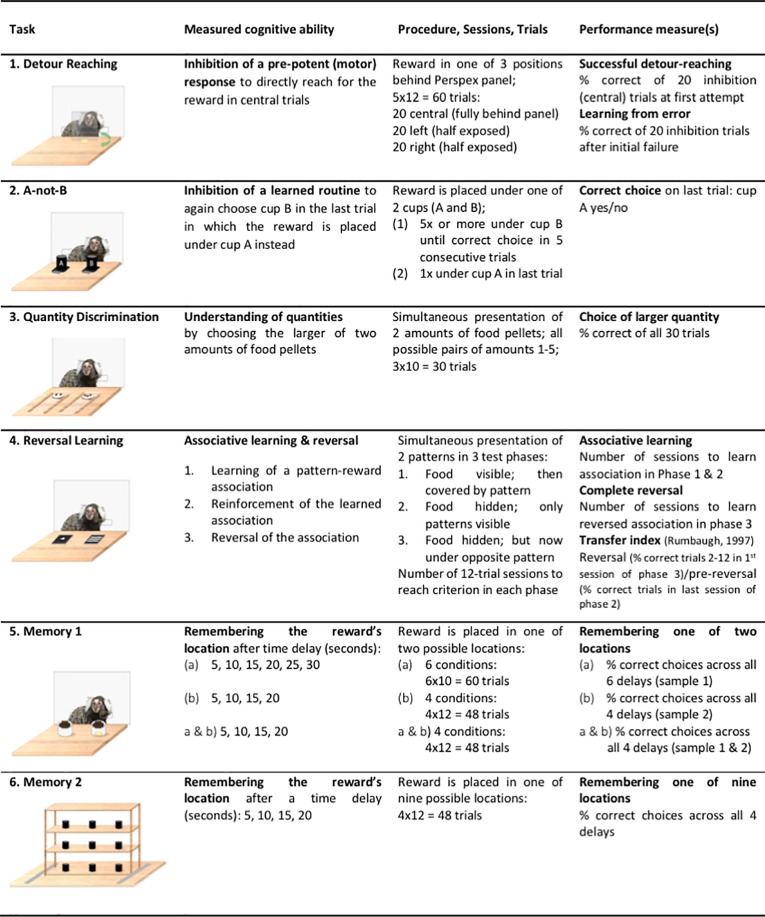
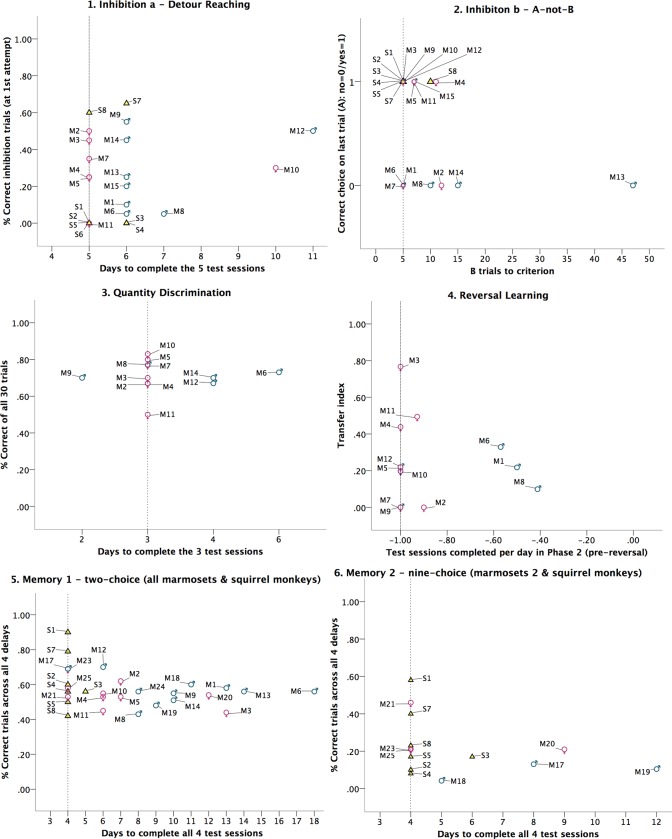
Dropouts are a common issue in cognitive tests with non-human primates. One main reason for dropouts is that researchers often face a trade-off between obtaining a sufficiently large sample size and logistic restrictions, such as limited access to testing facilities. The commonly-used opportunistic testing approach deals with this trade-off by only testing those individuals who readily participate and complete the cognitive tasks within a given time frame. All other individuals are excluded from further testing and data analysis. However, it is unknown if this approach merely excludes subjects who are not consistently motivated to participate, or if these dropouts systematically differ in cognitive ability. If the latter holds, the selection bias resulting from opportunistic testing would systematically affect performance scores and thus comparisons between individuals and species. We assessed the potential effects of opportunistic testing on cognitive performance in common marmosets (Callithrix jacchus) and squirrel monkeys (Saimiri sciureus) with a test battery consisting of six cognitive tests: two inhibition tasks (Detour Reaching and A-not-B), one cognitive flexibility task (Reversal Learning), one quantity discrimination task, and two memory tasks. Importantly, we used a full testing approach in which subjects were given as much time as they required to complete each task. For each task, we then compared the performance of subjects who completed the task within the expected number of testing days with those subjects who needed more testing time. We found that the two groups did not differ in task performance, and therefore opportunistic testing would have been justified without risking biased results. If our findings generalise to other species, maximising sample sizes by only testing consistently motivated subjects will be a valid alternative whenever full testing is not feasible.
在非人类灵长类动物的认知测试中,辍学是一个常见的问题。辍学的一个主要原因是,研究人员经常面临在获得足够大的样本量和逻辑限制(例如,有限的测试设施访问权限)之间进行权衡。常用的机会主义测试方法通过仅测试那些容易参与并在给定时间内完成认知任务的个体来解决这种权衡。所有其他个体都被排除在进一步的测试和数据分析之外。然而,尚不清楚这种方法是否只是排除了那些没有持续参与动机的个体,或者这些辍学个体在认知能力方面是否存在系统性差异。如果后者成立,那么机会主义测试产生的选择偏差将系统地影响表现分数,从而影响个体和物种之间的比较。我们使用由六个认知测试组成的测试套件来评估机会主义测试对普通狨猴(Callithrix jacchus)和松鼠猴(Saimiri sciureus)认知表现的潜在影响:两个抑制任务(绕道到达和 A 不 B),一个认知灵活性任务(反转学习),一个数量辨别任务,和两个记忆任务。重要的是,我们使用了一种完整的测试方法,让被试有足够的时间完成每个任务。对于每个任务,我们比较了在预期的测试天数内完成任务的被试的表现与需要更多测试时间的被试的表现。我们发现,这两组在任务表现上没有差异,因此,如果不冒结果有偏差的风险,机会主义测试是合理的。如果我们的发现适用于其他物种,那么在无法进行全面测试的情况下,通过仅测试始终保持积极性的被试来最大化样本量将是一种有效的替代方法。