Department of Ecology, Institute of Biology Roberto de A. Gomes, Rio de Janeiro State University, Rio de Janeiro, RJ, Brazil.
Department of Ecology, Institute of Biology, Federal University of Rio de Janeiro, Rio de Janeiro, RJ, Brazil.
PLoS One. 2019 Mar 20;14(3):e0213368. doi: 10.1371/journal.pone.0213368. eCollection 2019.
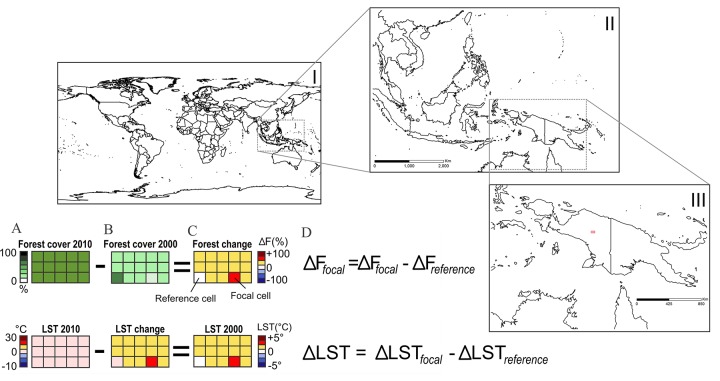
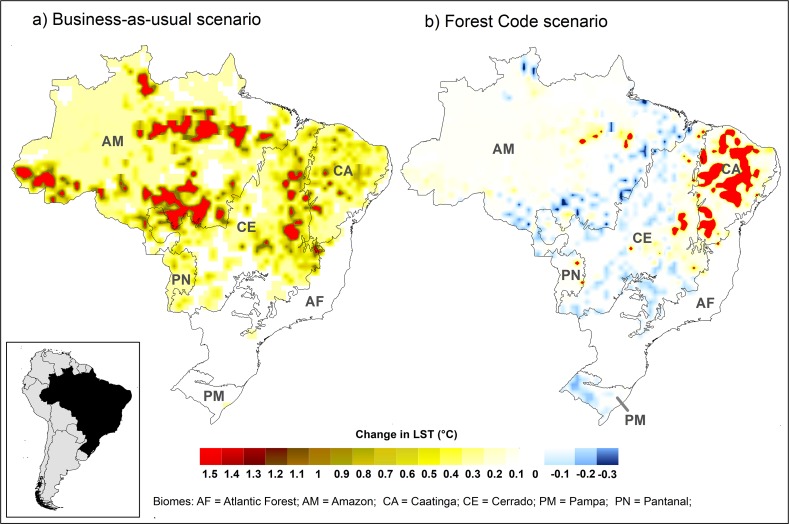
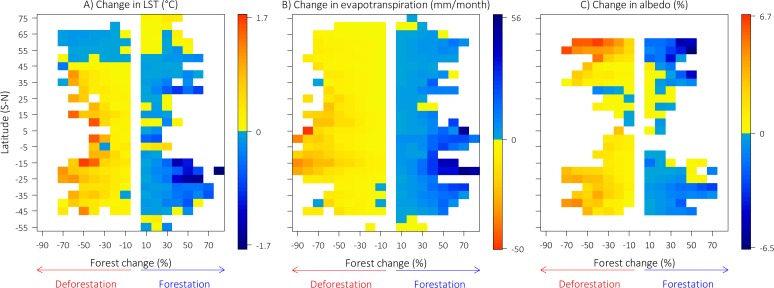
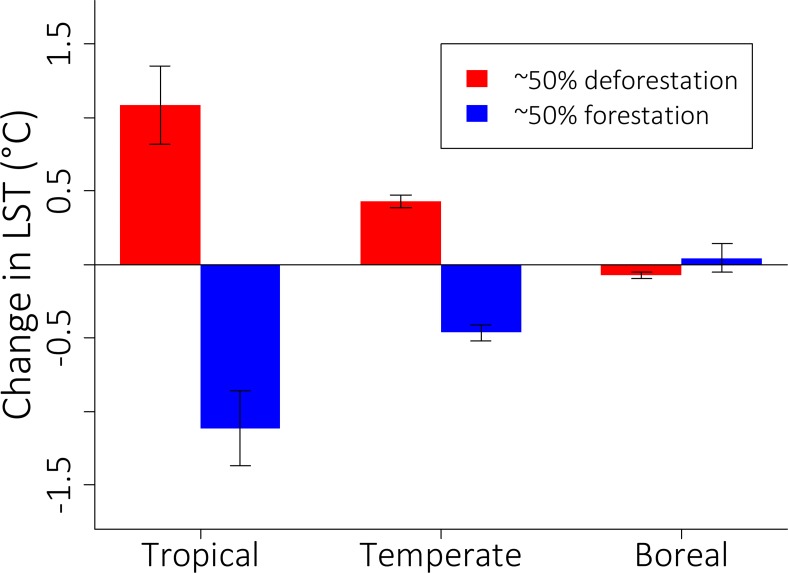
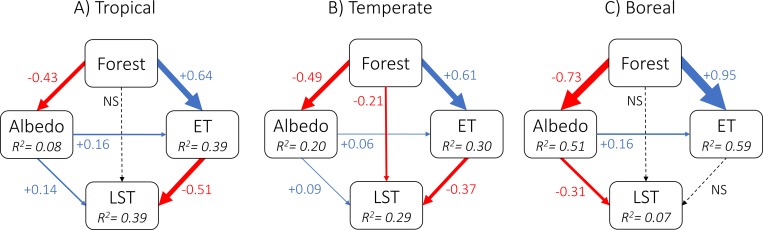
Changing forest cover is a key driver of local climate change worldwide, as it affects both albedo and evapotranspiration (ET). Deforestation and forestation are predicted to have opposing influences on surface albedo and ET rates, and thus impact local surface temperatures differently. Relationships between forest change, albedo, ET, and local temperatures may further vary regionally, as the strengths of warming by albedo effects and cooling by ET effects vary with latitude. Despite these important relationships, the magnitude of forest cover effects on local surface temperature across the globe remains unclear. Using recently-released global forest change data, we first show that forestation and deforestation have pervasive and opposite effects on LST, ET and albedo worldwide. Deforestation from 2000 to 2010 caused consistent warming of 0.38 ± 0.02 (mean ± SE) and 0.16 ± 0.01°C in tropical and temperate regions respectively, while forestation caused cooling in those regions of -0.18 ± 0.02 and -0.19 ± 0.02°C. Tropical forests were particularly sensitive to the climate effects of forest change, with forest cover losses of ~50% associated with increased LST of 1.08 ± 0.25°C, whereas similar forest cover gains decreased LST by -1.11 ± 0.26°C. Secondly, based on a new structural equation model, we show that these changes on LST were largely mediated by changes in albedo and ET. Finally, based on this model, we show that predicted forest changes in Brazil associated with a business-as-usual land use scenario through 2050 may increase LST up to 1.45°C. Our results contribute to a better understanding of the mechanistic inter-relationships between forest change and changes in albedo, ET and LST, and provide additional evidence that forestation has the potential to reverse deforestation impacts on local climate, especially in tropical and temperate regions.
森林覆盖的变化是全球局部气候变化的主要驱动因素,因为它会同时影响反照率和蒸散量(ET)。预计森林砍伐和造林对地表反照率和 ET 速率有相反的影响,因此对当地地表温度的影响也不同。森林变化、反照率、ET 和当地温度之间的关系在区域上可能进一步变化,因为反照率效应的变暖强度和 ET 效应的冷却强度随纬度而变化。尽管存在这些重要的关系,但全球范围内森林覆盖对当地地表温度的影响程度仍不清楚。我们使用最近发布的全球森林变化数据,首先表明,造林和毁林对全球的 LST、ET 和反照率有普遍的、相反的影响。2000 年至 2010 年的森林砍伐导致热带和温带地区的 LST 分别持续变暖 0.38±0.02°C 和 0.16±0.01°C,而造林则使这些地区降温 0.18±0.02°C 和 0.19±0.02°C。热带森林对森林变化的气候影响特别敏感,森林覆盖损失约 50%与 LST 增加 1.08±0.25°C 有关,而类似的森林覆盖增加则使 LST 降低了-1.11±0.26°C。其次,基于一个新的结构方程模型,我们表明,LST 的这些变化主要是由反照率和 ET 的变化介导的。最后,根据这个模型,我们表明,巴西在未来到 2050 年的土地利用情景下,预计的森林变化可能会使 LST 升高 1.45°C。我们的研究结果有助于更好地理解森林变化与反照率、ET 和 LST 变化之间的机制相互关系,并提供了更多证据表明,造林有可能扭转森林砍伐对当地气候的影响,特别是在热带和温带地区。