Cutaneous Leukocyte Biology Section, National Institutes of Arthritis and Musculoskeletal and Skin Diseases, National Institutes of Health, Bethesda, MD, USA.
Department of Pathology, Ronald O. Perelman Department of Dermatology, and Department of Medicine, New York University School of Medicine, New York, NY, USA.
Immunity. 2019 Mar 19;50(3):552-565. doi: 10.1016/j.immuni.2019.02.023.
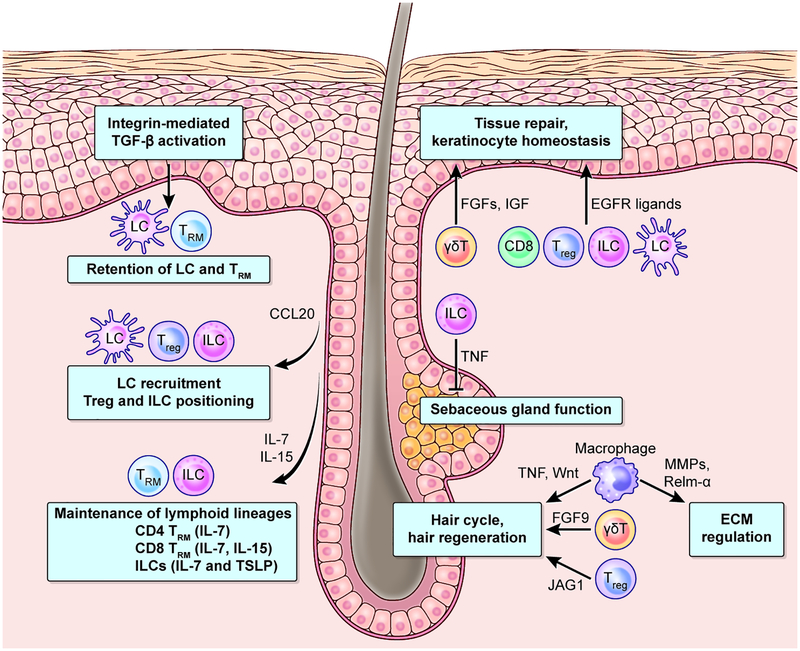
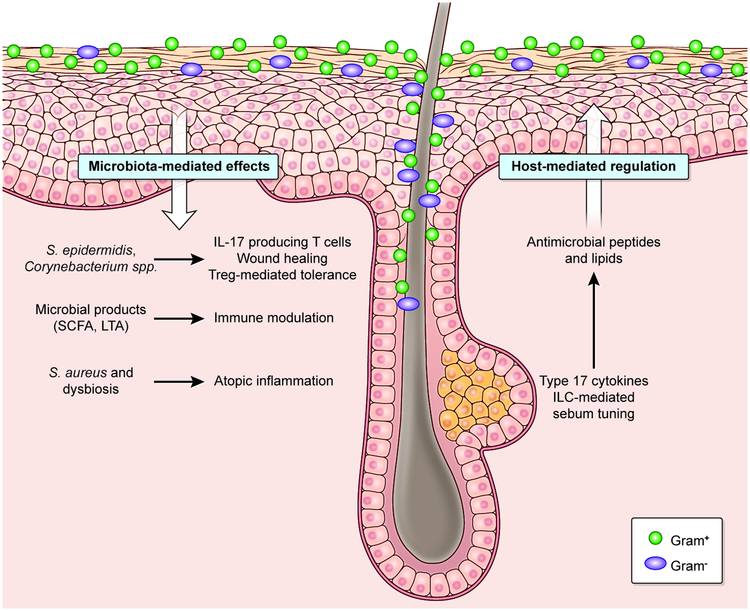
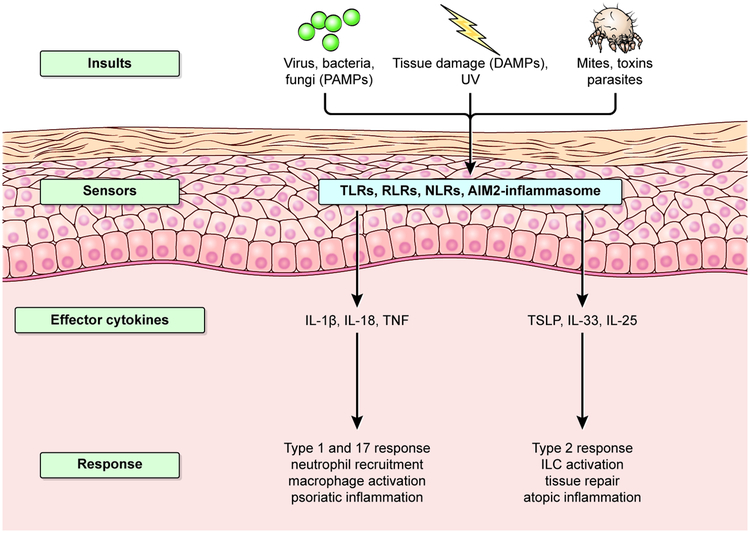
The skin interfaces with the external environment and is home to a myriad of immune cells that patrol the barrier to ward off harmful agents and aid in tissue repair. The formation of the cutaneous immune arsenal begins before birth and evolves throughout our lifetime, incorporating exogenous cues from microbes and inflammatory encounters, to achieve optimal fitness and function. Here, we discuss the context-specific signals that drive productive immune responses in the skin epithelium, highlighting key modulators of these reactions, including hair follicles, neurons, and commensal microbes. We thus also discuss the causal and mechanistic underpinning of inflammatory skin diseases that have been revealed in recent years. Finally, we discuss the non-canonical functions of cutaneous immune cells including their burgeoning role in epithelial regeneration and repair. The rapidly growing field of cutaneous immunity is revealing immune mechanisms and functions that can be harnessed to boost skin health and treat disease.
皮肤与外部环境相互作用,是无数免疫细胞的家园,这些免疫细胞在屏障中巡逻,以抵御有害物,并帮助组织修复。皮肤免疫武器库的形成始于出生前,并在我们的一生中不断发展,将来自微生物和炎症的外源性线索纳入其中,以实现最佳的适应性和功能。在这里,我们讨论了驱动皮肤上皮细胞产生有效免疫反应的特定环境信号,强调了这些反应的关键调节剂,包括毛囊、神经元和共生微生物。因此,我们还讨论了近年来揭示的炎症性皮肤病的因果和机制基础。最后,我们讨论了皮肤免疫细胞的非典型功能,包括它们在表皮再生和修复中不断涌现的作用。快速发展的皮肤免疫领域正在揭示可以用来促进皮肤健康和治疗疾病的免疫机制和功能。