Department of Chemistry and Polymer Science, Stellenbosch University, Stellenbosch, 7600, South Africa.
Department of Biomedical Science, University of Cagliari, 09042, Monserrato, Italy.
BMC Cancer. 2019 Mar 20;19(1):248. doi: 10.1186/s12885-019-5388-8.
Garlic has been used for centuries for its flavour and health promoting properties that include protection against cancer. The vinyl disulfide-sulfoxide ajoene is one of the phytochemicals found in crushed cloves, hypothesised to act by S-thiolating reactive cysteines in target proteins.
Using our fluorescently labelled ajoene analogue called dansyl-ajoene, ajoene's protein targets in MDA-MB-231 breast cancer cells were tagged and separated by 2D electrophoresis. A predominant band was identified by MALDI-TOF MS/MS to be vimentin. Target validation experiments were performed using pure recombinant vimentin protein. Computational modelling of vimentin bound to ajoene was performed using Schrödinger and pK calculations by Epik software. Cytotoxicity of ajoene in MDA-MB-231 and HeLa cells was measured by the MTT assay. The vimentin filament network was visualised in ajoene-treated and non-treated cells by immunofluorescence and vimentin protein expression was determined by immunoblot. The invasion and migration activity was measured by wound healing and transwell assays using wildtype cells and cells in which the vimentin protein had been transiently knocked down by siRNA or overexpressed.
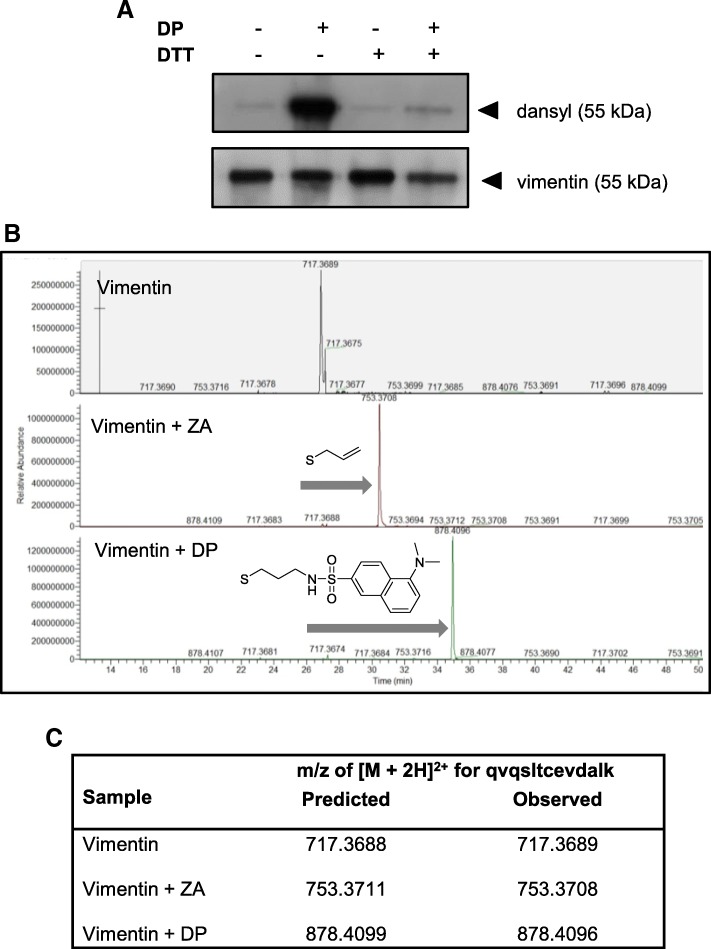
The dominant protein tagged by dansyl-ajoene was identified to be the 57 kDa protein vimentin. The vimentin target was validated to reveal that ajoene and dansyl-ajoene covalently bind to recombinant vimentin via a disulfide linkage at Cys-328. Computational modelling showed Cys-328 to be exposed at the termini of the vimentin tetramer. Treatment of MDA-MB-231 or HeLa cells with a non-cytotoxic concentration of ajoene caused the vimentin filament network to condense; and to increase vimentin protein expression. Ajoene inhibited the invasion and migration of both cancer cell lines which was found to be dependent on the presence of vimentin. Vimentin overexpression caused cells to become more migratory, an effect that was completely rescued by ajoene.
The garlic-derived phytochemical ajoene targets and covalently modifies vimentin in cancer cells by S-thiolating Cys-328. This interaction results in the disruption of the vimentin filament network and contributes to the anti-metastatic activity of ajoene in cancer cells.
大蒜因其风味和促进健康的特性,包括预防癌症,已被使用了几个世纪。丙烯基二硫化物-亚砜阿霍烯是粉碎的蒜瓣中发现的植物化学物质之一,据推测它通过使靶蛋白中的巯基化反应性半胱氨酸来发挥作用。
使用我们标记的荧光阿霍烯类似物称为丹磺酰基-阿霍烯,标记 MDA-MB-231 乳腺癌细胞中的阿霍烯蛋白靶标,并通过二维电泳分离。通过 MALDI-TOF MS/MS 鉴定出主要的一条带为波形蛋白。使用纯重组波形蛋白蛋白进行靶标验证实验。使用 Schrödinger 和 Epik 软件的 pK 计算对与阿霍烯结合的波形蛋白进行计算建模。通过 MTT 测定法测量 MDA-MB-231 和 HeLa 细胞中阿霍烯的细胞毒性。用免疫荧光法观察阿霍烯处理和未处理细胞中的波形蛋白丝网络,并通过免疫印迹法测定波形蛋白蛋白表达。使用野生型细胞和通过 siRNA 瞬时敲低或过表达波形蛋白蛋白的细胞进行划痕愈合和 Transwell 测定,测量侵袭和迁移活性。
用丹磺酰基-阿霍烯标记的主要蛋白质被鉴定为 57 kDa 的蛋白质波形蛋白。验证了波形蛋白靶标,表明阿霍烯和丹磺酰基-阿霍烯通过半胱氨酸 328 处的二硫键共价结合重组波形蛋白。计算模型表明半胱氨酸 328 暴露在波形蛋白四聚体的末端。用非细胞毒性浓度的阿霍烯处理 MDA-MB-231 或 HeLa 细胞会导致波形蛋白丝网络凝聚;并增加波形蛋白蛋白表达。阿霍烯抑制两种癌细胞系的侵袭和迁移,这被发现依赖于波形蛋白的存在。波形蛋白过表达使细胞变得更具迁移性,而阿霍烯完全挽救了这种效应。
大蒜衍生的植物化学物质阿霍烯通过使半胱氨酸 328 巯基化来靶向和修饰癌细胞中的波形蛋白。这种相互作用导致波形蛋白丝网络的破坏,并有助于阿霍烯在癌细胞中的抗转移活性。