Department of Pediatrics, Pediatric Clinical Neuroscience Center, Seoul National University Children's Hospital, Seoul National University College of Medicine, Seoul, Korea.
Department of Pediatrics, Department of Genome Medicine and Science, Gil Medical Center, Gachon University College of Medicine, Incheon, Korea.
Orphanet J Rare Dis. 2019 Mar 20;14(1):68. doi: 10.1186/s13023-019-1041-5.
The Korean Undiagnosed Diseases Program (KUDP) was launched in January 2017 as a one-year pilot project to address the increasing global interest in patients with undiagnosed rare diseases. The purpose of this paper is to summarize the project results and emphasize the unmet research needs among patients with undiagnosed rare diseases in Korea.
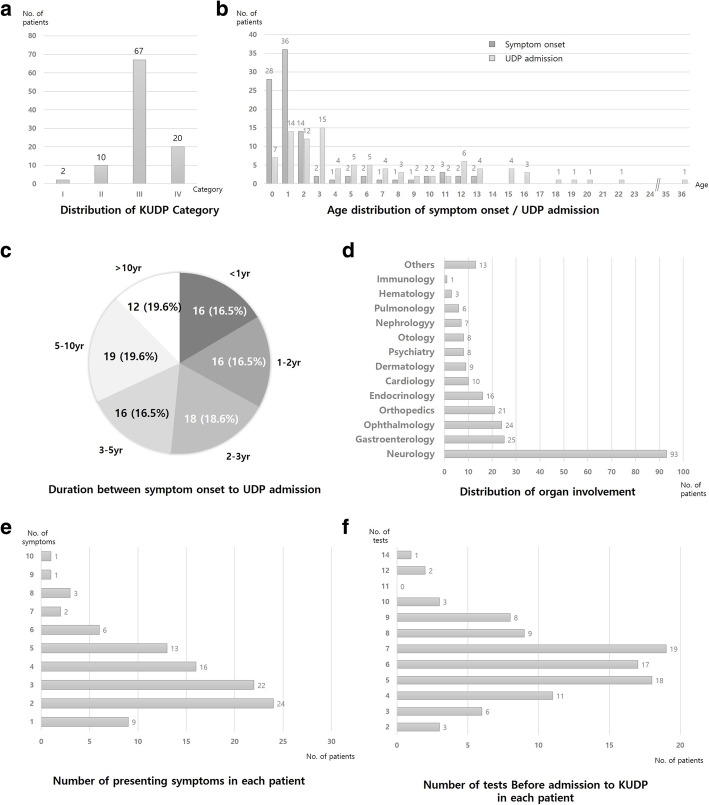
Patient enrollment, assessment, and diagnostic processes were determined by the KUDP clinical expert consortium. Patients followed a diagnostic workflow after being categorized into one of four groups: I) insufficient clinical information or lack of standard diagnostic processes; II) undiagnosed due to low disease awareness; III) clinically diagnosed but unconfirmed genetically due to genetic heterogeneities; or IV) unknown disease due to complex, atypical clinical presentations. After excluding two patients from group I, 97 patients were enrolled, including 10 in group II, 67 in group III, and 20 in group IV. Most of them (92 of 97, 94.8%) were pediatric patients (< 18 years old) and 59 (60.8%) were male. The primary symptoms for 80 patients (82.5%) were neurologic. During the one-year pilot study, 72 patients completed a diagnostic assessment including clinical and molecular genetic analyses; some patients also underwent pathological or biochemical analysis. Twenty-eight of these patients (28/72, 38.9%) achieved molecular genetic diagnosis. Thirteen patients were diagnosed based on traditional tests, including biochemical assay, single or targeted genetic analysis, and chromosomal microarray. We performed whole exome sequencing on 52 patients, among whom 15 (28.8%, 15/52) reached a final diagnosis. One new disorder was identified via international collaboration.
Using an efficient clinical diagnostic workflow, this KUDP pilot study resulted in a fair diagnostic success rate, improving the potential for additional diagnoses and new scientific discovery of complex and rare diseases. KUDP also satisfied unmet needs for rare diseases with multisystem involvement, highlighting the value of emerging genomic technologies for further research into rare and still-undiagnosed conditions.
韩国未确诊疾病计划(KUDP)于 2017 年 1 月启动,作为为期一年的试点项目,旨在满足对全球未确诊罕见疾病患者日益增长的兴趣。本文旨在总结项目成果,并强调韩国未确诊罕见病患者的未满足的研究需求。
患者的入组、评估和诊断过程由 KUDP 临床专家联盟确定。患者被分为以下四组之一后,遵循诊断工作流程:I)临床信息不足或缺乏标准诊断流程;II)由于疾病意识低而未确诊;III)临床诊断但由于遗传异质性导致基因未确认;或 IV)由于复杂、非典型的临床表现而未知疾病。在排除 I 组的两名患者后,共有 97 名患者入组,其中 II 组 10 例,III 组 67 例,IV 组 20 例。他们大多数(97 例中的 92 例,94.8%)是儿科患者(<18 岁),59 例(60.8%)为男性。80 例患者(82.5%)的主要症状为神经系统。在为期一年的试点研究中,72 名患者完成了包括临床和分子遗传学分析的诊断评估;一些患者还进行了病理或生化分析。其中 28 名患者(28/72,38.9%)获得了分子遗传学诊断。13 名患者根据传统检测方法确诊,包括生化检测、单基因或靶向基因分析和染色体微阵列。我们对 52 名患者进行了全外显子组测序,其中 15 名(52 名中的 15 名,28.8%)最终确诊。通过国际合作发现了一种新的疾病。
使用高效的临床诊断工作流程,本 KUDP 试点研究取得了相当高的诊断成功率,提高了进一步诊断和对复杂罕见疾病的新科学发现的可能性。KUDP 还满足了多系统受累罕见疾病的未满足需求,突出了新兴基因组技术对进一步研究罕见和仍未确诊疾病的价值。