Department of Basic Sciences, College of Veterinary Medicine, Mississippi State University, Mississippi State, MS, United States.
Department of Nutrition and Veterinary Clinical Nutrition, Faculty of Veterinary Medicine, Damanhour University, Damanhour, Egypt.
Front Immunol. 2019 Mar 6;10:392. doi: 10.3389/fimmu.2019.00392. eCollection 2019.
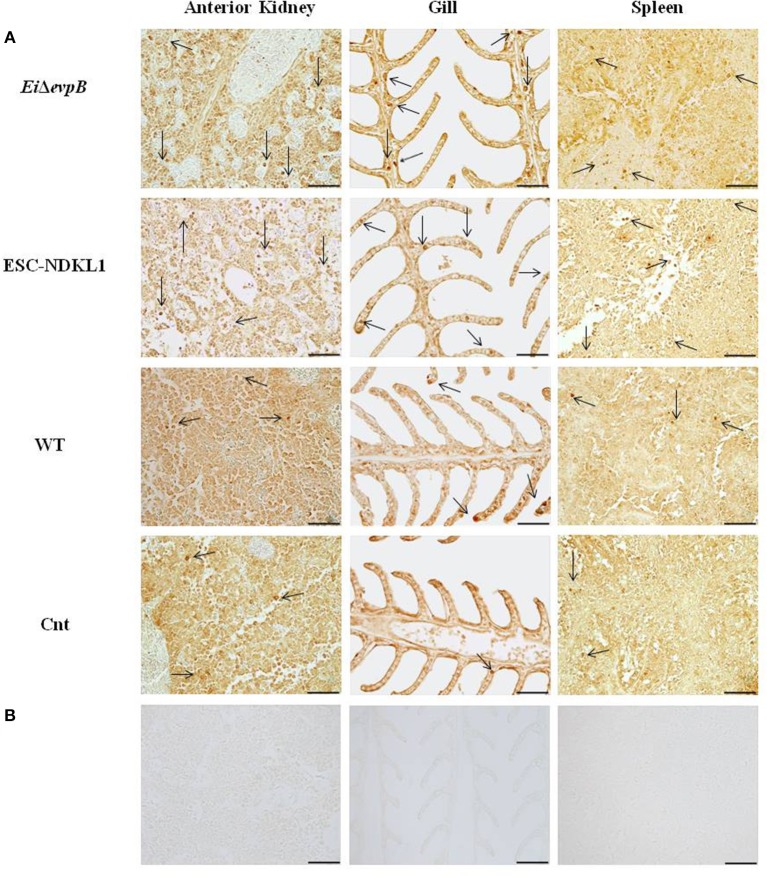
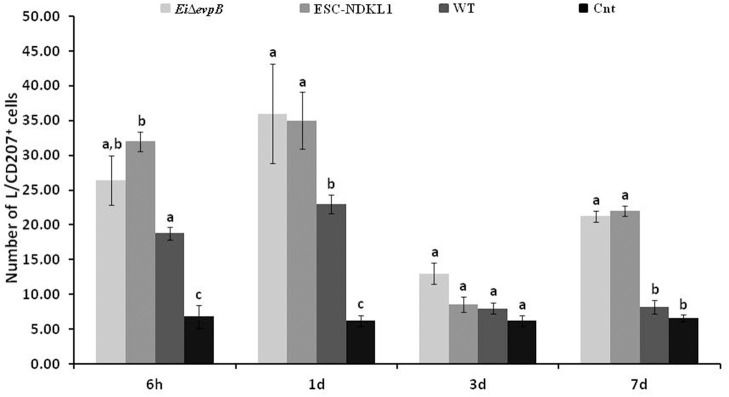
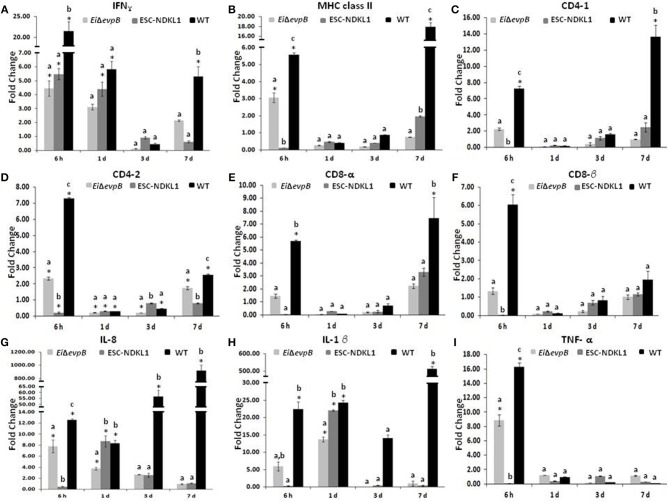
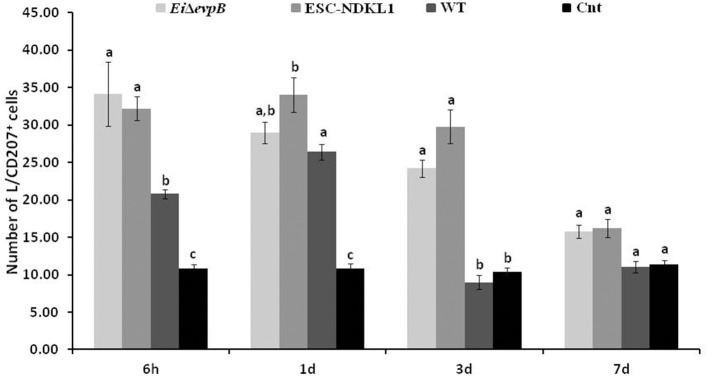
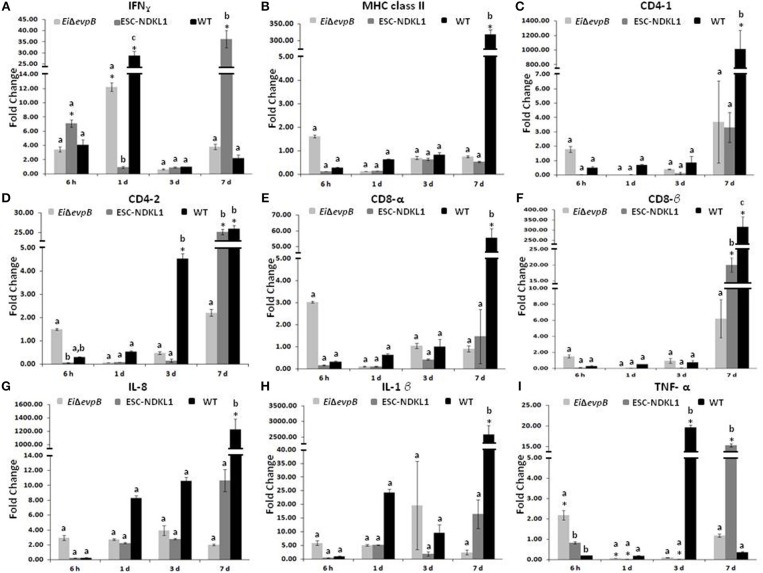
is a Gram-negative intracellular pathogen that causes enteric septicemia of catfish (ESC). Successful vaccination against intracellular pathogens requires T cell priming by antigen presenting cells (APCs) that bridge innate and adaptive immunity. However, the evidence on immunological mechanisms that underscore pathogenesis and the protective role of live attenuated vaccines (LAVs) is scarce. We assessed the expression of immune genes related to antigen presentation by real-time PCR and the distribution patterns of Langerhans-like (L/CD207) cells by immunohistochemistry in the immune-related tissues of channel catfish challenged with two novel LAVs, Δ, and ESC-NDKL1 and wild type (WT) strain. Our results indicated significantly elevated expression of IFN-γ gene in the anterior kidney (AK) and spleen of vaccinated catfish at the early stages of exposure, which correlated with increased numbers of L/CD207 cells. In general, the ESC-NDKL1-induced IFN-γ gene expression patterns in the AK resembled that of the patterns induced by Δ. However the MHCII gene expression patterns differed between the strains with significant increases at 6 h post-challenge (pc) with the Δ and at 7 d pc with the ESC-NDKL1 strains, respectively. Significant increases in activity of T helper type polarization genes such as IFN-γ and T cell co-receptors after exposure to ESC-NDKL1, in combination with elevated numbers of L/CD207 cells at 7 d pc with both LAVs compared to uninfected and the WT-exposed counterparts, were documented in the spleen. The dominant pro-inflammatory environment with dramatically overexpressed inflammatory genes in the AK and 7 d pc in the spleen in response to was found in exposed catfish. In general, the pro-inflammatory gene expression profiles in the ESC-NDKL1 pc showed more similarities to the WT strain-induced gene profiles compared to the Δ counterpart. In addition, WT significantly decreased the numbers of Langerhans-like L/CD207 cells in the AK and spleen at 3 and 7 days pc. In conclusion, we report the differential framework of initiation of innate and adaptive immune responses between strains with both LAVs having a potential of satisfying the stringent requirements for successful vaccines.
是一种革兰氏阴性细胞内病原体,可引起鲶鱼肠败血症(ESC)。成功接种针对细胞内病原体的疫苗需要抗原呈递细胞(APC)引发 T 细胞,从而桥接先天免疫和适应性免疫。然而,关于强调发病机制和减毒活疫苗(LAV)的保护作用的免疫学机制的证据很少。我们通过实时 PCR 评估了两种新型 LAV,Δ和 ESC-NDKL1 以及野生型(WT)菌株感染后,与抗原呈递相关的免疫基因的表达,并通过免疫组织化学评估了郎格汉斯样(L / CD207)细胞的分布模式。鱼的免疫相关组织。我们的结果表明,在接触早期,疫苗接种鲶鱼的前肾(AK)和脾脏中 IFN-γ基因的表达显着升高,这与 L / CD207细胞数量的增加有关。一般而言,ESC-NDKL1 在 AK 中诱导的 IFN-γ基因表达模式类似于Δ诱导的模式。然而,两种菌株的 MHCII 基因表达模式有所不同,Δ在攻毒后 6 小时(pc)和 ESC-NDKL1 在 7 天 pc 时均有显着增加。暴露于 ESC-NDKL1 后,T 辅助型极化基因(如 IFN-γ和 T 细胞共受体)的活性显着增加,与未感染和 WT 暴露的对照相比,两种 LAV 在 7 天 pc 时 L / CD207 细胞的数量均增加。在暴露的鲶鱼中,在 AK 中观察到针对的主要促炎环境,并且在脾中在 7 天 pc 时炎症基因的表达明显升高。一般而言,ESC-NDKL1 在攻毒后第 7 天的 AK 和脾中促炎基因的表达谱与 WT 诱导的基因谱更为相似。此外,WT 显着减少了 3 天和 7 天 pc 时 AK 和脾中郎格汉斯样 L / CD207 细胞的数量。总之,我们报告了两种 LAV 之间先天和适应性免疫反应启动的差异框架,这两种 LAV 都有可能满足成功疫苗的严格要求。