Dahlberg J, Andersson G
Department of Sociology, The Stockholm University Demography Unit, Stockholm University, SE-106 91 Stockholm, Sweden.
Hum Reprod Open. 2018 Sep 29;2018(4):hoy015. doi: 10.1093/hropen/hoy015. eCollection 2018.
Have seasonal variations in births by factors related to maternal education, age, parity and re-partnering changed over a 72-year period?
Seasonal variation in births has been reduced overall but also changed its pattern over the last seven decades.
The number of births varies markedly by season, but the causes of this variation are not fully understood. Seasonality of births is, in some populations, strongly influenced by sociodemographic factors.
A longitudinal study design was used by analysing the seasonal variation in live births between 1940 and 2012, and relating it to mothers' sociodemographic characteristics at the time of childbirth (maternal education, age, parity and re-partnering).
PARTICIPANTS/MATERIALS SETTING METHODS: Register data on 6 768 810 live births in Sweden between 1940 and 2012 were used. Information on biological parents are available for more than 95% of all births. Multinomial logistic regressions were used to calculate predicted probabilities of giving birth for each calendar month.
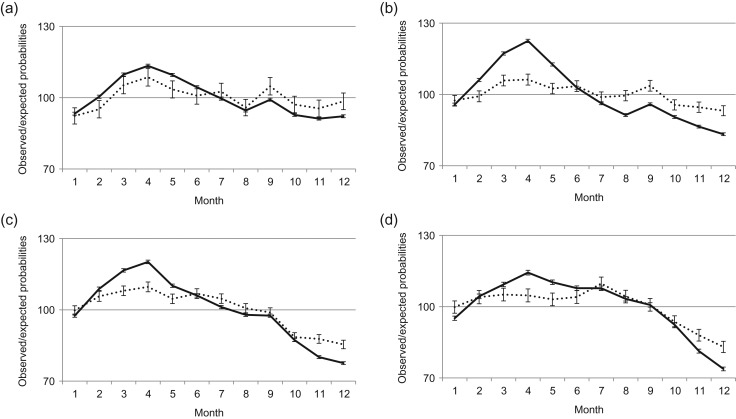
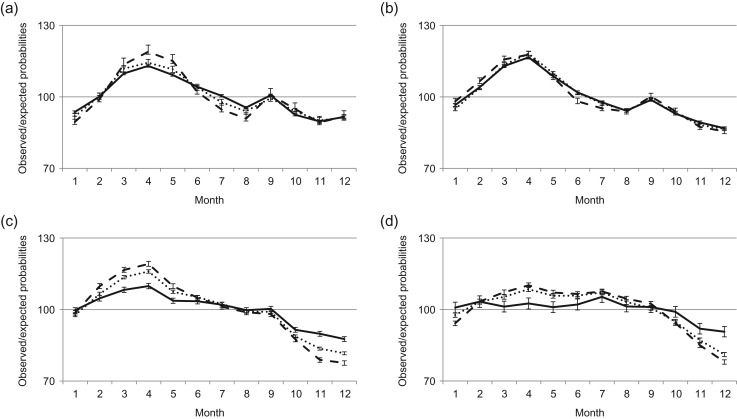
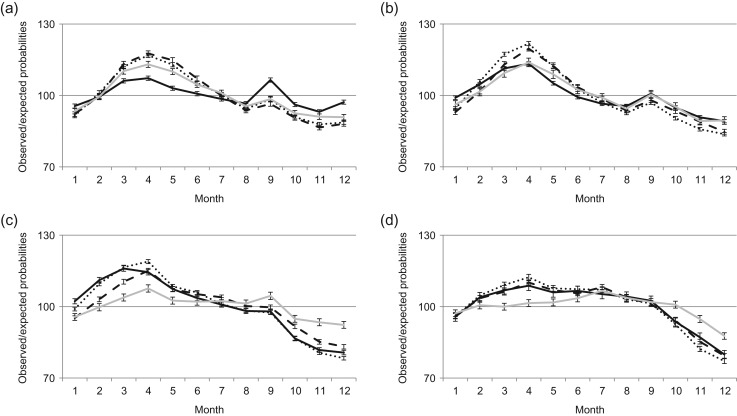
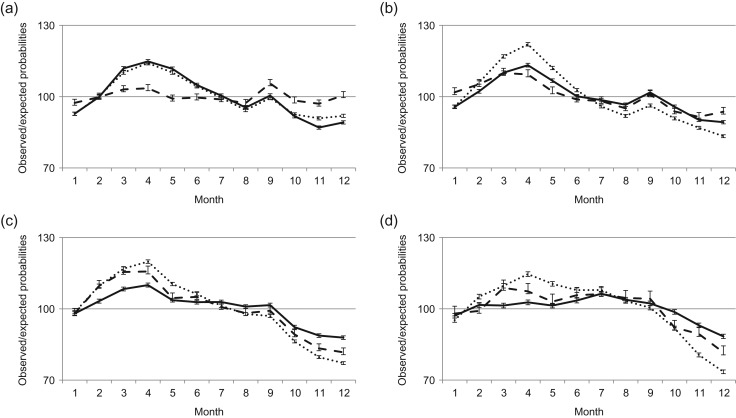
Between 1940 and 1999, Swedish birth rates showed the typical seasonal variation with high numbers of births during the spring, and low numbers of births during the last quarter of the year. However, during the 21st century, the seasonal variation in fertility declined so that only minor variation in birth rates between February and September now remains. Still, the pattern of low birth rates at the end of the year remains and has even become more pronounced from the 1980s onwards. The characteristic 'Christmas effect' that used to be visible in September has vanished over the last 30 years. The roles in seasonal variation of maternal education, the mother's age, parity and instances where the mother has re-partnered between subsequent births changed during the second half of the 20th century. From 1980s onwards, the decline in birth rates during the last quarter of the year became particularly pronounced among highly educated mothers. Over the 72 years studied, the seasonal variation among first-time mothers declined steadily and has almost disappeared at the end of the study period. Using data that cover ~180 000 births in each month, all meaningful results are statistically significant.
The study uses data from one Nordic country only, making it difficult to draw conclusions that may hold for other countries.
The typical seasonal variation reported for Sweden between 1940 and 1999, with high numbers of births during the spring and low numbers of births during the last quarter of the year, is in line with results from most other European countries during the same time period. However, the significant decline in seasonal variation in the early 21st century is a novel development. The study underlines that in a society with low fertility and efficient birth control, active choices and behaviours associated with an individual's sociodemographic characteristics tend to matter more for the seasonal timing of childbearing than environmental factors related to the physiological ability to reproduce and cultural-behavioural factors related to the frequency of intercourse.
STUDY FUNDING/COMPETING INTERESTS: The study was funded by the Swedish Research Council (Vetenskapsrådet) via the Swedish Initiative for Research on Microdata in the Social and Medical Sciences (SIMSAM): Stockholm University SIMSAM Node for Demographic Research (grant registration number 340-2013-5164). The authors declare no conflicts of interest.
Not applicable.

在72年的时间里,与孕产妇教育、年龄、胎次和重新伴侣关系相关的因素导致的出生季节性变化是否发生了改变?
总体而言,出生的季节性变化有所减少,但在过去七十年中其模式也发生了变化。
出生数量随季节有显著变化,但其变化原因尚未完全了解。在某些人群中,出生的季节性受到社会人口因素的强烈影响。
采用纵向研究设计,分析1940年至2012年期间活产的季节性变化,并将其与分娩时母亲的社会人口特征(孕产妇教育、年龄、胎次和重新伴侣关系)相关联。
参与者/材料设置方法:使用了瑞典1940年至2012年期间6768810例活产的登记数据。超过95%的所有出生都可获得生物学父母的信息。使用多项逻辑回归来计算每个日历月的预测分娩概率。
1940年至1999年期间,瑞典的出生率呈现典型的季节性变化,春季出生人数多,而一年最后一个季度出生人数少。然而,在21世纪,生育的季节性变化下降,以至于现在2月至9月之间的出生率只有微小变化。尽管如此,年底出生率低的模式仍然存在,并且从20世纪80年代起甚至变得更加明显。过去在9月可见的典型“圣诞效应”在过去30年中已经消失。孕产妇教育、母亲年龄、胎次以及母亲在随后分娩之间重新伴侣的情况在20世纪下半叶对季节性变化的作用发生了变化。从20世纪80年代起,年底出生率的下降在高学历母亲中尤为明显。在研究的72年中,初产妇的季节性变化稳步下降,在研究期结束时几乎消失。使用每月约180000例出生的数据,所有有意义的结果在统计学上均具有显著性。
该研究仅使用了一个北欧国家的数据,因此难以得出可能适用于其他国家的结论。
1940年至1999年期间瑞典报告的典型季节性变化,春季出生人数多,一年最后一个季度出生人数少,与同一时期大多数其他欧洲国家的结果一致。然而,21世纪初季节性变化的显著下降是一个新情况。该研究强调,在一个低生育率和有效节育的社会中,与个人社会人口特征相关的积极选择和行为在生育的季节性时间安排上往往比与生殖生理能力相关的环境因素以及与性交频率相关的文化行为因素更为重要。
研究资金/利益冲突:该研究由瑞典研究理事会(Vetenskapsrådet)通过瑞典社会和医学科学微观数据研究倡议(SIMSAM)资助:斯德哥尔摩大学人口研究SIMSAM节点(资助注册号340 - 2013 - 5164)。作者声明无利益冲突。
不适用。