Department of Thoracic Surgery, Fudan University Shanghai Cancer Center, Shanghai 200032, P.R. China.
Department of Shanghai Lung Cancer Center, Shanghai Chest Hospital, Shanghai Jiao Tong University, Shanghai 200030, P.R. China.
Oncol Rep. 2019 May;41(5):2636-2646. doi: 10.3892/or.2019.7080. Epub 2019 Mar 20.
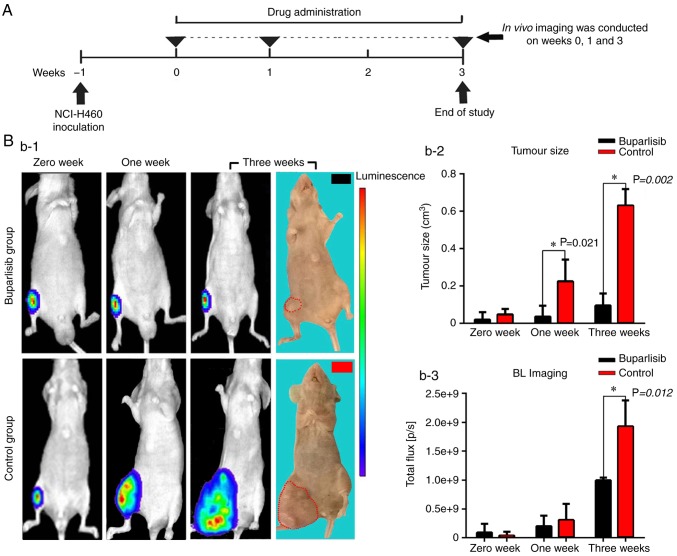
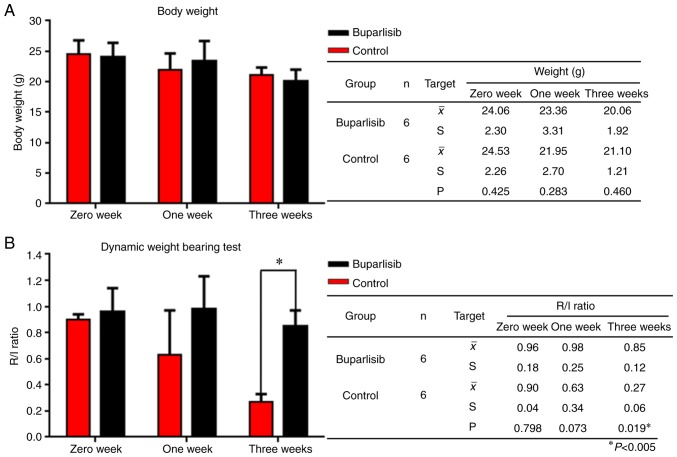
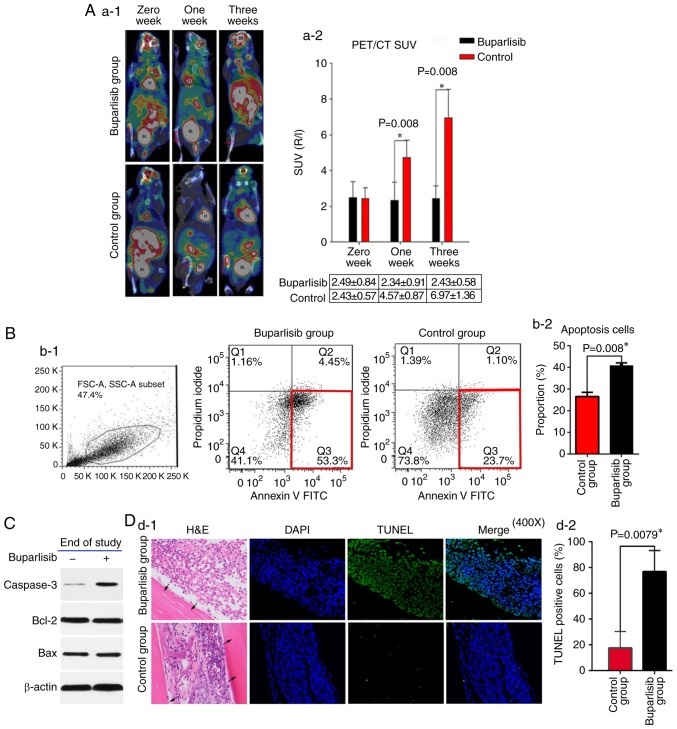
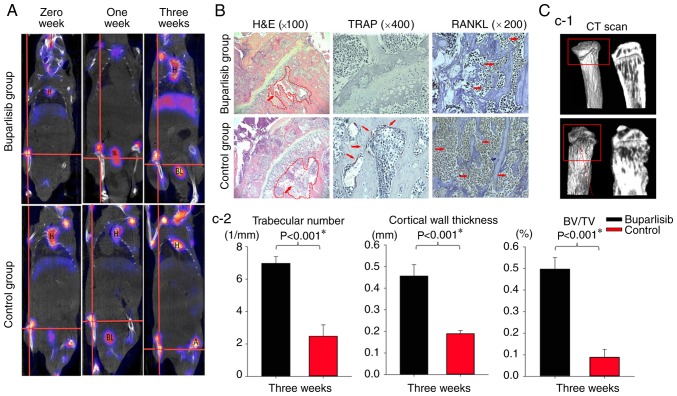
Non‑small cell lung cancer (NSCLC) metastasis commonly occurs in bone, which often results in pathological fractures. Sustained phosphoinositide‑3‑kinase (PI3K) signalling promotes the growth of PI3K‑dependent NSCLC and elevates osteoclastogenic potential. The present study investigated the effects of a PI3K inhibitor on NSCLC growth in bone and osteoclast formation, and aimed to determine whether it could control symptoms associated with bone metastasis. A bone metastasis xenograft model was established by implanting NCI‑H460‑luc2 lung cancer cells, which contain a phosphatidylinositol‑4,5‑bisphosphate 3‑kinase catalytic subunit α mutation, into the right tibiae of mice. After 1 week, the tumours were challenged with a PI3K inhibitor (buparlisib) or blank control for 3 weeks. Tumour growth and burden were longitudinally assessed in vivo via reporter gene bioluminescence imaging (BLI), small animal positron emission tomography/computed tomography (CT) [18F‑fluorodeoxyglucose (18F‑FDG)] and single‑photon emission computed tomography/CT [99mTc‑methylene diphosphonate (99mTc‑MDP)] imaging. Tibia sections of intraosseous NCI‑H460 tumours were analysed by immunohistochemistry (IHC), western blotting and flow cytometry. Dynamic weight bearing (DWB) tests were further performed to examine the improvement of symptoms associated with bone metastasis during the entire study. Administration of buparlisib significantly inhibited the progression of bone metastasis of NSCLC, as evidenced by significantly reduced uptake of 18F‑FDG, 99mTc‑MDP and BLI signals in the treated lesions. In addition, buparlisib appeared to inhibit the expression of tartrate‑resistant acid phosphatase and receptor activator of nuclear factor‑κB ligand, as determined by IHC. Buparlisib also resulted in increased cell apoptosis, as determined by a higher percentage of Annexin V staining and increased caspase 3 expression. Furthermore, buparlisib significantly increased weight‑bearing capacity, as revealed by DWB tests. The PI3K inhibitor, buparlisib, suppressed osteoclast formation in vivo, and exhibited antitumour activity, thus leading to increased weight‑bearing ability in mice with bone metastasis of lung cancer. Therefore, targeting the PI3K pathway may be a potential therapeutic strategy that prevents the structural skeletal damage associated with bone metastasis of lung cancer.
非小细胞肺癌(NSCLC)转移通常发生在骨骼中,这常常导致病理性骨折。持续的磷酸肌醇 3-激酶(PI3K)信号促进了 PI3K 依赖性 NSCLC 的生长,并提高了破骨细胞生成潜能。本研究旨在探讨 PI3K 抑制剂对 NSCLC 在骨骼中的生长和破骨细胞形成的影响,并确定其是否可以控制与骨转移相关的症状。通过将含有磷脂酰肌醇-4,5-二磷酸 3-激酶催化亚单位α突变的 NCI-H460-luc2 肺癌细胞植入小鼠右侧胫骨,建立了骨转移异种移植模型。1 周后,用 PI3K 抑制剂(buparlisib)或空白对照处理肿瘤 3 周。通过报告基因生物发光成像(BLI)、小动物正电子发射断层扫描/计算机断层扫描(CT)[18F-氟脱氧葡萄糖(18F-FDG)]和单光子发射计算机断层扫描/CT[99mTc-亚甲基二膦酸盐(99mTc-MDP)]成像,在体内进行肿瘤生长和负荷的纵向评估。通过免疫组织化学(IHC)、western blot 和流式细胞术分析骨内 NCI-H460 肿瘤的胫骨切片。进一步进行动态负重(DWB)测试,以检查整个研究过程中与骨转移相关症状的改善情况。buparlisib 的给药显著抑制了 NSCLC 骨转移的进展,这表现在处理病灶中 18F-FDG、99mTc-MDP 和 BLI 信号的摄取明显减少。此外,buparlisib 似乎抑制了抗酒石酸酸性磷酸酶和核因子-κB 配体受体激活剂的表达,这是通过 IHC 确定的。buparlisib 还导致细胞凋亡增加,这是通过 Annexin V 染色的百分比增加和 caspase 3 表达增加来确定的。此外,buparlisib 显著增加了 DWB 测试中的承重能力。PI3K 抑制剂 buparlisib 抑制了体内破骨细胞的形成,并表现出抗肿瘤活性,从而导致肺癌骨转移小鼠的承重能力增加。因此,靶向 PI3K 通路可能是一种潜在的治疗策略,可防止与肺癌骨转移相关的结构性骨骼损伤。