Institute of Molecular Medicine, Renji Hospital, Shanghai Jiao Tong University School of Medicine, Shanghai, 200127, China.
College of Chemistry and Molecular Engineering, Peking-Tsinghua Center for Life Sciences, Synthetic and Functional Biomolecules Center, and Key Laboratory of Bioorganic Chemistry and Molecular Engineering of Ministry of Education, Peking University, Beijing, 100871, China.
Nat Commun. 2019 Mar 21;10(1):1317. doi: 10.1038/s41467-019-09267-x.
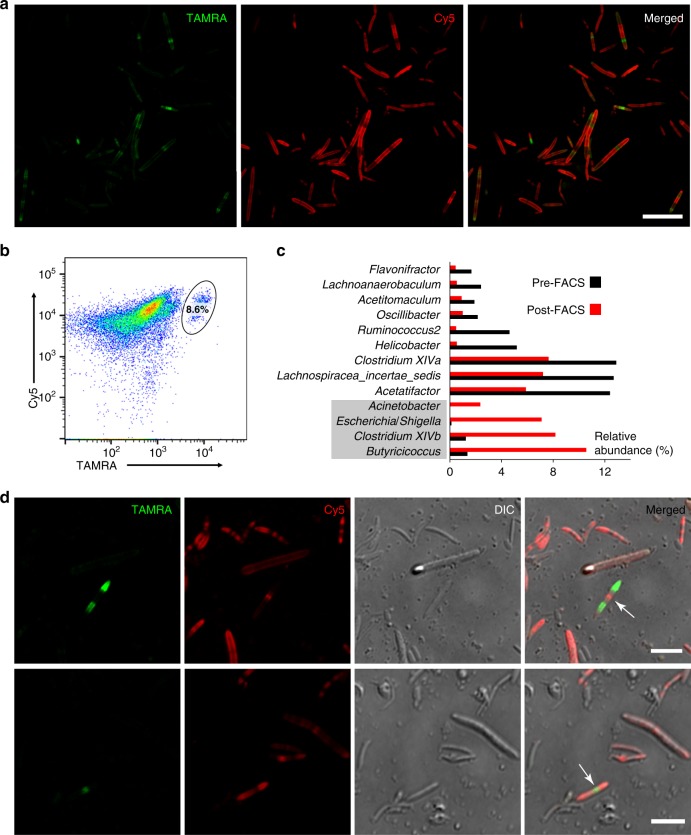
Currently, there are more than 200 fecal microbiota transplantation (FMT) clinical trials worldwide. However, our knowledge of this microbial therapy is still limited. Here we develop a strategy using sequential tagging with D-amino acid-based metabolic probes (STAMP) for assessing the viabilities of transplanted microbiotas. A fluorescent D-amino acid (FDAA) is first administered to donor mice to metabolically label the gut microbiotas in vivo. The labeled microbiotas are transplanted to recipient mice, which receive a second FDAA with a different color. The surviving transplants should incorporate both FDAAs and can be readily distinguished by presenting two colors simultaneously. Isolation of surviving bacteria and 16S rDNA sequencing identify several enriched genera, suggesting the importance of specific bacteria in FMT. In addition, using STAMP, we evaluate the effects on transplant survival of pre-treating recipients using different antibiotics. We propose STAMP as a versatile tool for deciphering the complex biology of FMT, and potentially improving its treatment efficacy.
目前,全球有超过 200 项粪便微生物群移植(FMT)临床试验。然而,我们对这种微生物疗法的了解仍然有限。在这里,我们开发了一种使用基于 D-氨基酸的代谢探针(STAMP)进行连续标记的策略,用于评估移植微生物群的活力。首先将荧光 D-氨基酸(FDAA)施用于供体小鼠,以在体内代谢标记肠道微生物群。标记的微生物群被移植到受体小鼠中,这些受体小鼠接受另一种颜色的第二种 FDAA。存活的移植物应该同时包含两种 FDAAs,并且可以通过同时呈现两种颜色来轻松区分。分离存活细菌并进行 16S rDNA 测序可鉴定出几种富集属,表明 FMT 中特定细菌的重要性。此外,使用 STAMP,我们评估了用不同抗生素预处理受体对移植物存活的影响。我们提出 STAMP 作为一种用于破译 FMT 复杂生物学的通用工具,并有可能提高其治疗效果。