O'Shea Christopher, Holmes Andrew P, Winter James, Correia Joao, Ou Xianhong, Dong Ruirui, He Shicheng, Kirchhof Paulus, Fabritz Larissa, Rajpoot Kashif, Pavlovic Davor
Institute of Cardiovascular Sciences, University of Birmingham, Birmingham, United Kingdom.
School of Computer Science, University of Birmingham, Birmingham, United Kingdom.
Front Physiol. 2019 Mar 7;10:182. doi: 10.3389/fphys.2019.00182. eCollection 2019.
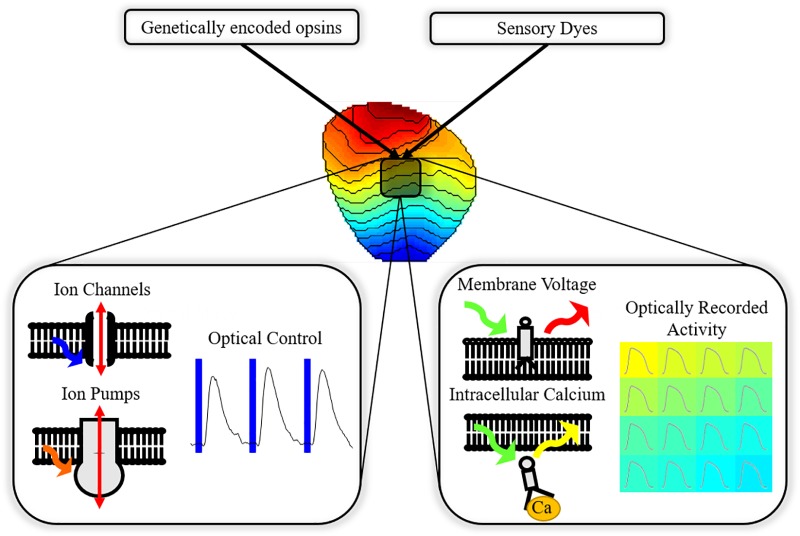
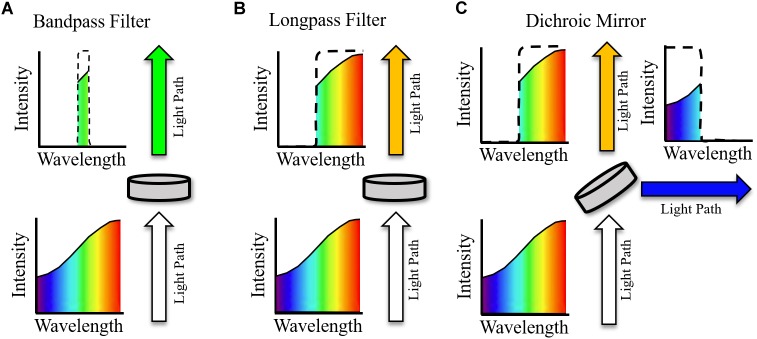
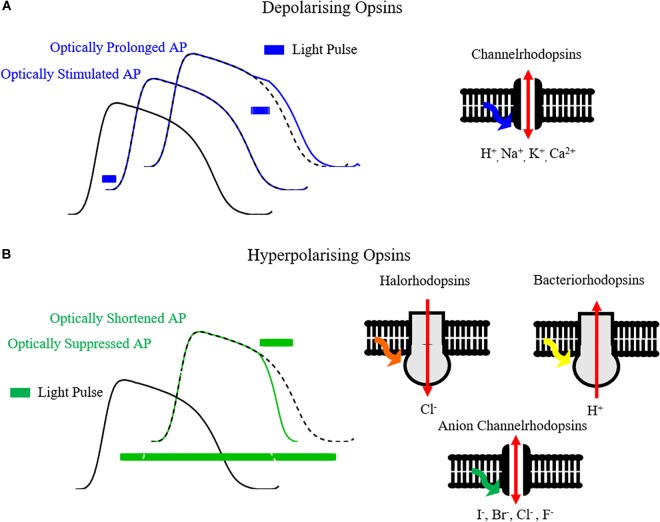
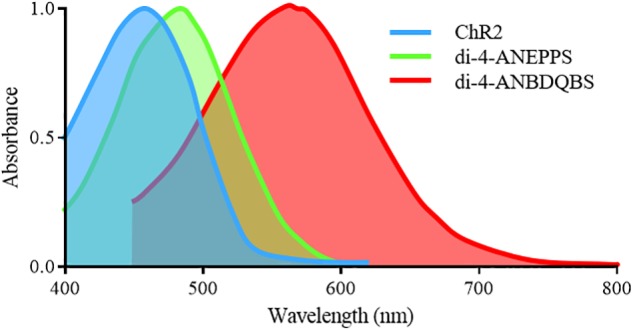
Optogenetic control of the heart is an emergent technology that offers unparalleled spatio-temporal control of cardiac dynamics via light-sensitive ion pumps and channels (opsins). This fast-evolving technique holds broad scope in both clinical and basic research setting. Combination of optogenetics with optical mapping of voltage or calcium fluorescent probes facilitates 'all-optical' electrophysiology, allowing precise optogenetic actuation of cardiac tissue with high spatio-temporal resolution imaging of action potential and calcium transient morphology and conduction patterns. In this review, we provide a synopsis of optogenetics and discuss in detail its use and compatibility with optical interrogation of cardiac electrophysiology. We briefly discuss the benefits of all-optical cardiac control and electrophysiological interrogation compared to traditional techniques, and describe mechanisms, unique features and limitations of optically induced cardiac control. In particular, we focus on state-of-the-art setup design, challenges in light delivery and filtering, and compatibility of opsins with fluorescent reporters used in optical mapping. The interaction of cardiac tissue with light, and physical and computational approaches to overcome the 'spectral congestion' that arises from the combination of optogenetics and optical mapping are discussed. Finally, we summarize recent preclinical work applications of combined cardiac optogenetics and optical mapping approach.
心脏的光遗传学控制是一项新兴技术,它通过光敏感离子泵和通道(视蛋白)对心脏动力学提供无与伦比的时空控制。这项快速发展的技术在临床和基础研究领域都具有广泛的应用前景。光遗传学与电压或钙荧光探针的光学映射相结合,促进了“全光学”电生理学的发展,能够在对动作电位、钙瞬变形态和传导模式进行高时空分辨率成像的同时,对心脏组织进行精确的光遗传学刺激。在这篇综述中,我们概述了光遗传学,并详细讨论了其在心脏电生理学光学检测中的应用及兼容性。我们简要讨论了与传统技术相比,全光学心脏控制和电生理学检测的优势,并描述了光诱导心脏控制的机制、独特特征和局限性。特别地,我们关注了最先进的实验装置设计、光传输和滤波方面的挑战,以及视蛋白与光学映射中使用的荧光报告分子的兼容性。我们还讨论了心脏组织与光的相互作用,以及克服光遗传学和光学映射相结合所产生的“光谱拥挤”的物理和计算方法。最后,我们总结了心脏光遗传学与光学映射联合方法最近的临床前工作应用。