Li Pengsong, Fu Xiaofen, Chen Ming, Zhang Lei, Li Shizhong
1MOST-USDA Joint Research Center for Biofuels, Beijing Engineering Research Center for Biofuels, Institute of New Energy Technology, Tsinghua University, Beijing, 100084 China.
Agricultural Utilization Research Center, Nutrition and Health Research Institute, COFCO Corporation, No.4 Road, Future Science and Technology Park South, Beiqijia, Changping, Beijing, 102209 China.
Biotechnol Biofuels. 2019 Mar 9;12:49. doi: 10.1186/s13068-019-1390-2. eCollection 2019.
The thermotolerant yeast is a potential candidate for high-temperature fermentation. When was used for high-temperature ethanol fermentation, a fermentation arrest was observed during the late fermentation stage and the stress responses have been investigated based on the integration of RNA-Seq and metabolite data. In order to bring new insights into the cellular responses of after the fermentation arrest during high-temperature ethanol fermentation, quantitative proteomic profiling and integrated analysis with transcriptomic data were performed in this study.
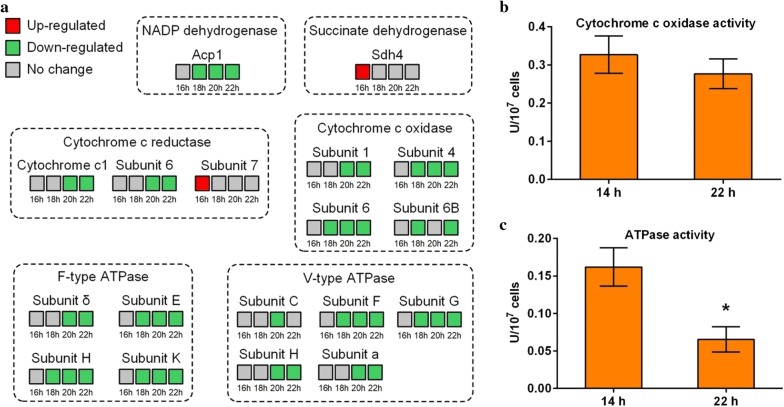
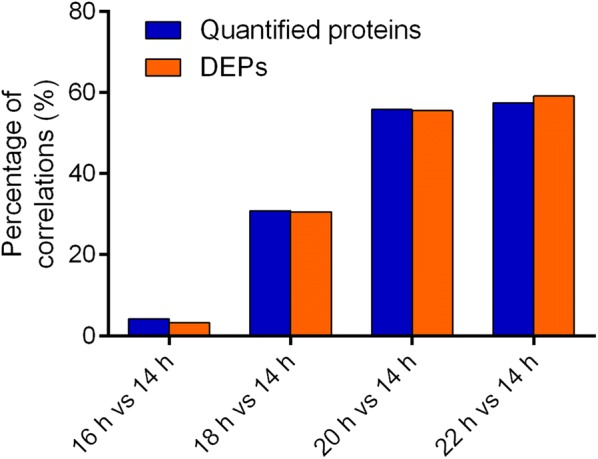
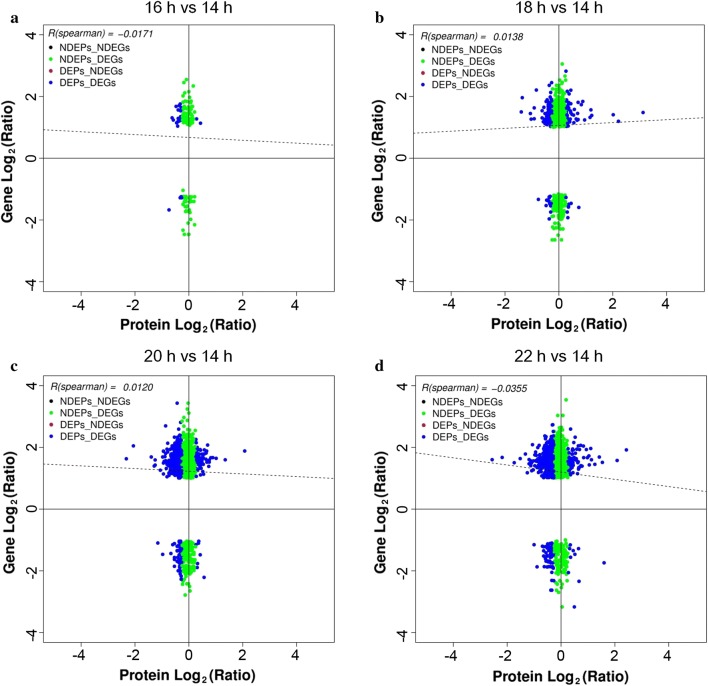
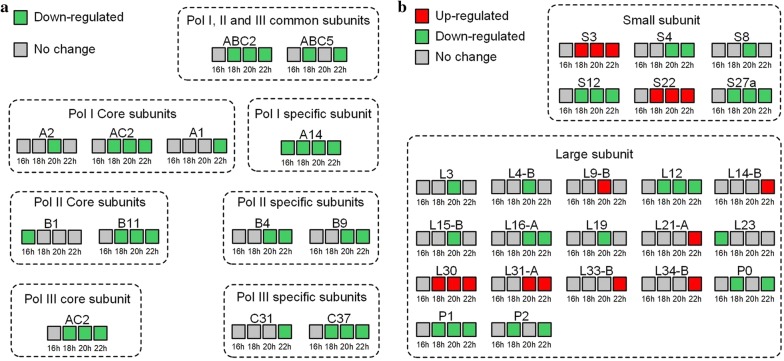
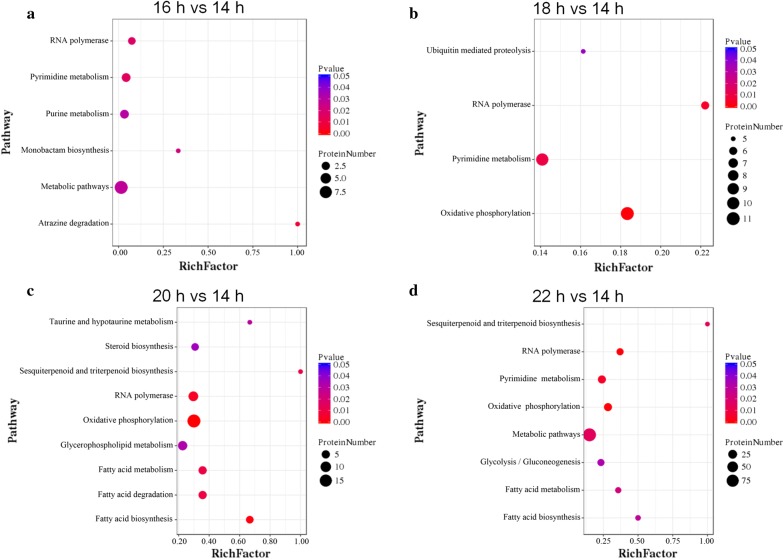
Samples collected at 14, 16, 18, 20 and 22 h during high-temperature fermentation were subjected to isobaric tags for relative and absolute quantitation (iTRAQ)-based proteomic profiling and integrated analysis with transcriptomic data. The correlations between transcripts and proteins for the comparative group 16 h vs 14 h accounted for only 4.20% quantified proteins and 3.23% differentially expressed proteins (DEPs), respectively, much higher percentages of correlations (30.56%-59.11%) were found for other comparative groups (i.e., 18 h vs 14 h, 20 h vs 14 h, and 22 h vs 14 h). According to Spearman correlation tests between transcriptome and proteome (the absolute value of a correlation coefficient between 0.5 and 1 indicates a strong correlation), poor correlations were found for all quantified proteins ( = - 0.0355 to 0.0138), DEPs ( = - 0.0079 to 0.0233) and the DEPs with opposite expression trends to corresponding differentially expressed genes (DEGs) ( = - 0.0478 to 0.0636), whereas stronger correlations were observed in terms of the DEPs with the same expression trends as the correlated DEGs ( = 0.5593 to 0.7080). The results of multiple reaction monitoring (MRM) verification indicate that the iTRAQ results were reliable. After the fermentation arrest, a number of proteins involved in transcription, translation, oxidative phosphorylation and fatty acid metabolism were down-regulated, some molecular chaperones and proteasome proteins were up-regulated, the ATPase activity significantly decreased, and the total fatty acids gradually accumulated. In addition, the contents of palmitic acid, oleic acid, C16, C18, C22 and C24 fatty acids increased by 16.77%, 28.49%, 14.14%, 26.88%, 628.57% and 125.29%, respectively.
This study confirmed some biochemical and enzymatic alterations provoked by the stress conditions in the specific case of : such as decreases in transcription, translation and oxidative phosphorylation, alterations in cellular fatty acid composition, and increases in the abundance of molecular chaperones and proteasome proteins. These findings provide potential targets for further metabolic engineering towards improvement of the stress tolerance in .
耐热酵母是高温发酵的潜在候选菌株。当用于高温乙醇发酵时,在发酵后期观察到发酵停滞,并基于RNA测序和代谢物数据的整合对胁迫反应进行了研究。为了深入了解高温乙醇发酵过程中发酵停滞后该酵母的细胞反应,本研究进行了定量蛋白质组分析并与转录组数据进行整合分析。
在高温发酵的14、16、18、20和22小时收集的样品进行了基于等压标签相对和绝对定量(iTRAQ)的蛋白质组分析,并与转录组数据进行整合分析。比较组16小时与14小时的转录本与蛋白质之间的相关性分别仅占定量蛋白质的4.20%和差异表达蛋白质(DEPs)的3.23%,而其他比较组(即18小时与14小时、20小时与14小时以及22小时与14小时)发现的相关性百分比要高得多(30.56%-59.11%)。根据转录组和蛋白质组之间的Spearman相关性检验(相关系数绝对值在0.5至1之间表示强相关性),所有定量蛋白质(r = -0.0355至0.0138)、DEPs(r = -0.0079至0.0233)以及与相应差异表达基因(DEGs)表达趋势相反的DEPs(r = -0.0478至0.0636)的相关性都很差,而与相关DEGs表达趋势相同的DEPs的相关性更强(r = 0.5593至0.7080)。多反应监测(MRM)验证结果表明iTRAQ结果可靠。发酵停滞后,一些参与转录、翻译、氧化磷酸化和脂肪酸代谢的蛋白质下调,一些分子伴侣和蛋白酶体蛋白上调,ATP酶活性显著降低,总脂肪酸逐渐积累。此外,棕榈酸、油酸、C16、C18、C22和C24脂肪酸的含量分别增加了16.77%、28.49%、14.14%、26.88%、628.57%和125.29%。
本研究证实了在该酵母特定情况下胁迫条件引起的一些生化和酶促变化:如转录、翻译和氧化磷酸化的减少、细胞脂肪酸组成的改变以及分子伴侣和蛋白酶体蛋白丰度的增加。这些发现为进一步进行代谢工程以提高该酵母的胁迫耐受性提供了潜在靶点。