Retina Foundation of the Southwest, Dallas, Texas, United States.
Department of Ophthalmology, University of Oklahoma Health Science Center, Oklahoma City, Oklahoma, United States.
Invest Ophthalmol Vis Sci. 2019 Mar 1;60(4):1122-1131. doi: 10.1167/iovs.18-25473.
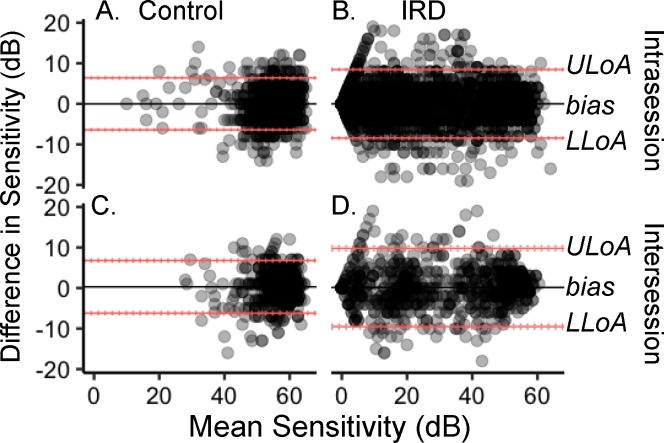
Dark-adapted visual fields were obtained from patients with inherited retinal degeneration (IRD) and controls to evaluate the effect that age, retinal region, and disease had on scotopic sensitivity. Intra- and intersession test-retest repeatabilities for patients and controls were measured to establish significant change for longitudinal studies.
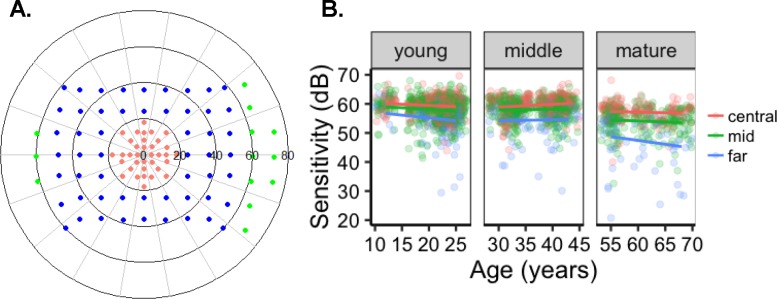
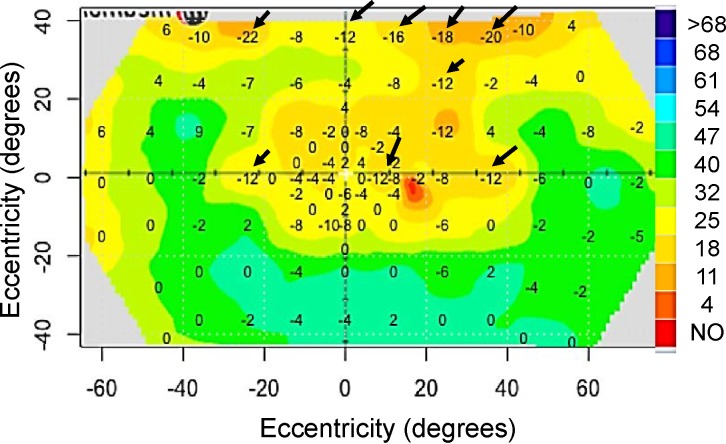
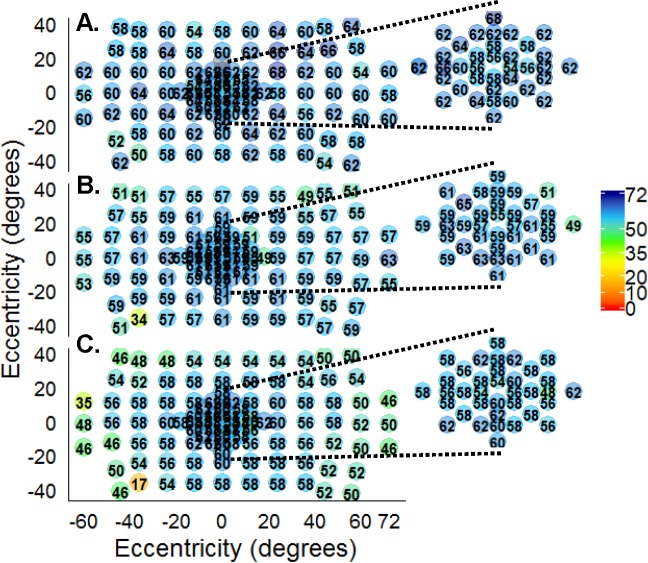
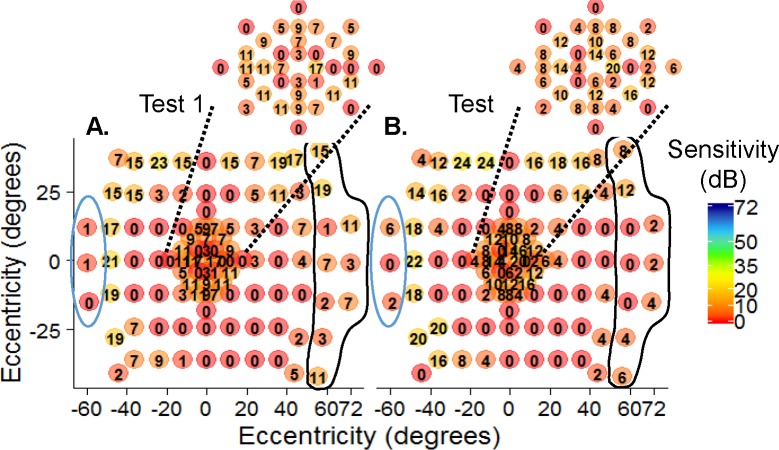
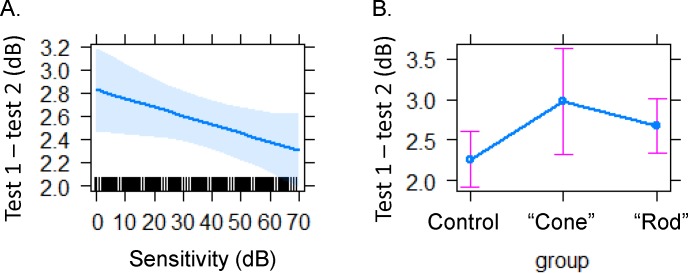
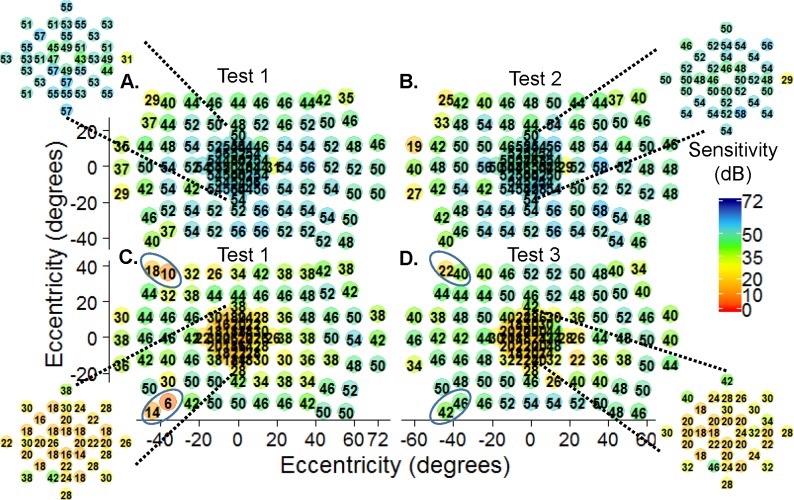
A total of 41 patients with IRD and 30 controls had one eye dilated and dark-adapted for 40 minutes. Scotopic sensitivity was measured with a Medmont dark-adapted chromatic (DAC) perimeter (size V stimulus, 200-ms duration, background luminance < 0.0001 cd/m2, dynamic range 0-75 decibel [dB]). Mixed effects analysis was performed to analyze age, retinal eccentricity, and sensitivity. The intra-/intersession coefficients of repeatability (CR) were calculated for controls and patients with IRD.
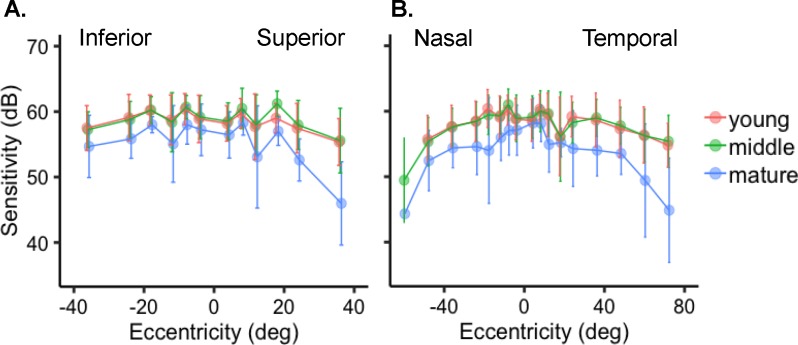
Each additional year was associated with lower sensitivity (-0.22 dB) per year in normal controls over age 50 compared to younger controls (12-49 years). The superior field had lower sensitivity than the inferior, but the nasal field was not different compared to the temporal field in normal controls. The CR for intra- and intersession testing on mean sensitivity (MS)/pointwise sensitivity (PWS) were ±1.5/±8.5 and ±3.3/±9.8 dB, respectively, for patients with IRD. Control MS/PWS CR were ±1.5/±6.1 dB for intrasession and ±1.7/±6.8 dB for intersession DAC perimetry.
The DAC perimeter is an important asset because it tests a wide field of scotopic vision. The CR are comparable to those of other perimetry devices. Effects of age and retinal region should be considered when assessing scotopic sensitivity measured with the DAC perimeter.
对遗传性视网膜变性 (IRD) 患者和对照者进行暗适应视野检查,以评估年龄、视网膜区域和疾病对暗适应敏感性的影响。测量患者和对照者的内-间测试-重测重复性,以确定纵向研究中的显著变化。
共有 41 名 IRD 患者和 30 名对照者一只眼睛散瞳并暗适应 40 分钟。使用 Medmont 暗适应彩色 (DAC) 周边仪 (大小 V 刺激,200ms 持续时间,背景亮度<0.0001 cd/m2,动态范围 0-75 分贝 [dB]) 测量暗适应敏感性。采用混合效应分析方法分析年龄、视网膜偏心度和敏感性。计算对照者和 IRD 患者的内-间重复可重复性 (CR) 系数。
与年轻对照组 (12-49 岁) 相比,正常对照组中每增加 1 岁,50 岁以上患者的敏感性每年降低 0.22dB。与正常对照组相比,上视野的敏感性较低,而鼻侧视野与颞侧视野无差异。IRD 患者的内-间测试平均敏感性 (MS)/点敏感性 (PWS) 的 CR 分别为±1.5/±8.5 和±3.3/±9.8dB,而 IRD 患者的内-间测试 MS/PWS 的 CR 分别为±1.5/±6.1dB 和±1.7/±6.8dB。
DAC 周边仪是一种重要的资产,因为它可以测试广泛的暗适应视野。CR 与其他周边仪设备相当。在使用 DAC 周边仪评估暗适应敏感性时,应考虑年龄和视网膜区域的影响。