Wellcome Centre for Human Neuroimaging, UCL Queen Square Institute of Neurology, University College London, London WC1N 3AR, United Kingdom.
Wellcome Centre for Human Neuroimaging, UCL Queen Square Institute of Neurology, University College London, London WC1N 3AR, United Kingdom
J Neurosci. 2019 May 29;39(22):4375-4386. doi: 10.1523/JNEUROSCI.2497-18.2019. Epub 2019 Mar 22.
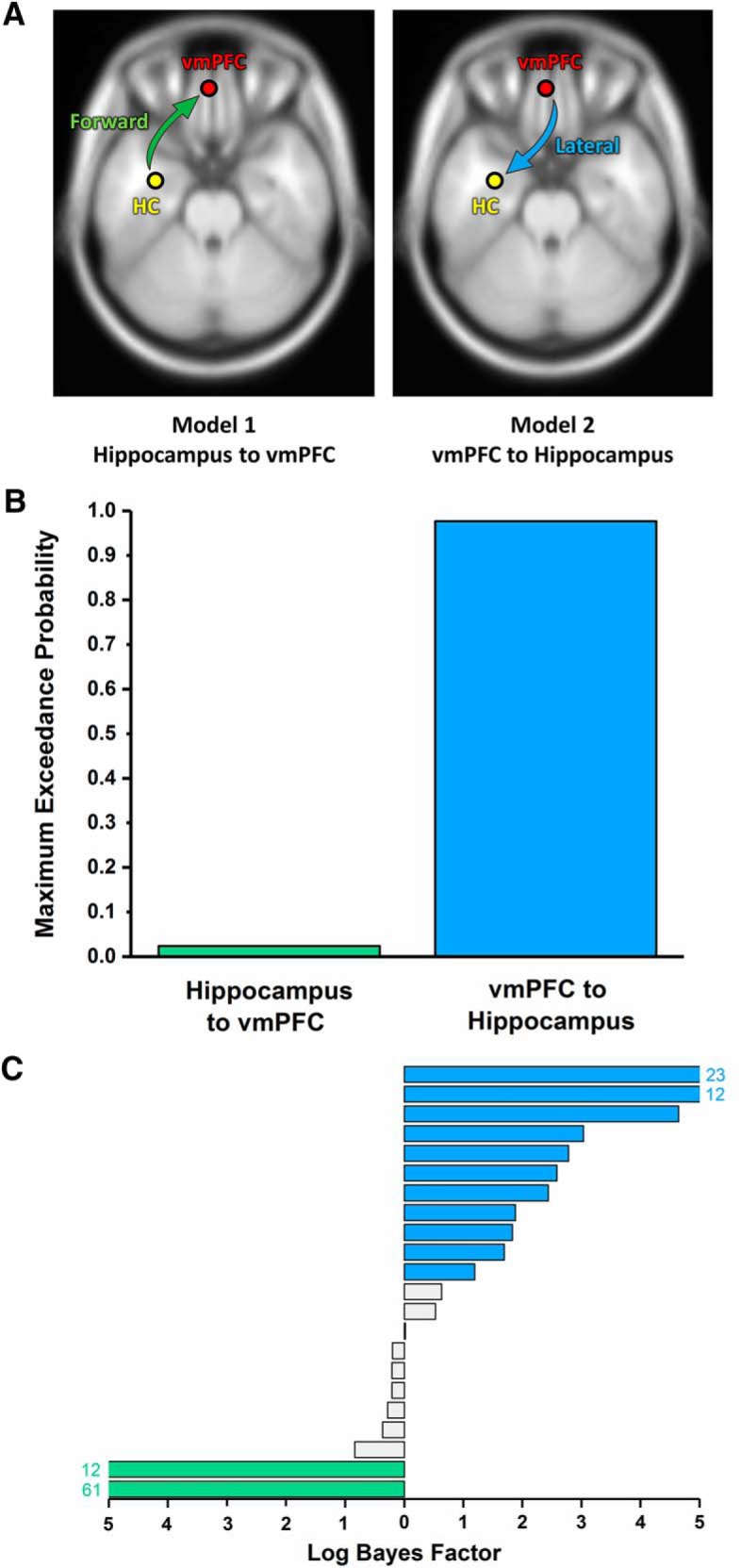
Retrieval of long-term episodic memories is characterized by synchronized neural activity between hippocampus and ventromedial prefrontal cortex (vmPFC), with additional evidence that vmPFC activity leads that of the hippocampus. It has been proposed that the mental generation of scene imagery is a crucial component of episodic memory processing. If this is the case, then a comparable interaction between the two brain regions should exist during the construction of novel scene imagery. To address this question, we leveraged the high temporal resolution of MEG to investigate the construction of novel mental imagery. We tasked male and female humans with imagining scenes and single isolated objects in response to one-word cues. We performed source-level power, coherence, and causality analyses to characterize the underlying interregional interactions. Both scene and object imagination resulted in theta power changes in the anterior hippocampus. However, higher theta coherence was observed between the hippocampus and vmPFC in the scene compared with the object condition. This interregional theta coherence also predicted whether imagined scenes were subsequently remembered. Dynamic causal modeling of this interaction revealed that vmPFC drove activity in hippocampus during novel scene construction. Additionally, theta power changes in the vmPFC preceded those observed in the hippocampus. These results constitute the first evidence in humans that episodic memory retrieval and scene imagination rely on similar vmPFC-hippocampus neural dynamics. Furthermore, they provide support for theories emphasizing similarities between both cognitive processes and perspectives that propose the vmPFC guides the construction of context-relevant representations in the hippocampus. Episodic memory retrieval is characterized by a dialog between hippocampus and ventromedial prefrontal cortex (vmPFC). It has been proposed that the mental generation of scene imagery is a crucial component of episodic memory processing. An ensuing prediction would be of a comparable interaction between the two brain regions during the construction of novel scene imagery. Here, we leveraged the high temporal resolution of MEG and combined it with a scene imagination task. We found that a hippocampal-vmPFC dialog existed and that it took the form of vmPFC driving the hippocampus. We conclude that episodic memory and scene imagination share fundamental neural dynamics and the process of constructing vivid, spatially coherent, contextually appropriate scene imagery is strongly modulated by vmPFC.
长时情景记忆的提取以海马体和腹内侧前额叶皮层(vmPFC)之间的同步神经活动为特征,并有额外的证据表明 vmPFC 的活动先于海马体。有人提出,情景意象的心理生成是情景记忆处理的一个关键组成部分。如果是这样的话,那么在构建新的情景意象时,这两个大脑区域之间应该存在类似的相互作用。为了解决这个问题,我们利用 MEG 的高时间分辨率来研究新的心理意象的构建。我们让男性和女性人类根据一个单词的提示来想象场景和单个孤立的物体。我们进行了源级功率、相干性和因果分析,以描述潜在的区域间相互作用。场景和物体想象都会导致前海马体的θ功率变化。然而,在场景条件下,海马体和 vmPFC 之间观察到更高的θ相干性。这种区域间的θ相干性也预测了想象的场景是否随后被记住。对这种相互作用的动态因果建模表明,在构建新场景时,vmPFC 驱动海马体的活动。此外,vmPFC 中的θ功率变化先于海马体中的θ功率变化。这些结果构成了人类中第一个证据,表明情景记忆检索和场景想象依赖于相似的 vmPFC-海马体神经动力学。此外,它们为强调这两个认知过程相似性的理论提供了支持,并提出 vmPFC 指导海马体中与上下文相关的表示的构建。情景记忆检索的特征是海马体和腹内侧前额叶皮层(vmPFC)之间的对话。有人提出,情景意象的心理生成是情景记忆处理的一个关键组成部分。一个随之而来的预测是,在构建新的情景意象时,这两个大脑区域之间会存在类似的相互作用。在这里,我们利用 MEG 的高时间分辨率,并将其与情景想象任务相结合。我们发现存在海马体-vmPFC 对话,其形式为 vmPFC 驱动海马体。我们得出结论,情景记忆和场景想象共享基本的神经动力学,并且构建生动、空间连贯、上下文适当的场景意象的过程强烈受到 vmPFC 的调节。