Department of Computational Biology and Medical Sciences, Graduate School of Frontier Sciences, The University of Tokyo, Bldg. FSB-401, 5-1-5 Kashiwanoha, Kashiwa, Chiba, 277-8562, Japan.
Earth-Life Science Institute, Tokyo Institute of Technology, 2-12-1-IE-1, Ookayama, Meguro-ku, Tokyo, 152-8550, Japan.
Nat Commun. 2019 Mar 22;10(1):1325. doi: 10.1038/s41467-019-09147-4.
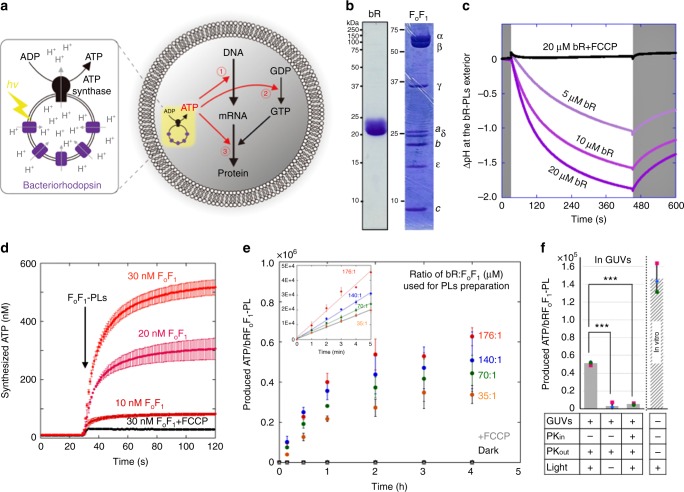
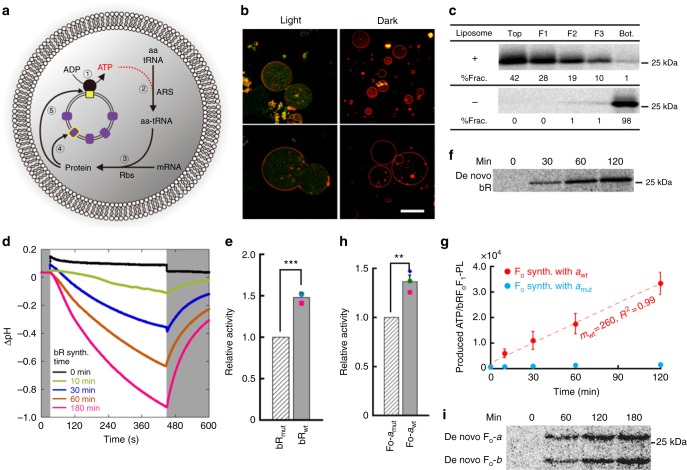
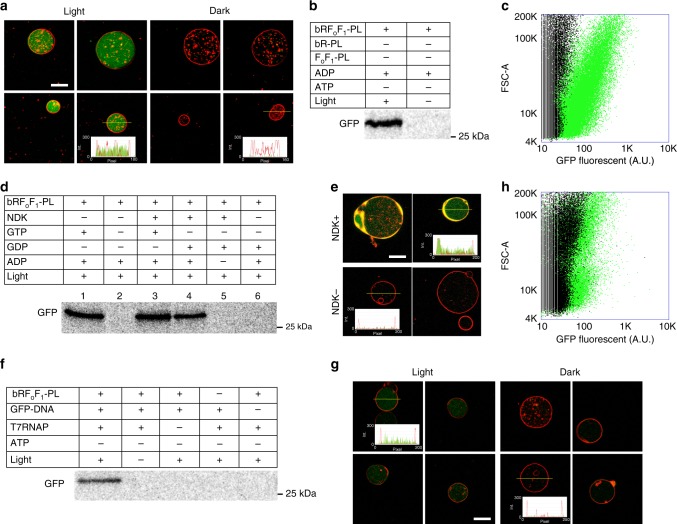
Attempts to construct an artificial cell have widened our understanding of living organisms. Many intracellular systems have been reconstructed by assembling molecules, however the mechanism to synthesize its own constituents by self-sufficient energy has to the best of our knowledge not been developed. Here, we combine a cell-free protein synthesis system and small proteoliposomes, which consist of purified ATP synthase and bacteriorhodopsin, inside a giant unilamellar vesicle to synthesize protein by the production of ATP by light. The photo-synthesized ATP is consumed as a substrate for transcription and as an energy for translation, eventually driving the synthesis of bacteriorhodopsin or constituent proteins of ATP synthase, the original essential components of the proteoliposome. The de novo photosynthesized bacteriorhodopsin and the parts of ATP synthase integrate into the artificial photosynthetic organelle and enhance its ATP photosynthetic activity through the positive feedback of the products. Our artificial photosynthetic cell system paves the way to construct an energetically independent artificial cell.
尝试构建人工细胞拓宽了我们对生物体的理解。许多细胞内系统已经通过组装分子被重建,然而,据我们所知,还没有开发出通过自给自足的能量来合成自身成分的机制。在这里,我们将无细胞蛋白合成系统与小的类脂体结合在一起,类脂体由纯化的 ATP 合酶和菌紫质组成,位于一个巨大的单层囊泡内,通过光产生的 ATP 进行蛋白合成。光合成的 ATP 被用作转录的底物,并作为翻译的能量,最终驱动菌紫质或 ATP 合酶的组成蛋白的合成,这是类脂体的原始必需成分。新合成的菌紫质和 ATP 合酶的部分整合到人工光合细胞器中,并通过产物的正反馈增强其 ATP 光合活性。我们的人工光合作用细胞系统为构建一个能量独立的人工细胞铺平了道路。