Kaiser Permanente Washington Health Research Institute, Kaiser Permanente Washington, Seattle, WA, USA.
Department of Medicine, Division of General Internal Medicine, University of Washington, Seattle, WA, USA.
J Alzheimers Dis. 2019;68(3):1071-1083. doi: 10.3233/JAD-180942.
Past research has focused on risk factors for developing dementia, with increasing recognition of "resilient" people who live to old age with intact cognitive function despite pathological features of Alzheimer's disease (AD).
To evaluate demographic factors, mid-life characteristics, and non-AD neuropathology findings that may be associated with cognitive resilience to AD pathology.
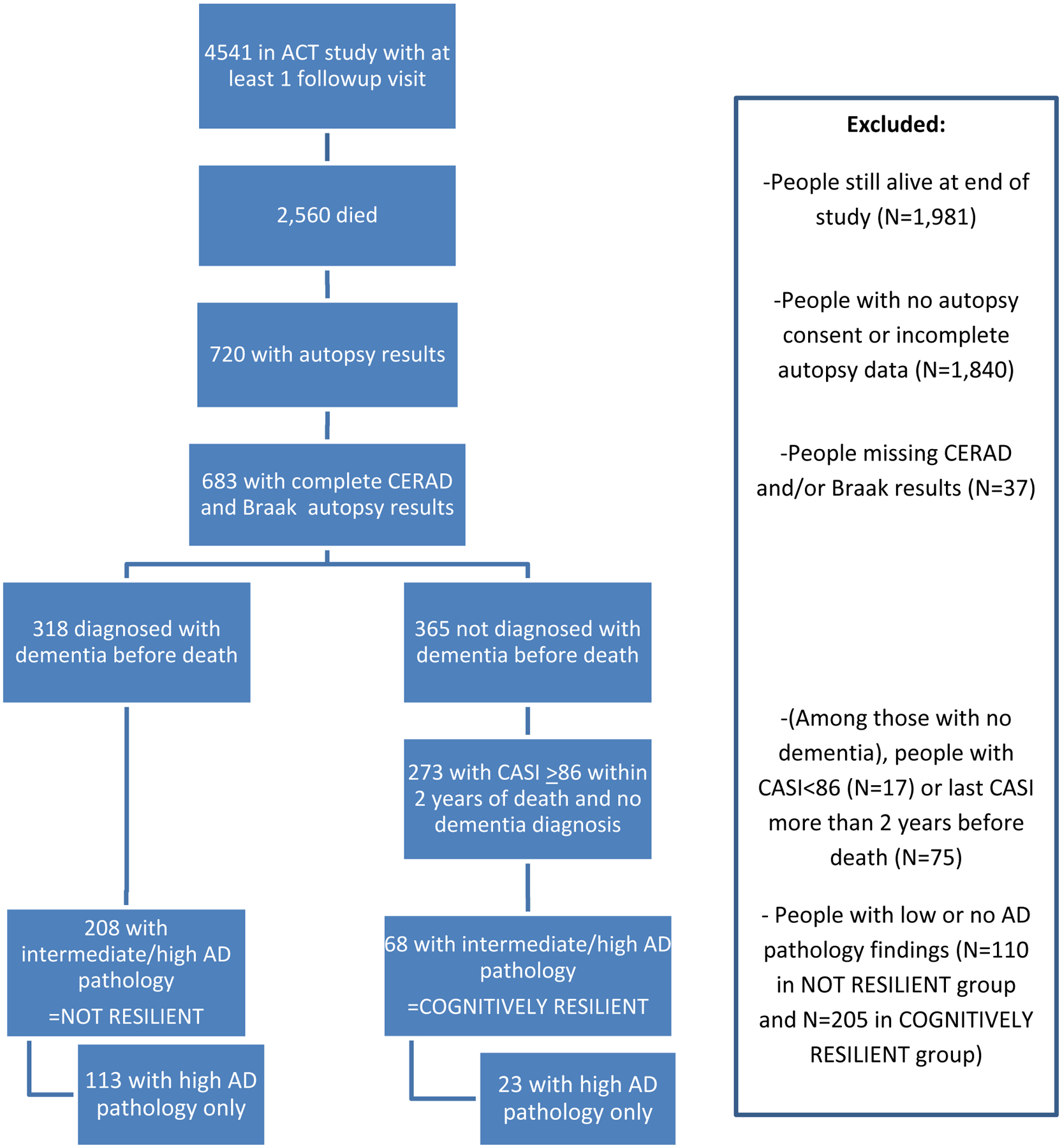
We analyzed data from 276 autopsy cases with intermediate or high levels of AD pathology from the Adult Changes in Thought study. We defined cognitive resilience as having Cognitive Abilities Screening Instrument scores ≥86 within two years of death and no clinical dementia diagnosis; non-resilient people had dementia diagnoses from AD or other causes before death. We compared mid-life characteristics, demographics, and additional neuropathology findings between resilient and non-resilient people. We used multivariable logistic regression to estimate odds ratios (ORs) with 95% confidence intervals (CIs) for being resilient compared to not being resilient adjusting for demographic and neuropathology factors.
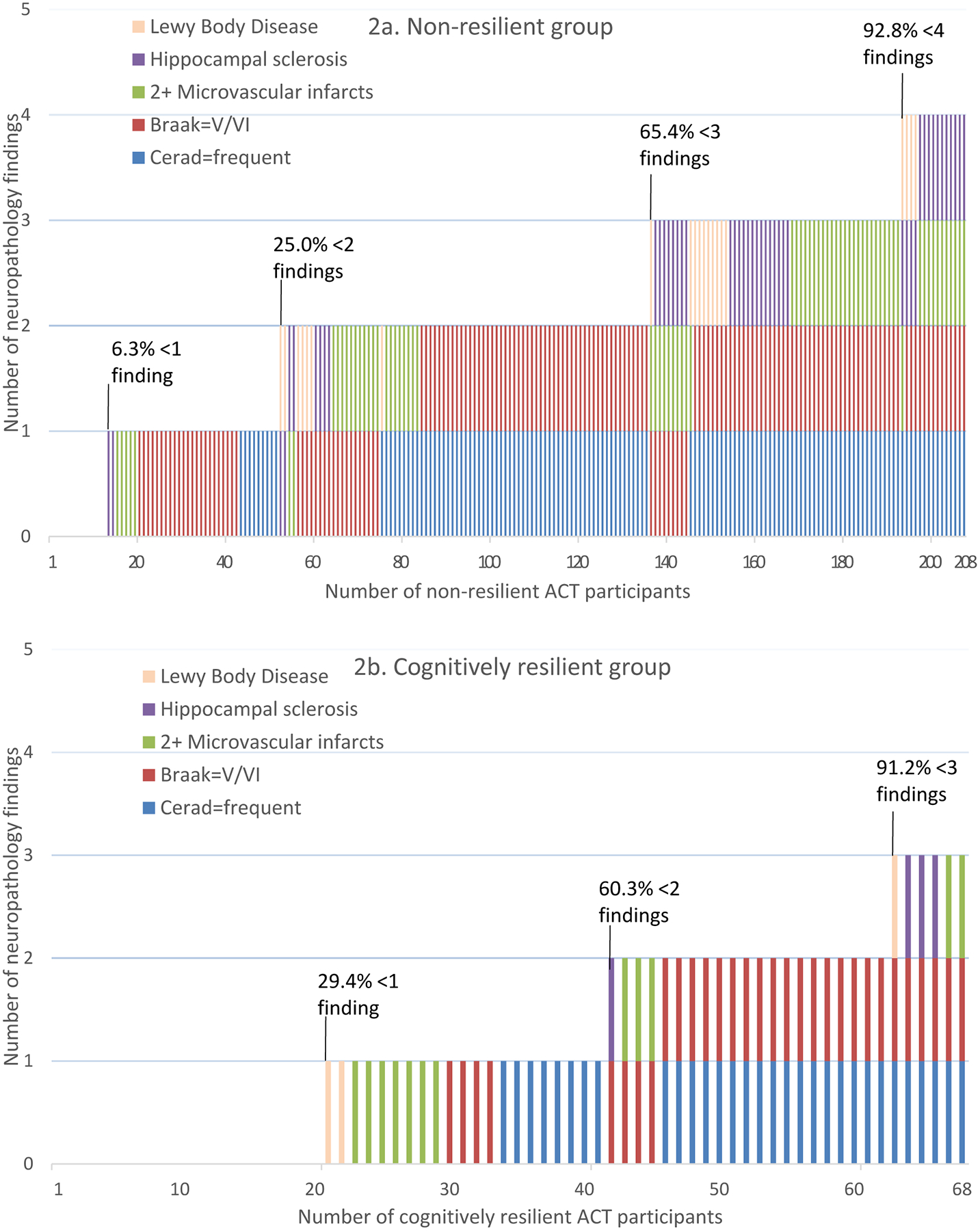
We classified 68 (25%) people as resilient and 208 (75%) as not resilient. A greater proportion of resilient people had a college degree (50%) compared with non-resilient (32%, p = 0.01). The odds of being resilient were significantly increased among people with a college education (OR = 2.01, 95% CI = 1.01-3.99) and significantly reduced among people with additional non-AD neuropathology findings such as hippocampal sclerosis (OR = 0.28, 95% CI = 0.09-0.89) and microinfarcts (OR = 0.34, 95% CI = 0.15-0.78).
Increased education and absence of non-AD pathology may be independently associated with cognitive resilience, highlighting the importance of evaluating co-morbid factors in future research on mechanisms of cognitive resilience.
过去的研究集中在痴呆症的风险因素上,越来越多的人认识到“有韧性”的人,尽管存在阿尔茨海默病(AD)的病理特征,但他们能活到老年,认知功能完好。
评估与 AD 病理认知弹性相关的人口统计学因素、中年特征和非 AD 神经病理学发现。
我们分析了来自成人思维变化研究的 276 例 AD 病理中度或高度水平的尸检病例数据。我们将认知弹性定义为在死亡前两年内认知能力筛查工具(Cognitive Abilities Screening Instrument)评分≥86 且无临床痴呆诊断;非弹性人群在死亡前有 AD 或其他原因导致的痴呆诊断。我们比较了弹性和非弹性人群的中年特征、人口统计学和其他神经病理学发现。我们使用多变量逻辑回归来估计调整人口统计学和神经病理学因素后与不具有弹性相比具有弹性的优势比(OR)及其 95%置信区间(CI)。
我们将 68 人(25%)分类为具有弹性,208 人(75%)为不具有弹性。具有弹性的人具有大学学历的比例(50%)明显高于非弹性的人(32%,p=0.01)。具有大学学历的人具有弹性的几率显著增加(OR=2.01,95%CI=1.01-3.99),而具有其他非 AD 神经病理学发现(如海马硬化症(OR=0.28,95%CI=0.09-0.89)和微梗死(OR=0.34,95%CI=0.15-0.78)的人具有弹性的几率显著降低。
教育程度的提高和非 AD 病理学的缺失可能与认知弹性独立相关,这突出表明在未来关于认知弹性机制的研究中,评估合并症因素的重要性。