Department of Ophthalmology, University of Washington, Seattle, WA, USA.
Department of Laboratory Medicine and Pathology, University of Washington, Seattle, WA, USA.
Brain Pathol. 2021 Nov;31(6):e12974. doi: 10.1111/bpa.12974. Epub 2021 May 19.
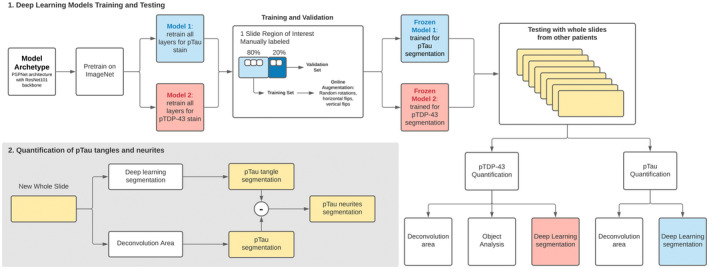
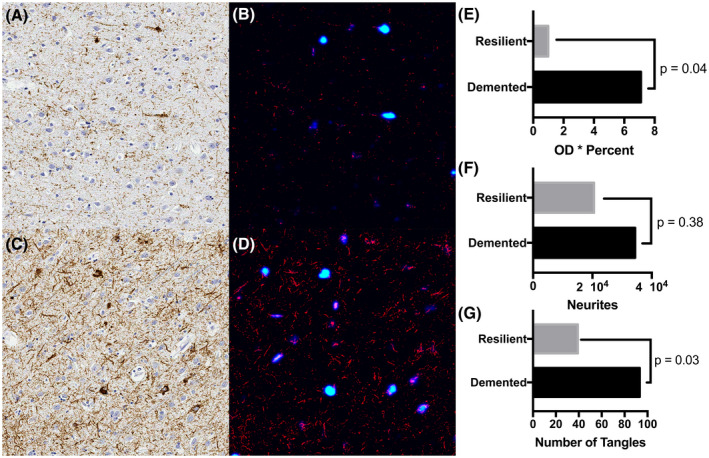
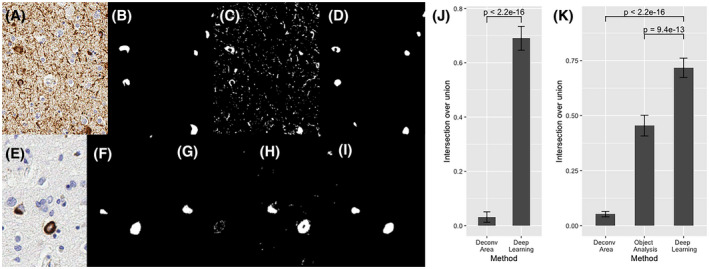
People who have Alzheimer's disease neuropathologic change (ADNC) typically associated with dementia but not the associated cognitive decline can be considered to be "resilient" to the effects of ADNC. We have previously reported lower neocortical levels of hyperphosphorylated tau (pTau) and less limbic-predominant age-related TDP-43 encephalopathy neuropathologic change (LATE-NC) in the resilient participants compared to those with dementia and similar ADNC as determined by current NIA-AA recommendations using traditional semi-quantitative assessments of amyloid β and pathological tau burden. To better understand differences between AD-dementia and resilient participants, we developed and applied a deep learning approach to analyze the neuropathology of 14 brain donors from the Adult Changes in Thought study, including seven stringently defined resilient participants and seven age-matched AD-dementia controls. We created two novel, fully automated deep learning algorithms to quantify the level of phosphorylated TDP-43 (pTDP-43) and pTau in whole slide imaging. The models performed better than traditional techniques for quantifying pTDP-43 and pTau. The second model was able to segment lesions staining for pTau into neurofibrillary tangles (NFTs) and tau neurites (neuronal processes positive for pTau). Both groups had similar quantities of pTau localizing to neurites, but the pTau burden associated with NFTs in the resilient group was significantly lower compared to the group with dementia. These results validate use of deep learning approaches to quantify clinically relevant microscopic characteristics from neuropathology workups. These results also suggest that the burden of NFTs is more strongly associated with cognitive impairment than the more diffuse neuritic tau commonly seen with tangle pathology and suggest that additional factors may underlie resilience mechanisms defined by traditional means.
患有阿尔茨海默病神经病理改变(ADNC)的人通常与痴呆症相关,但与认知能力下降无关,可被认为对 ADNC 的影响具有“弹性”。我们之前曾报道过,与痴呆症患者和根据当前 NIA-AA 建议使用传统半定量评估淀粉样蛋白β和病理性 tau 负担确定的具有相似 ADNC 的患者相比,具有弹性的参与者的新皮质中磷酸化 tau(pTau)水平较低,且边缘为主的年龄相关性 TDP-43 脑淀粉样血管病神经病理改变(LATE-NC)较少。为了更好地理解 AD-痴呆症和具有弹性的参与者之间的差异,我们开发并应用了深度学习方法来分析来自成人思维变化研究的 14 名脑供体的神经病理学,包括 7 名严格定义的具有弹性的参与者和 7 名年龄匹配的 AD-痴呆症对照。我们创建了两个新的、完全自动化的深度学习算法来定量全幻灯片成像中磷酸化 TDP-43(pTDP-43)和 pTau 的水平。该模型在定量 pTDP-43 和 pTau 方面的表现优于传统技术。第二个模型能够将 pTau 染色的病变分割为神经原纤维缠结(NFTs)和 tau 神经元(pTau 阳性的神经元过程)。两组的 pTau 定位到神经元的数量相似,但与痴呆症组相比,具有弹性的组中的 NFT 相关的 pTau 负担明显较低。这些结果验证了使用深度学习方法从神经病理学检查中定量具有临床相关性的微观特征。这些结果还表明,与更常见的与缠结病理学相关的神经原纤维缠结tau 相比,NFT 负担与认知障碍的相关性更强,并表明传统方法定义的弹性机制可能存在其他因素。