Rothamsted Research, West Common, Harpenden, Hertfordshire AL5 2JQ, UK.
Molecules. 2019 Mar 23;24(6):1152. doi: 10.3390/molecules24061152.
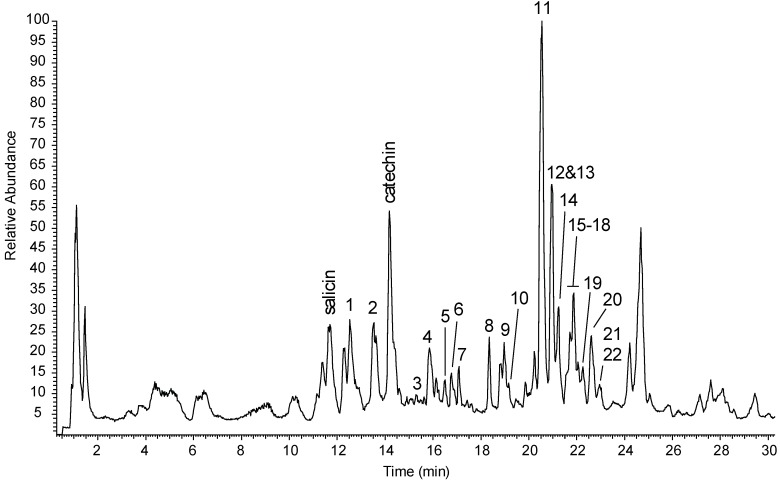
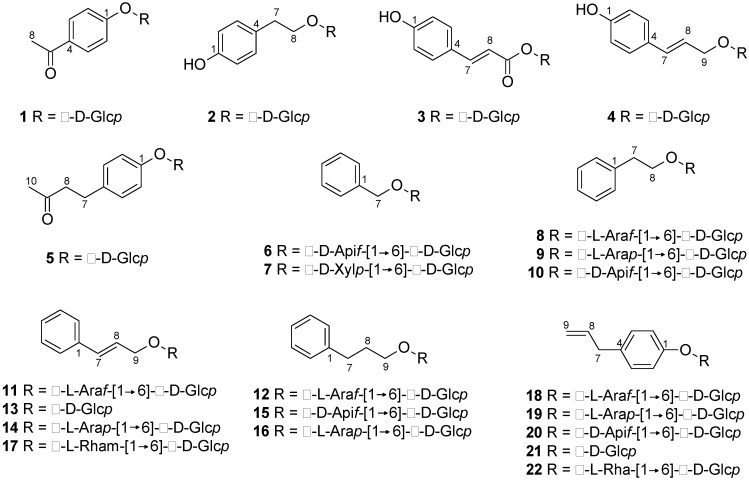
(almond leaved willow) is an established crop, grown in coppicing regimes for basket-making materials. It is known as a source of non-salicinoid phenolic glycosides, such as triandrin and salidroside. A spontaneous natural hybrid of and was subjected to metabolite profiling by high resolution LC-MS, and 22 phenolic glycosides, including 18 that are new to the Salicaceae, were identified. Structures were determined by HPLC isolation and NMR methods. The hybridisation process has introduced novel chemistry into the Salix phenolic glycoside palette, in particular, the ability to generate disaccharide conjugates where the glycosyl group is further extended by a range of sugars, including apiose, rhamnose, xylose, and arabinose. Also of note is the appearance of chavicol derivatives, also not previously seen in spp. The work demonstrates the plasticity of the phenolic glycoside biosynthetic pathway, and the potential to improve established crops such as and , via high-value metabolites, for both basketry and bioenergy markets.
(垂柳)是一种已被广泛种植的作物,通常以萌生方式栽培,用于制作篮子等手工艺品。它是一种非水杨酸类酚糖苷的来源,如 triandrin 和 salidroside。 和 的自然杂交种被进行了高分辨 LC-MS 的代谢物分析,鉴定出 22 种酚糖苷,其中 18 种是柳科的新物质。结构通过 HPLC 分离和 NMR 方法确定。杂交过程为柳属酚糖苷库引入了新的化学物质,特别是能够生成二糖缀合物的能力,其中糖基通过一系列糖进一步扩展,包括芹糖、鼠李糖、木糖和阿拉伯糖。值得注意的是,chavicol 衍生物的出现,在以前的 spp 中也没有见过。这项工作展示了酚糖苷生物合成途径的可塑性,以及通过高价值代谢物来改善现有作物(如 和 )的潜力,以满足篮子和生物能源市场的需求。