Key Laboratory of Animal Nutrition and Feed Science (South China) of Ministry of Agriculture, State Key Laboratory of Livestock and Poultry Breeding, Guangdong Public Laboratory of Animal Breeding and Nutrition, Guangdong Key Laboratory of Animal Breeding and Nutrition, Institute of Animal Science, Guangdong Academy of Agricultural Sciences, Guangzhou 510640, China.
Department of Animal Production, Faculty of Agriculture, Cairo University, Giza 12613, Egypt.
Toxins (Basel). 2019 Mar 23;11(3):176. doi: 10.3390/toxins11030176.
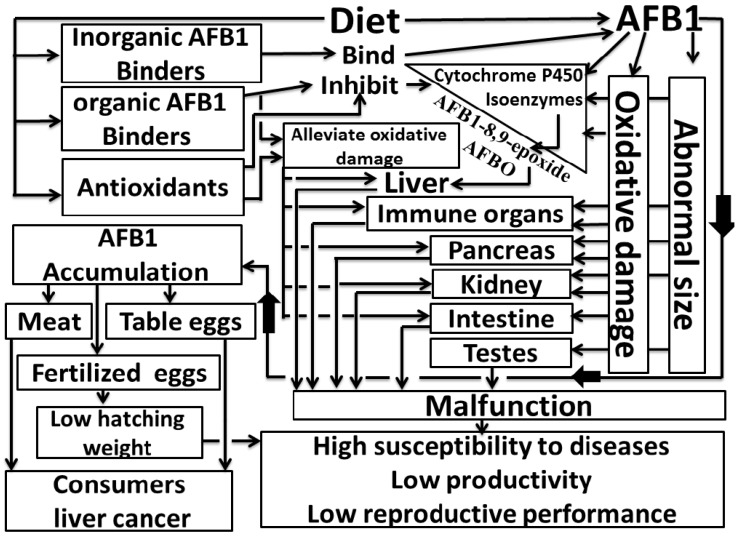
The presence of aflatoxin B₁ (AFB₁) in poultry diets decreases the hatchability, hatchling weight, growth rate, meat and egg production, meat and egg quality, vaccination efficiency, as well as impairing the feed conversion ratio and increasing the susceptibility of birds to disease and mortality. AFB₁ is transferred from poultry feed to eggs, meat, and other edible parts, representing a threat to the health of consumers because AFB₁ is carcinogenic and implicated in human liver cancer. This review considers how AFB₁ produced by and strains can affect the immune system, antioxidant defense system, digestive system, and reproductive system in poultry, as well as its effects on productivity and reproductive performance. Nutritional factors can offset the effects of AFB₁ in poultry and, thus, it is necessary to identify and select suitable additives to address the problems caused by AFB₁ in poultry.
黄曲霉毒素 B₁(AFB₁)存在于家禽饲料中会降低孵化率、雏鸡体重、生长速度、产肉和产蛋量、肉和蛋的质量、疫苗效率,并降低饲料转化率,增加鸟类对疾病和死亡率的易感性。AFB₁ 从家禽饲料转移到鸡蛋、肉和其他可食用部分,对消费者的健康构成威胁,因为 AFB₁具有致癌性,并与人类肝癌有关。本综述考虑了 和 菌株产生的 AFB₁ 如何影响家禽的免疫系统、抗氧化防御系统、消化系统和生殖系统,以及其对生产性能和繁殖性能的影响。营养因素可以抵消 AFB₁ 在家禽中的作用,因此有必要识别和选择合适的添加剂来解决 AFB₁ 给家禽带来的问题。