• 文献检索
  • 文档翻译
  • 深度研究
  • 学术资讯
  • Suppr Zotero 插件Zotero 插件
  • 邀请有礼
  • 套餐&价格
  • 历史记录
应用&插件
Suppr Zotero 插件Zotero 插件浏览器插件Mac 客户端Windows 客户端微信小程序
定价
高级版会员购买积分包购买API积分包
服务
文献检索文档翻译深度研究API 文档MCP 服务
关于我们
关于 Suppr公司介绍联系我们用户协议隐私条款
关注我们

Suppr 超能文献

核心技术专利:CN118964589B侵权必究
粤ICP备2023148730 号-1Suppr @ 2026

文献检索

告别复杂PubMed语法,用中文像聊天一样搜索,搜遍4000万医学文献。AI智能推荐,让科研检索更轻松。

立即免费搜索

文件翻译

保留排版,准确专业,支持PDF/Word/PPT等文件格式,支持 12+语言互译。

免费翻译文档

深度研究

AI帮你快速写综述,25分钟生成高质量综述,智能提取关键信息,辅助科研写作。

立即免费体验

耳鸣患者的抑郁状况:一项系统性综述。

Depression in Patients with Tinnitus: A Systematic Review.

机构信息

1 Department of Medicine, University of California, San Francisco, California, USA.

2 Department of Neurology, University of California, San Francisco, California, USA.

出版信息

Otolaryngol Head Neck Surg. 2019 Jul;161(1):28-35. doi: 10.1177/0194599819835178. Epub 2019 Mar 26.

DOI:10.1177/0194599819835178
PMID:30909841
原文链接:https://pmc.ncbi.nlm.nih.gov/articles/PMC7721477/
Abstract

OBJECTIVE

Tinnitus is a condition that causes distress and impairment across cognitive, functional, and psychiatric spectra. In the psychiatric realm, tinnitus has long been associated with depression. To better characterize the co-occurrence of depression and tinnitus, we performed a systematic review of the prevalence of depression among patients with tinnitus.

DATA SOURCES

We comprehensively examined original studies reporting the prevalence of depression in adult populations with tinnitus, as indexed in the PubMed and Web of Science databases and published from January 2006 to August 2016.

REVIEW METHODS

All identified articles were reviewed independently by 2 researchers, with a third reviewer for adjudication. Included studies were evaluated for threats to validity across 3 domains-representativeness, response rate, and ascertainment of outcome-on a 4-point modified Newcastle-Ottawa Quality Assessment Scale.

RESULTS

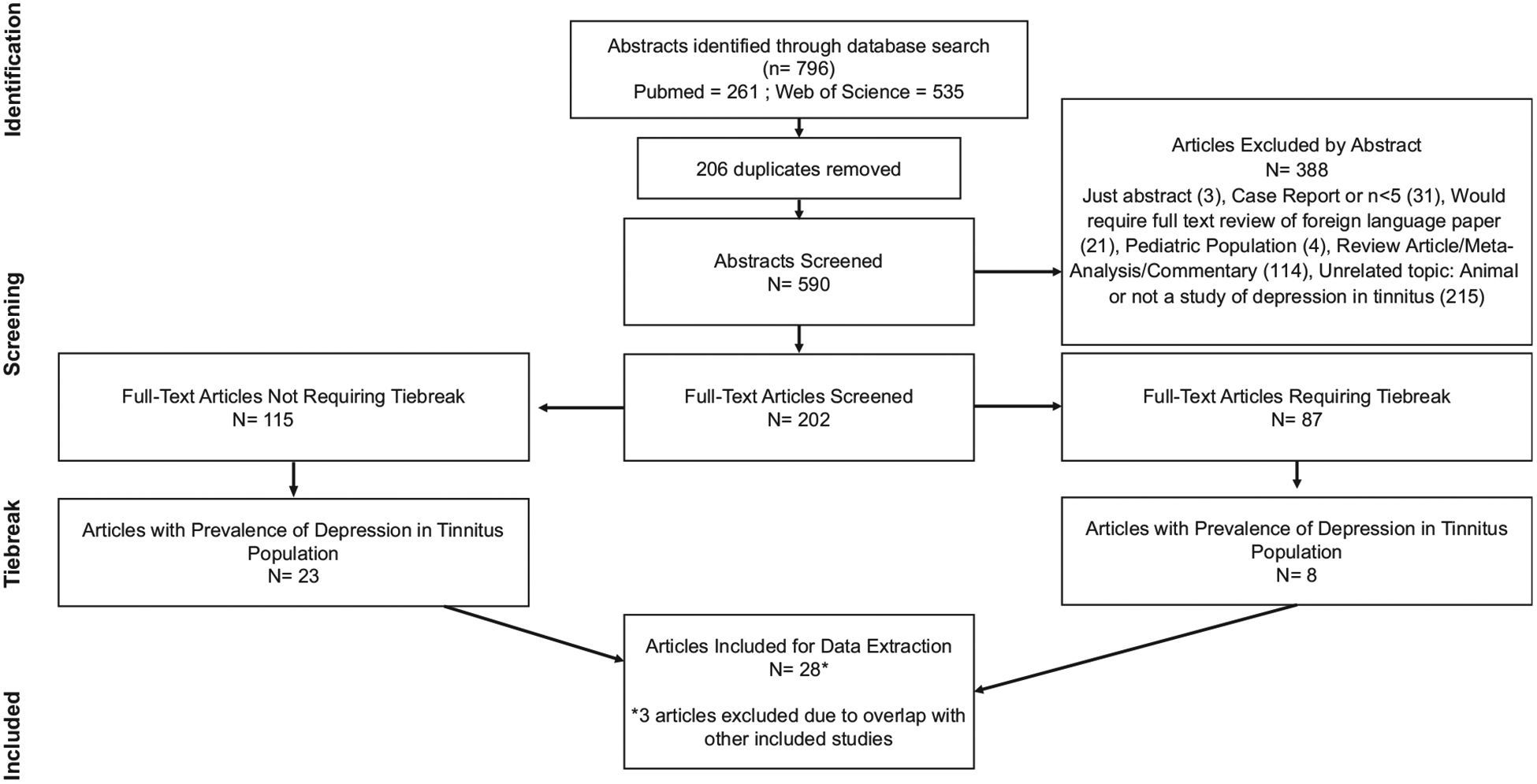
Twenty-eight studies were included, representing 15 countries and 9979 patients with tinnitus. Among the included studies, the median prevalence of depression was 33%, with an interquartile range of 19% to 49% and an overall range of 6% to 84%. Studies were high quality overall, with a mean score of 3.3 (SD = 0.76), and 89% utilized a validated tool to ascertain depression.

CONCLUSIONS

We conducted one of the largest contemporary comprehensive reviews, which suggests a 33% prevalence of depression among patients with tinnitus. Our review reaffirms that a substantial proportion of patients with tinnitus have depression, and we recommend that all who treat tinnitus should screen and treat their patients for depression, if present.

摘要

目的

耳鸣是一种会导致认知、功能和精神障碍的病症。在精神医学领域,耳鸣长期以来与抑郁症相关。为了更好地描述耳鸣与抑郁症的共同发生情况,我们对耳鸣患者中抑郁症的患病率进行了系统回顾。

资料来源

我们全面检索了 PubMed 和 Web of Science 数据库中 2006 年 1 月至 2016 年 8 月发表的关于成年耳鸣患者中抑郁症患病率的原始研究,并索引了这些研究。

综述方法

由 2 名研究人员独立审查所有确定的文章,并由第 3 名评审员进行裁决。对纳入的研究从代表性、应答率和结局确定 3 个方面进行了 4 分制改良 Newcastle-Ottawa 质量评估量表评估。

结果

共纳入 28 项研究,代表了 15 个国家的 9979 名耳鸣患者。纳入研究中,抑郁症的中位数患病率为 33%,四分位距为 19%至 49%,总体范围为 6%至 84%。研究整体质量较高,平均得分为 3.3(标准差=0.76),89%的研究使用了经过验证的工具来确定抑郁症。

结论

我们进行了一次当代最大规模的综合回顾之一,表明耳鸣患者中抑郁症的患病率为 33%。我们的综述再次证实,相当一部分耳鸣患者患有抑郁症,我们建议所有治疗耳鸣的医生都应筛查并治疗存在的抑郁症状。
https://cdn.ncbi.nlm.nih.gov/pmc/blobs/a602/7721477/f43b4a1a1a6e/nihms-1650394-f0001.jpg

相似文献

1
Depression in Patients with Tinnitus: A Systematic Review.耳鸣患者的抑郁状况:一项系统性综述。
Otolaryngol Head Neck Surg. 2019 Jul;161(1):28-35. doi: 10.1177/0194599819835178. Epub 2019 Mar 26.
2
Systematic review on the evidences of an association between tinnitus and depression.耳鸣与抑郁相关性的系统评价研究。
Braz J Otorhinolaryngol. 2013 Jan-Feb;79(1):106-11. doi: 10.5935/1808-8694.20130018.
3
Tinnitus and its association with psychiatric disorders: systematic review.耳鸣及其与精神障碍的关联:系统评价
J Laryngol Otol. 2014 Aug;128(8):660-4. doi: 10.1017/S0022215114001030. Epub 2014 Jul 17.
4
Tinnitus Patients Suffering from Anxiety and Depression: A Review.患有焦虑和抑郁的耳鸣患者:综述
Int Tinnitus J. 2017 Jun 1;21(1):68-73. doi: 10.5935/0946-5448.20170013.
5
Tinnitus and the prevalence of co-morbid psychological stress.耳鸣与共病心理应激的患病率
Niger J Med. 2008 Jan-Mar;17(1):95-7. doi: 10.4314/njm.v17i1.37365.
6
Correlation Between Chronic Tinnitus Distress and Symptoms of Depression: A Systematic Review.慢性耳鸣困扰与抑郁症状之间的相关性:一项系统综述。
Front Neurol. 2022 May 2;13:870433. doi: 10.3389/fneur.2022.870433. eCollection 2022.
7
Tinnitus in Temporomandibular Disorders patients: any clinical implications from research findings?颞下颌关节紊乱病患者的耳鸣:研究结果有何临床意义?
Evid Based Dent. 2019 Mar;20(1):30-31. doi: 10.1038/s41432-019-0012-y.
8
A systematic review and meta-analysis of psychological functioning in chronic tinnitus.慢性耳鸣患者心理功能的系统评价和荟萃分析。
Clin Psychol Rev. 2018 Mar;60:62-86. doi: 10.1016/j.cpr.2017.12.006. Epub 2017 Dec 30.
9
The impact of Type D personality on health-related quality of life in tinnitus patients is mainly mediated by anxiety and depression.D 型人格特质对耳鸣患者健康相关生活质量的影响主要是通过焦虑和抑郁来介导的。
Otol Neurotol. 2010 Jan;31(1):11-8. doi: 10.1097/MAO.0b013e3181bc3dd1.
10
A systematic review of techniques and effects of self-help interventions for tinnitus: Application of taxonomies from health psychology.耳鸣自助干预技术与效果的系统评价:健康心理学分类法的应用
Int J Audiol. 2016 Jul;55 Suppl 3:S79-89. doi: 10.3109/14992027.2015.1137363. Epub 2016 May 5.

引用本文的文献

1
Identifying psychological and clinical risk factors for moderate-to-severe tinnitus in older patients with hearing loss: a multivariable prediction model.识别老年听力损失患者中重度耳鸣的心理和临床风险因素:多变量预测模型
Front Neurol. 2025 Jul 23;16:1647071. doi: 10.3389/fneur.2025.1647071. eCollection 2025.
2
When the Mind Meets the Ear: A Scoping Review on Tinnitus and Clinically Measured Psychiatric Comorbidities.当心灵与耳朵相遇:耳鸣与临床测量的精神共病的范围综述
J Clin Med. 2025 May 28;14(11):3785. doi: 10.3390/jcm14113785.
3
Development and Psychometric Validation of Tinnitus Qualities and Impact Questionnaire.

本文引用的文献

1
Prevalence of Depression Among Adults Aged 20 and Over: United States, 2013-2016.2013 - 2016年美国20岁及以上成年人中抑郁症的患病率
NCHS Data Brief. 2018 Feb(303):1-8.
2
A review of tinnitus.耳鸣研究综述。
Aust J Gen Pract. 2018 Apr;47(4):205-208. doi: 10.31128/AJGP-12-17-4420.
3
A systematic review and meta-analysis of psychological functioning in chronic tinnitus.慢性耳鸣患者心理功能的系统评价和荟萃分析。
耳鸣特质与影响问卷的编制及心理测量学验证
Clin Pract. 2025 Apr 27;15(5):87. doi: 10.3390/clinpract15050087.
4
Tinnitus Stepped-Care: A Model for Standardizing Clinical Services for Tinnitus.耳鸣阶梯式护理:一种规范耳鸣临床服务的模式。
Semin Hear. 2025 Mar 7;45(3-04):255-275. doi: 10.1055/s-0045-1804509. eCollection 2024 Aug.
5
Comparative Analysis of the Efficacy of Transcutaneous Electrical Nerve Stimulation in Somatic and Idiopathic Tinnitus Patients.经皮电刺激神经疗法对躯体性耳鸣和特发性耳鸣患者疗效的对比分析
Brain Behav. 2025 Mar;15(3):e70429. doi: 10.1002/brb3.70429.
6
ESR Essentials: diagnostic strategies in tinnitus-practice recommendations by the European Society of Head and Neck Radiology.红细胞沉降率要点:欧洲头颈放射学会关于耳鸣诊断策略的实践建议
Eur Radiol. 2025 Mar;35(3):1303-1312. doi: 10.1007/s00330-024-11316-z. Epub 2025 Jan 2.
7
A retrospective two-center cohort study of the bidirectional relationship between depression and tinnitus-related distress.一项关于抑郁症与耳鸣相关痛苦双向关系的回顾性双中心队列研究。
Commun Med (Lond). 2024 Nov 21;4(1):242. doi: 10.1038/s43856-024-00678-6.
8
A Prospective Self-Report Survey-Based Cohort Study on Factors That Have an Influence on Tinnitus.一项基于前瞻性自我报告调查的队列研究:关于影响耳鸣的因素
Audiol Res. 2024 Oct 10;14(5):875-892. doi: 10.3390/audiolres14050074.
9
Can Residual Inhibition Predict the Success of Sound Enrichment Treatment for Tinnitus?残余抑制能否预测耳鸣声治疗的疗效?
Brain Behav. 2024 Oct;14(10):e70083. doi: 10.1002/brb3.70083.
10
Is Transcutaneous Electrical Nerve Stimulation Therapy the Answer for Tinnitus: A Prospective Study.经皮电刺激神经疗法是耳鸣的解决之道吗:一项前瞻性研究。
Indian J Otolaryngol Head Neck Surg. 2024 Oct;76(5):4050-4055. doi: 10.1007/s12070-024-04778-6. Epub 2024 Jun 12.
Clin Psychol Rev. 2018 Mar;60:62-86. doi: 10.1016/j.cpr.2017.12.006. Epub 2017 Dec 30.
4
Prevalence, Severity, Exposures, and Treatment Patterns of Tinnitus in the United States.美国耳鸣的患病率、严重程度、暴露因素及治疗模式
JAMA Otolaryngol Head Neck Surg. 2016 Oct 1;142(10):959-965. doi: 10.1001/jamaoto.2016.1700.
5
Psychological mediators of chronic tinnitus: The critical role of depression.慢性耳鸣的心理调节因素:抑郁的关键作用。
J Affect Disord. 2016 Nov 1;204:234-40. doi: 10.1016/j.jad.2016.06.055. Epub 2016 Jun 21.
6
Anxiety and depression, personality traits relevant to tinnitus: A scoping review.焦虑和抑郁:与耳鸣相关的人格特质——一项范围综述
Int J Audiol. 2016 Nov;55(11):605-15. doi: 10.1080/14992027.2016.1198966. Epub 2016 Jul 7.
7
Effectiveness of sound therapy in patients with tinnitus resistant to previous treatments: importance of adjustments.声疗法对既往治疗无效的耳鸣患者的有效性:调整的重要性。
Braz J Otorhinolaryngol. 2016 May-Jun;82(3):297-303. doi: 10.1016/j.bjorl.2015.05.009. Epub 2015 Oct 16.
8
Multidisciplinary assessment of patients with musical hallucinations, tinnitus and hearing loss.对患有音乐幻觉、耳鸣和听力损失患者的多学科评估。
Psychopathology. 2015;48(4):251-5. doi: 10.1159/000435891. Epub 2015 Aug 12.
9
Relationship between tinnitus and suicidal behaviour in Korean men and women: a cross-sectional study.韩国男性和女性耳鸣与自杀行为之间的关系:一项横断面研究。
Clin Otolaryngol. 2016 Jun;41(3):222-7. doi: 10.1111/coa.12500. Epub 2016 Feb 4.
10
Severe to profound hearing impairment: quality of life, psychosocial consequences and audiological rehabilitation.重度至极重度听力障碍:生活质量、心理社会影响及听力学康复
Disabil Rehabil. 2015;37(20):1849-56. doi: 10.3109/09638288.2014.982833. Epub 2015 Jul 9.