Louis Calder Center, Fordham University, Armonk, New York 10504, USA.
Department of Biological Sciences, University of Memphis, Memphis, Tennessee 38152, USA.
Genome Res. 2019 May;29(5):762-770. doi: 10.1101/gr.235754.118. Epub 2019 Mar 25.
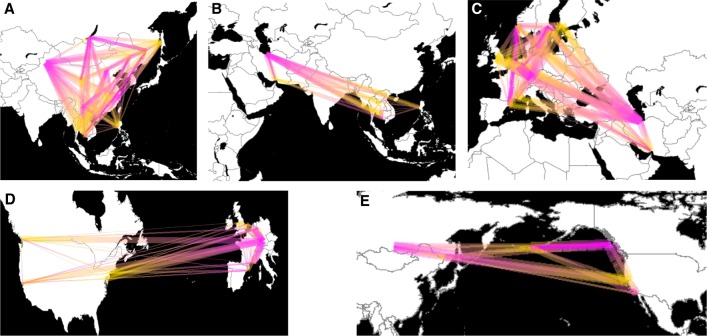
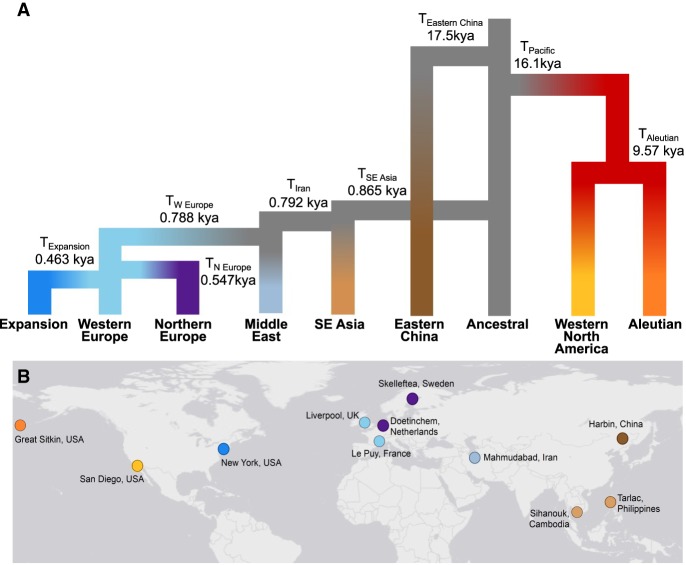
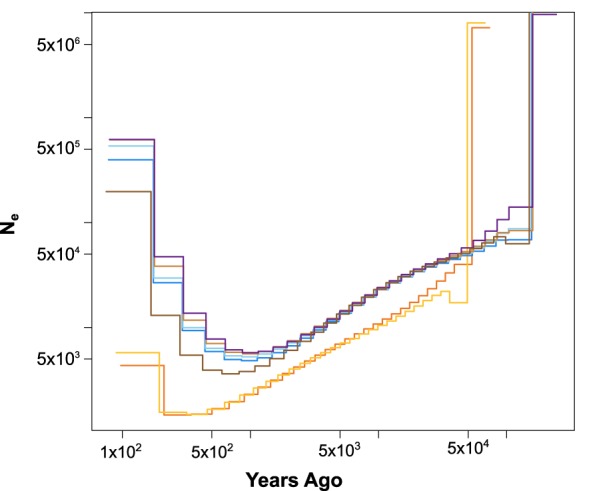
Fossil evidence indicates that the globally distributed brown rat () originated in northern China and Mongolia. Historical records report the human-mediated invasion of rats into Europe in the 1500s, followed by global spread because of European imperialist activity during the 1600s-1800s. We analyzed 14 genomes representing seven previously identified evolutionary clusters, and tested alternative demographic models to infer patterns of range expansion, divergence times, and changes in effective population ( ) size for this globally important pest species. We observed three range expansions from the ancestral population that produced the Pacific (diverged ∼16.1 kya), eastern China (∼17.5 kya), and Southeast (SE) Asia (∼0.86 kya) lineages. Our model shows a rapid range expansion from SE Asia into the Middle East and then continued expansion into central Europe 788 yr ago (1227 AD). We observed declining within all brown rat lineages from 150-1 kya, reflecting population contractions during glacial cycles. increased since 1 kya in Asian and European, but not in Pacific, evolutionary clusters. Our results support the hypothesis that northern Asia was the ancestral range for brown rats. We suggest that southward human migration across China between the 800s-1550s AD resulted in the introduction of rats to SE Asia, from which they rapidly expanded via existing maritime trade routes. Finally, we discovered that North America was colonized separately on both the Atlantic and Pacific seaboards, by evolutionary clusters of vastly different ages and genomic diversity levels. Our results should stimulate discussions among historians and zooarcheologists regarding the relationship between humans and rats.
化石证据表明,分布广泛的褐家鼠()起源于中国北方和蒙古。历史记载表明,人类在 16 世纪至 19 世纪期间的欧洲殖民活动中,将老鼠引入了欧洲,随后老鼠在全球范围内传播。我们分析了代表七个先前确定的进化群的 14 个基因组,并测试了替代的人口统计学模型,以推断这种对全球重要的害虫物种的范围扩张、分化时间和有效种群()大小变化模式。我们观察到从祖先种群中发生的三次范围扩张,产生了太平洋(分化约 16.1 kya)、东亚(约 17.5 kya)和东南亚(约 0.86 kya)谱系。我们的模型显示,从东南亚到中东的快速扩张,然后在 788 年前(公元 1227 年)继续扩张到中欧。我们观察到所有褐家鼠谱系从 150-1 kya 以来的持续下降,反映了冰期循环期间的种群收缩。自 1 kya 以来,亚洲和欧洲的种群数量增加,但太平洋的种群数量没有增加。我们的结果支持北方亚洲是褐家鼠祖先范围的假设。我们建议,公元 800 年至 1550 年之间,人类从中国向南迁徙,导致老鼠被引入东南亚,从那里它们通过现有的海上贸易路线迅速扩张。最后,我们发现,北大西洋和太平洋沿岸的褐家鼠分别由截然不同的年龄和基因组多样性水平的进化群殖民。我们的结果应该会激发历史学家和动物考古学家之间关于人类和老鼠之间关系的讨论。