State Key Laboratory of Water Resources and Hydropower Engineering Science, Wuhan University, Wuhan, 430072, China.
Key Laboratory of Engineering Sediment, Tianjin Research Institute for Water Transport Engineering, Ministry of Transport, Tianjin, 300456, China.
Sci Rep. 2019 Mar 25;9(1):5060. doi: 10.1038/s41598-019-41583-6.
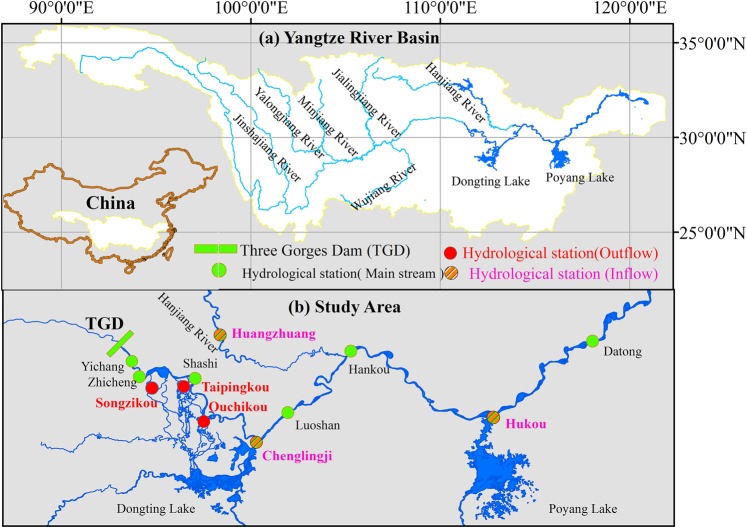
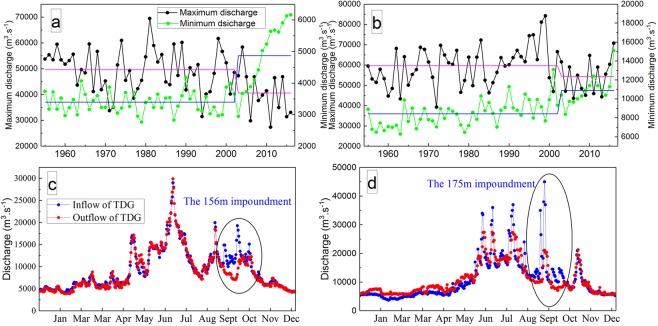
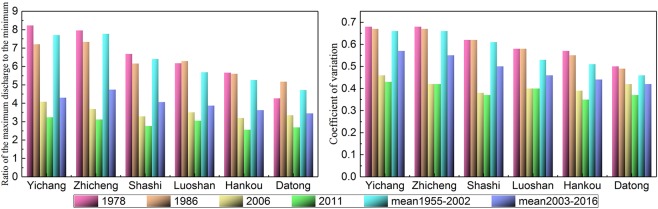
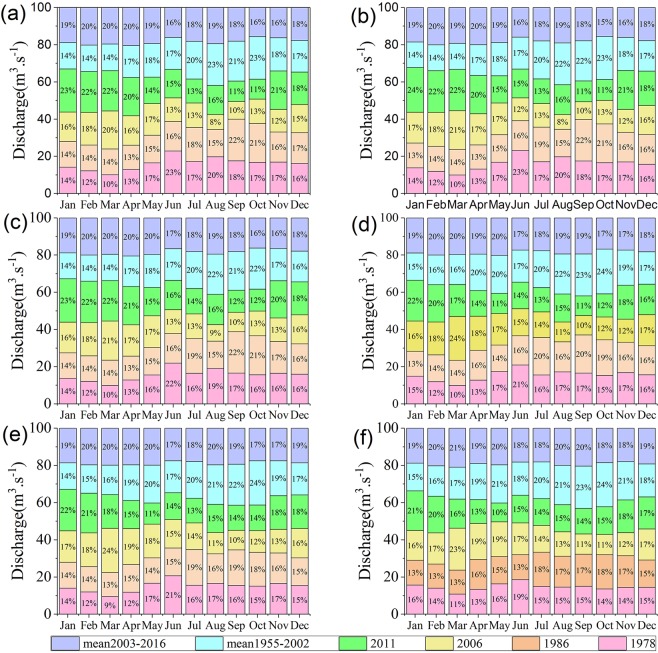
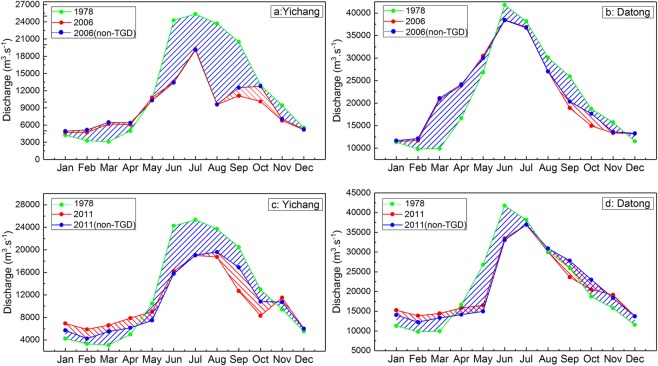
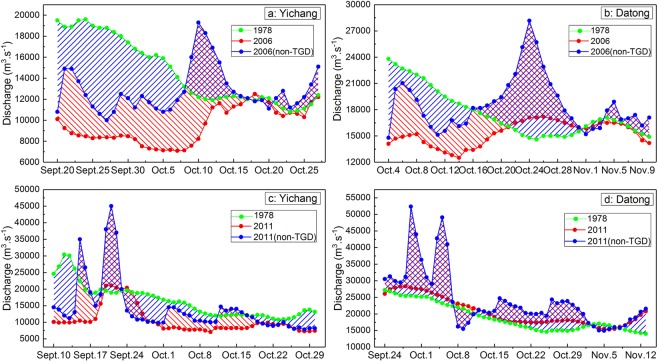
Understanding the effects of climate variability and reservoir operation on runoff is important for shipping, irrigation and water supply services, especially during extreme drought years. After the operation of the Three Gorges Dam (TGD) began, the discharge processes in the mid-lower reaches of the Yangtze River were completely different from those during the pre-dam period. The measured hydrological data and the Mike 11-HD model were used to estimate the contributions of the TGD operation and climate variability to the variation in discharge during extreme drought years. The results are as follows: under the effects of the TGD operation and extreme drought, the special phenomenon of a "positive discharge anomaly in drought season and negative discharge anomaly in flood season" occurred compared with the conditions in the pre-dam period. During the flood season, the contributions of climate variation (TGD operation) to the changes in streamflow from Yichang station to Datong station were 86.6% (13.4%) and 80.7% (19.7%) in 2006 and 64.8% (35.2%) and 71.3% (28.7%) in 2011. During the dry season, the values were 81.2% (18.8%) and 93.9% (6.1%) in 2006 and 59.9% (40.1%) and 72.9% (27.1%) in 2011. Clearly, climate variation was the main reason for the variation in seasonal runoff. Furthermore, even in the 156 m and 175 m impoundments, climate variation was the dominant factor.
理解气候变化和水库运行对径流量的影响对于航运、灌溉和供水服务非常重要,特别是在极端干旱年份。三峡大坝(TGD)运行后,长江中下游的水流过程与大坝前完全不同。利用实测水文资料和 Mike 11-HD 模型,估算了 TGD 运行和气候变化对极端干旱年份径流量变化的贡献。结果表明:在 TGD 运行和极端干旱的共同作用下,与大坝前相比,出现了“枯季正流量异常、洪季负流量异常”的特殊现象。在洪水季节,气候变化(TGD 运行)对宜昌至大通站流量变化的贡献在 2006 年和 2011 年分别为 86.6%(13.4%)和 80.7%(19.7%)、64.8%(35.2%)和 71.3%(28.7%)。在枯水季节,2006 年和 2011 年的数值分别为 81.2%(18.8%)和 93.9%(6.1%)、59.9%(40.1%)和 72.9%(27.1%)。显然,气候变化是季节径流量变化的主要原因。此外,即使在 156m 和 175m 蓄水期,气候变化也是主导因素。