Department of Pathology and Microbiology, Faculty of Veterinary Medicine, Université de Montréal, The Swine and Poultry Infectious Diseases Research Centre (CRIPA) and the Research Group on Zoonoses and Public Health (GREZOSP), St-Hyacinthe, Quebec, Canada.
Department of Public Health and Environment, Ecole Inter-Etats des Sciences et Médecine Vétérinaires (EISMV) de Dakar, Dakar, Senegal.
PLoS One. 2019 Mar 26;14(3):e0214304. doi: 10.1371/journal.pone.0214304. eCollection 2019.
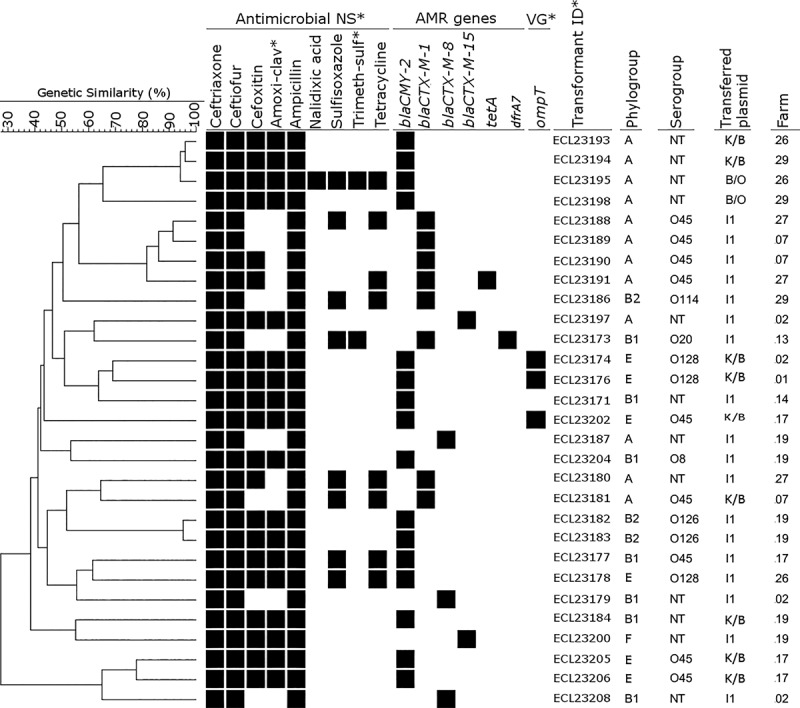
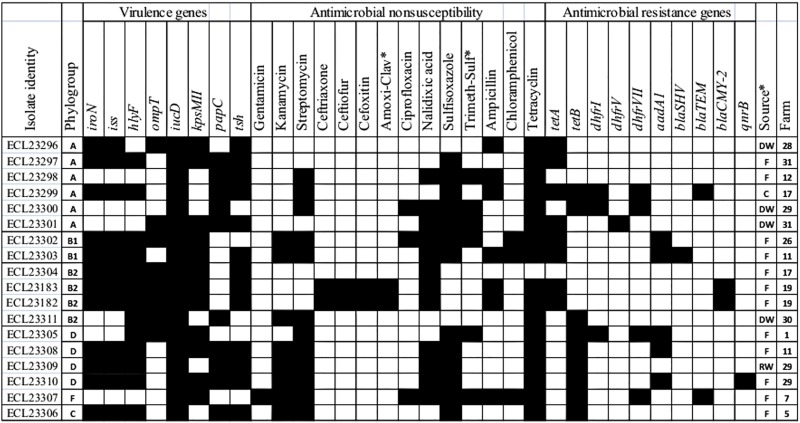
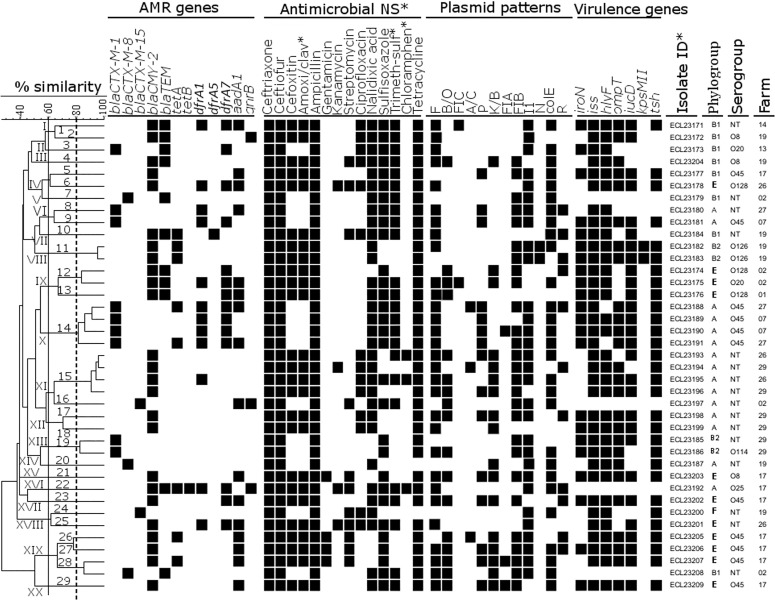
Escherichia coli is a normal inhabitant of the intestinal microbiota of chickens, a small proportion of which may be avian pathogenic E. coli (APEC) or potential extraintestinal pathogenic E. coli (ExPEC), capable of causing disease in humans. These E. coli may also be resistant to antimicrobials of critical importance in human or veterinary health. This study aims to 1) determine the prevalence of antimicrobial resistance (AMR) and resistance genes, multidrug resistance (MDR), chromosomal mechanisms of quinolone-resistance and virulence profiles of E. coli isolated from healthy chicken farms in the region of Dakar, Senegal, 2) investigate the spread of third-generation cephalosporins (3GC) resistance in E. coli isolated from healthy chicken farms with respect to virulence and resistance genes, serogroups, Pulsed-Field Gel Electrophoresis (PFGE), phylogenetic groups, plasmid types and transferability and 3) determine whether nonsusceptibility against 3GC on farms could be linked to risk factors. More than 68% of isolates from environmental faecal and drinking water samples, carcasses and carcass washes collected on 32 healthy chicken farms were multidrug resistant (MDR), resistance to antimicrobials critical in human health (3GC or ciprofloxacin) being found in all types of samples. Ciprofloxacin resistance was due to mutations in the gyrA and parC genes, 95% of tested farms harboring isolates carrying three mutations, in gyrA (Ser83Ile and Asp87Asn) and parC (Ser80Ile). Nine of the 32 farms (28.1%) demonstrated the presence of one or more 3GC-nonsusceptible indicator isolates but none of the potential risk factors were significantly associated with this presence on farms. Following ceftriaxone enrichment, presumptive extended-spectrum beta-lactamase/AmpC-beta-lactamase (ESBL/AmpC)-producer isolates were found in 17 of the 32 farms. 3GC resistance was mediated by blaCMY-2 or blaCTX-M genes, blaCTX-M being of genotypes blaCTX-M-1, blaCTX-M-8 and for the first time in chickens in Senegal, the genotype blaCTX-M-15. Clonally related ESBL/AmpC-producer isolates were found on different farms. In addition, blaCTX-M genes were identified on replicon plasmids I1 and K/B and blaCMY-2 on K/B, I1 and B/O. These plasmids were found in isolates of different clusters. In addition, 18 isolates, some of which were ESBL/AmpC-producers, were defined as potential human ExPEC. In conclusion, E. coli isolates potentially pathogenic for humans and demonstrating MDR, with resistance expressed against antimicrobials of critical importance in human health were found in healthy chickens in Senegal. Our results suggest that both clonal spreading and horizontal gene transfer play a role in the spread of 3GC-resistance and that chickens in Senegal could be a reservoir for AMR and ExPEC for humans. These results highlight the importance of raising awareness about compliance with biosecurity measures and prudent use of antimicrobials.
大肠杆菌是鸡肠道微生物群的正常居民,其中一小部分可能是禽致病性大肠杆菌(APEC)或潜在的肠外致病性大肠杆菌(ExPEC),能够引起人类疾病。这些大肠杆菌也可能对人类或兽医健康中至关重要的抗菌药物具有耐药性。本研究旨在:1)确定塞内加尔达喀尔地区健康鸡场分离的大肠杆菌的抗生素耐药性(AMR)和耐药基因、多药耐药(MDR)、喹诺酮耐药的染色体机制和毒力谱;2)研究健康鸡场分离的第三代头孢菌素(3GC)耐药大肠杆菌的耐药基因、血清型、脉冲场凝胶电泳(PFGE)、系统发育群、质粒类型和可转移性以及转移能力的关系;3)确定农场对 3GC 的非敏感性是否与风险因素有关。来自 32 个健康鸡场的环境粪便和饮用水样本、胴体和胴体冲洗物中采集的超过 68%的分离物是多药耐药(MDR)的,对人类健康至关重要的抗生素(3GC 或环丙沙星)耐药,所有类型的样本都有发现。环丙沙星耐药是由于 gyrA 和 parC 基因的突变,95%的测试农场携带携带三种突变的菌株,gyrA(Ser83Ile 和 Asp87Asn)和 parC(Ser80Ile)。在 32 个农场中有 9 个(28.1%)存在一个或多个 3GC 不敏感的指示分离株,但没有一个潜在的风险因素与农场的存在有显著相关性。在头孢曲松富集后,在 32 个农场中的 17 个农场中发现了推定的扩展谱β-内酰胺酶/AmpC-β-内酰胺酶(ESBL/AmpC)-产生菌分离物。3GC 耐药性由 blaCMY-2 或 blaCTX-M 基因介导,blaCTX-M 为 blaCTX-M-1、blaCTX-M-8 基因型,这是塞内加尔首次在鸡中发现的基因型 blaCTX-M-15。在不同的农场中发现了具有克隆相关性的 ESBL/AmpC-产生菌分离物。此外,在 I1 和 K/B 复制子质粒上鉴定到 blaCTX-M 基因,在 K/B、I1 和 B/O 上鉴定到 blaCMY-2 基因。这些质粒存在于不同群的分离物中。此外,18 个分离物,其中一些是 ESBL/AmpC 产生菌,被定义为潜在的人类 ExPEC。总之,在塞内加尔的健康鸡中发现了对人类潜在致病性且表现出对人类健康至关重要的抗生素耐药性的多药耐药大肠杆菌。我们的研究结果表明,3GC 耐药性的传播既涉及克隆传播,也涉及水平基因转移,塞内加尔的鸡可能是人类 AMR 和 ExPEC 的储库。这些结果强调了提高对遵守生物安全措施和谨慎使用抗菌药物的认识的重要性。