Abdulle Amaal Eman, van Roon Anniek M, Smit Andries J, Pasch Andreas, van Meurs Matijs, Bootsma Hendrika, Bakker Stephan J L, Said Mohammad Y, Fernandez Bernadette O, Feelisch Martin, van Goor Harry, Mulder Douwe J
Department of Internal Medicine, Division Vascular Medicine, University of Groningen - University Medical Centre Groningen, Groningen, The Netherlands.
Department of Biomedical Research, University of Bern, Bern, Switzerland.
Physiol Rep. 2019 Mar;7(6):e14017. doi: 10.14814/phy2.14017.
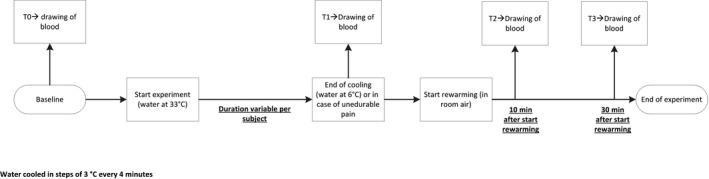
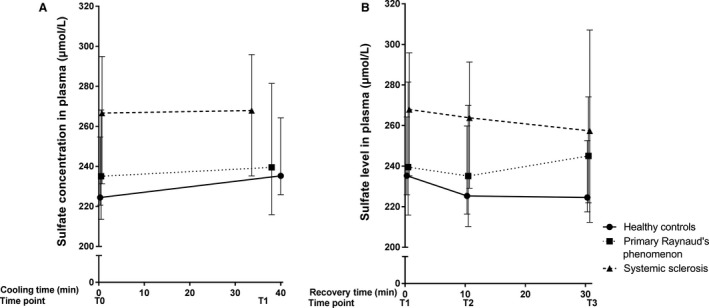
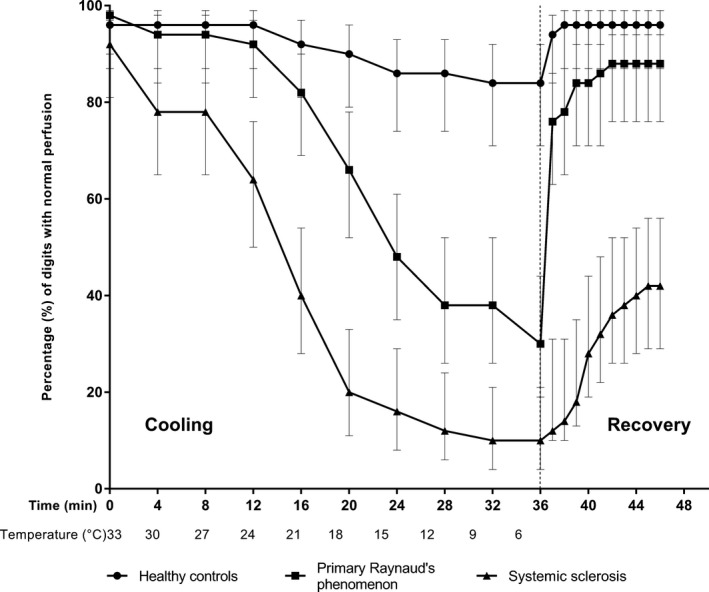
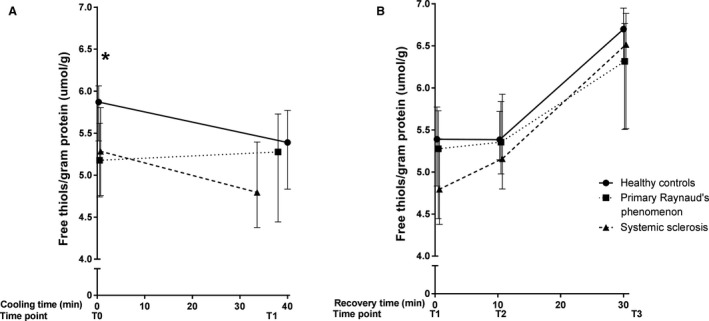
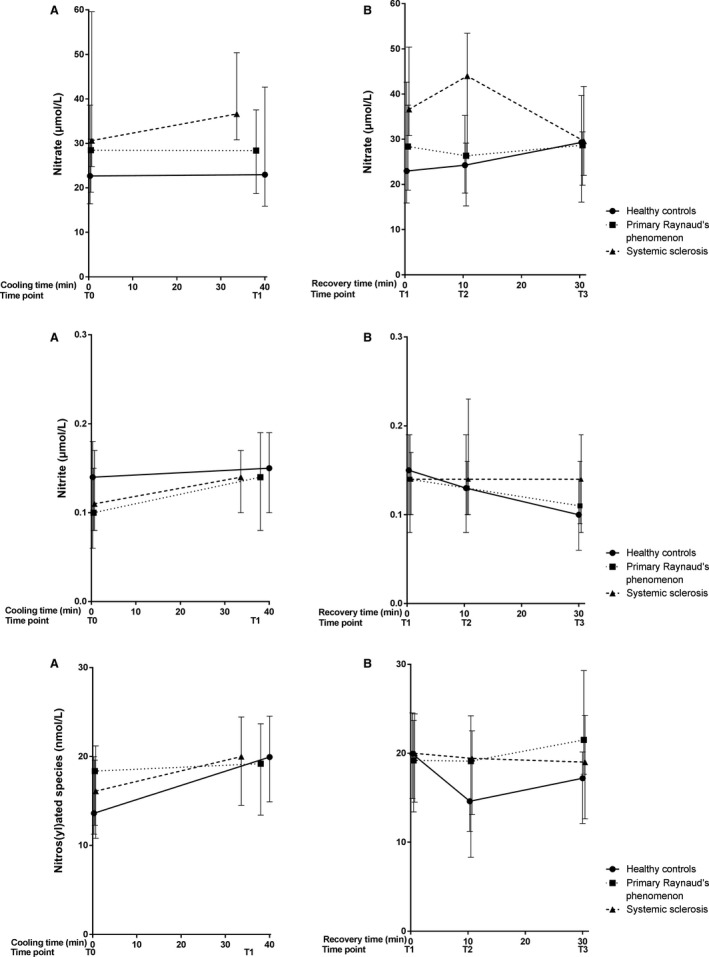
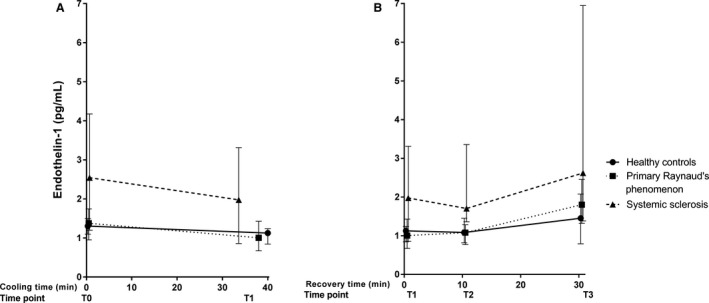
Raynaud's phenomenon (RP) is often the first sign of systemic sclerosis (SSc). Molecular mechanisms involved are incompletely understood, but reactive oxygen, nitrogen, and sulfur species are thought to play an important role in the pathogenesis of SSc. Free thiol groups play a protective role against oxidative stress and may represent an attractive therapeutic target. We aimed to investigate the effects of hypothermia-induced vasoconstriction on the responsiveness of redox-related markers. Thirty participants (n = 10/group [SSc, primary Raynaud's phenomenon (PRP), healthy controls (HC)]) were included in this study. Fingertip photoelectric plethysmography was performed during a standardized cooling and recovery experiment. Venous blood was collected at four predetermined time points. Free thiols, NO-derived species (nitros(yl)ated species, nitrite, nitrate), sulfate and endothelin-1 were measured. Lower baseline concentrations of free thiols were observed in PRP and SSc patients (HC: 5.87 [5.41-5.99] μmol/g; PRP: 5.17 [4.74-5.61]; SSc 5.28 [4.75-5.80], P = 0.04). Redox-related markers remained unchanged during cooling. However, an unexpected increase in systemic free thiol concentrations was observed in all groups during the recovery phase. The response of this marker differed between groups, with a higher increase found in SSc patients (HC Δ = 1.30 [1.48-1.17]; PRP Δ = 1.04 [1.06-1.03]; SSc Δ = 1.72 [1.13-1.49], P = 0.04). NO-derived species, sulfate and endothelin-1 levels remained unchanged throughout the recovery phase. This exploratory study sheds light on the rapid responsiveness of systemic free thiol concentrations following reperfusion, which may reflect overall redox balance. The robust response to reperfusion in SSc patients suggests that reductive systems involved in this response are functionally intact in these patients.
雷诺现象(RP)通常是系统性硬化症(SSc)的首个症状。其中涉及的分子机制尚未完全明确,但活性氧、氮和硫物质被认为在SSc的发病机制中起重要作用。游离巯基对氧化应激起保护作用,可能是一个有吸引力的治疗靶点。我们旨在研究低温诱导的血管收缩对氧化还原相关标志物反应性的影响。本研究纳入了30名参与者(n = 10/组[SSc、原发性雷诺现象(PRP)、健康对照(HC)])。在标准化的冷却和恢复实验过程中进行指尖光电体积描记法。在四个预定时间点采集静脉血。检测游离巯基、一氧化氮衍生物质(亚硝基化物质、亚硝酸盐、硝酸盐)、硫酸盐和内皮素-1。PRP和SSc患者的游离巯基基线浓度较低(HC:5.87[5.41 - 5.99]μmol/g;PRP:5.17[4.74 - 5.61];SSc 5.28[4.75 - 5.80],P = 0.04)。氧化还原相关标志物在冷却过程中保持不变。然而,在恢复阶段所有组均观察到全身游离巯基浓度意外升高。该标志物的反应在组间存在差异,SSc患者升高幅度更大(HC Δ = 1.30[1.48 - 1.17];PRP Δ = 1.04[1.06 - 1.03];SSc Δ = 1.72[1.13 - 1.49],P = 0.04)。一氧化氮衍生物质、硫酸盐和内皮素-1水平在整个恢复阶段保持不变。这项探索性研究揭示了再灌注后全身游离巯基浓度的快速反应性,这可能反映了整体氧化还原平衡。SSc患者对再灌注的强烈反应表明参与该反应的还原系统在这些患者中功能完整。