Department of Mechanical Aerospace and Nuclear Engineering, Rensselaer Polytechnic Institute, Troy, NY, United States of America.
Phys Med Biol. 2019 Apr 10;64(8):085010. doi: 10.1088/1361-6560/ab13fa.
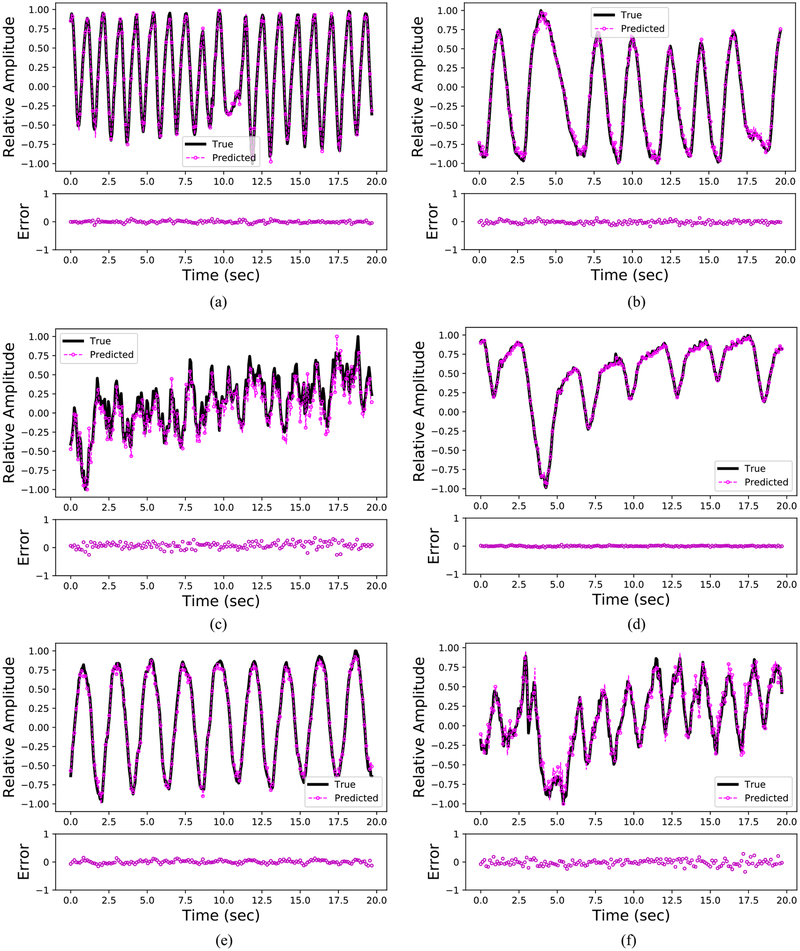
Radiation therapy of thoracic and abdominal tumors requires incorporating the respiratory motion into treatments. To precisely account for the patient's respiratory motions and predict the respiratory signals, a generalized model for predictions of different types of patients' respiratory motions is desired. The aim of this study is to explore the feasibility of developing a long short-term memory (LSTM)-based generalized model for the respiratory signal prediction. To achieve that, 1703 sets of real-time position management (RPM) data were collected from retrospective studies across three clinical institutions. These datasets were separated as the training, internal validity and external validity groups. Among all the datasets, 1187 datasets were used for model development and the remaining 516 datasets were used to test the model's generality power. Furthermore, an exhaustive grid search was implemented to find the optimal hyper-parameters of the LSTM model. The hyper-parameters are the number of LSTM layers, the number of hidden units, the optimizer, the learning rate, the number of epochs, and the length of time lags. The obtained model achieved superior accuracy over conventional artificial neural network (ANN) models: with the prediction window equaling to 500 ms, the LSTM model achieved an average relative mean absolute error (MAE) of 0.037, an average root mean square error (RMSE) of 0.048, and a maximum error (ME) of 1.687 in the internal validity data, and an average relative MAE of 0.112, an average RMSE of 0.139 and an ME of 1.811 in the external validity data. Compared to the LSTM model trained with default hyper-parameters, the MAE of the optimized model results decreased by 20%, indicating the importance of tuning the hyper-parameters of LSTM models to obtain superior accuracies. This study demonstrates the potential of deep LSTM models for the respiratory signal prediction and illustrates the impacts of major hyper-parameters in LSTM models.
胸部和腹部肿瘤的放射治疗需要将呼吸运动纳入治疗中。为了精确地考虑患者的呼吸运动并预测呼吸信号,需要一个可以预测不同类型患者呼吸运动的广义模型。本研究旨在探索开发基于长短期记忆网络(LSTM)的广义呼吸信号预测模型的可行性。
为此,我们从三个临床机构的回顾性研究中收集了 1703 组实时位置管理(RPM)数据。这些数据集被分为训练集、内部有效性验证集和外部有效性验证集。在所有数据集中,1187 组数据用于模型开发,其余 516 组数据用于测试模型的通用性。此外,我们还进行了详尽的网格搜索,以找到 LSTM 模型的最优超参数。这些超参数包括 LSTM 层数、隐藏单元数、优化器、学习率、epoch 数和时间延迟长度。
与传统的人工神经网络(ANN)模型相比,所获得的模型具有更高的准确性:在预测窗口等于 500ms 的情况下,LSTM 模型在内部有效性数据中实现了平均相对平均绝对误差(MAE)为 0.037、平均均方根误差(RMSE)为 0.048 和最大误差(ME)为 1.687,在外部有效性数据中实现了平均相对 MAE 为 0.112、平均 RMSE 为 0.139 和 ME 为 1.811。与使用默认超参数训练的 LSTM 模型相比,优化模型的 MAE 降低了 20%,这表明调整 LSTM 模型的超参数以获得更高的准确性非常重要。
本研究展示了深度学习 LSTM 模型在呼吸信号预测中的潜力,并说明了 LSTM 模型中超参数的重要性。