Renner Andreas, Gulyas Ingo, Buschmann Martin, Heilemann Gerd, Knäusl Barbara, Heilmann Martin, Widder Joachim, Georg Dietmar, Trnková Petra
Department of Radiation Oncology, Medical University of Vienna, Vienna, Austria.
Christian Doppler Laboratory for Image and Knowledge Driven Precision Radiation Oncology, Department of Radiation Oncology, Medical University of Vienna, Austria.
Phys Imaging Radiat Oncol. 2024 May 27;30:100594. doi: 10.1016/j.phro.2024.100594. eCollection 2024 Apr.
Active breathing motion management in radiotherapy consists of motion monitoring, quantification and mitigation. It is impacted by associated latencies of a few 100 ms. Artificial neural networks can successfully predict breathing motion and eliminate latencies. However, they require usually a large dataset for training. The objective of this work was to demonstrate that explicitly encoding the cyclic nature of the breathing signal into the training data enables significant reduction of training datasets which can be obtained from healthy volunteers.
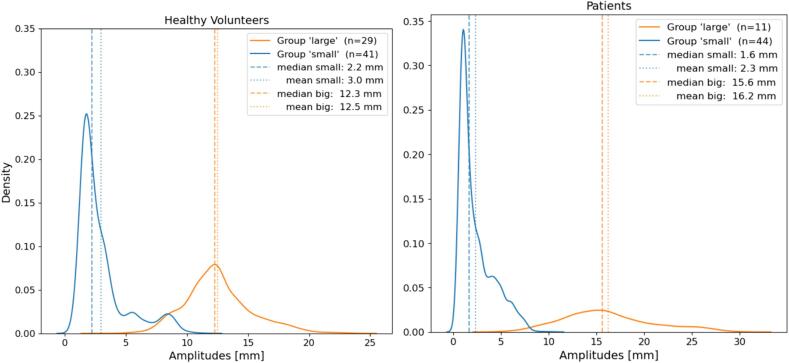
Seventy surface scanner breathing signals from 25 healthy volunteers in anterior-posterior direction were used for training and validation (ratio 4:1) of long short-term memory models. The model performance was compared to a model using decomposition into phase, amplitude and a time-dependent baseline. Testing of the models was performed on 55 independent breathing signals in anterior-posterior direction from surface scanner (35 lung, 20 liver) of 30 patients with a mean breathing amplitude of (5.9 ± 6.7) mm.
Using the decomposed breathing signal allowed for a reduction of the absolute root-mean square error (RMSE) from 0.34 mm to 0.12 mm during validation. Testing using patient data yielded an average absolute RMSE of the breathing signal of (0.16 ± 0.11) mm with a prediction horizon of 500 ms.
It was demonstrated that a motion prediction model can be trained with less than 100 datasets of healthy volunteers if breathing cycle parameters are considered. Applied to 55 patients, the model predicted breathing motion with a high accuracy.
放射治疗中的主动呼吸运动管理包括运动监测、量化和缓解。它受到几百毫秒的相关延迟影响。人工神经网络可以成功预测呼吸运动并消除延迟。然而,它们通常需要大量数据集进行训练。这项工作的目的是证明将呼吸信号的周期性明确编码到训练数据中能够显著减少可从健康志愿者获得的训练数据集。
使用来自25名健康志愿者的70个前后方向的表面扫描仪呼吸信号对长短期记忆模型进行训练和验证(比例为4:1)。将模型性能与使用分解为相位、幅度和时间相关基线的模型进行比较。在30名平均呼吸幅度为(5.9 ± 6.7)mm的患者的表面扫描仪(35例肺部,20例肝脏)的55个独立前后方向呼吸信号上对模型进行测试。
在验证期间,使用分解后的呼吸信号可将绝对均方根误差(RMSE)从0.34mm降低到0.12mm。使用患者数据进行测试时,呼吸信号的平均绝对RMSE为(0.16 ± 0.11)mm,预测范围为500ms。
结果表明,如果考虑呼吸周期参数,运动预测模型可以用少于100个健康志愿者的数据集进行训练。应用于55名患者时,该模型以高精度预测呼吸运动。