
用于区分注射用透明质酸填充剂产品的流变学和物理化学特性。
Rheologic and Physicochemical Properties Used to Differentiate Injectable Hyaluronic Acid Filler Products.
机构信息
From private practice; the Division of Dermatology, University of Toronto and private practice; and Galderma Laboratories, L.P.
出版信息
Plast Reconstr Surg. 2019 Apr;143(4):707e-720e. doi: 10.1097/PRS.0000000000005429.
BACKGROUND
Injectable hyaluronic acid fillers are routinely used for correction of soft-tissue volume loss and facial rejuvenation. Product differentiation has primarily been based on the rheologic parameter known as elastic modulus (G'), although other physicochemical properties are being explored to characterize potential product performance. As clinical data regarding product performance are lacking, the practical experience of injectors provides a valuable bridge in the knowledge gap between product rheologic data and product use.
METHODS
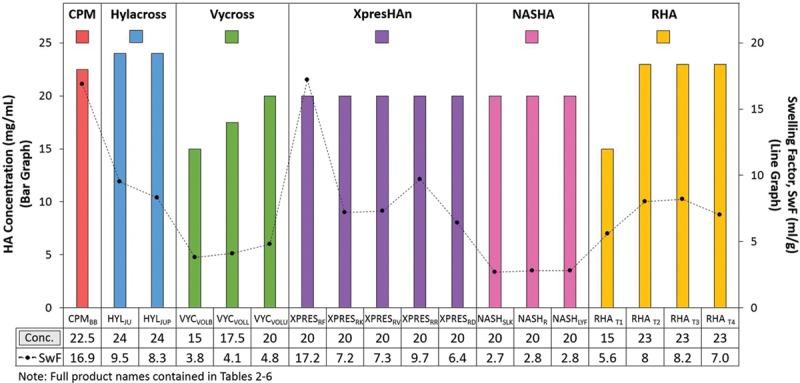
Rheologic and physicochemical measurements (swelling factor and cohesion) were collected for 18 products. To observe the impact of G' and hyaluronic acid concentration on swelling factor and cohesion, proportional relationships were evaluated. Contributing authors were queried regarding their G'-based selection of products when considering skin quality, degree of correction, injection depth, and anatomical location.
RESULTS
Relationships were observable between G' and swelling factor and G' and cohesion only when limited to products manufactured by the same crosslinking technology and the same concentration. No relationship between isolated hyaluronic acid concentration and swelling factor or cohesion was apparent. Although rheological parameters and the assumptions of ex vivo data translating to in vivo performance are oftentimes not completely aligned, in the clinical experience of the authors, in general, higher G' products are better suited for thicker skin and deeper injection planes, whereas lower G' products are better for more superficial planes, although exceptions to these trends are also made based on technical experience.
CONCLUSIONS
While rheologic and physicochemical characteristics can vary widely between products and the methods and measurements of these parameters are often difficult to correlate, G' represents a useful and consistent parameter for product differentiation. Understanding how to select products based on G' is valuable knowledge for customizing injection plans and contributes to an optimal aesthetic outcome.
背景
注射用透明质酸填充剂通常用于纠正软组织容量丢失和面部年轻化。产品的差异化主要基于流变学参数,即弹性模量(G'),尽管其他物理化学性质也在被探索以表征潜在的产品性能。由于缺乏关于产品性能的临床数据,注射医师的实际经验在产品流变学数据和产品使用之间的知识空白中提供了宝贵的桥梁。
方法
收集了 18 种产品的流变学和物理化学测量(膨胀因子和内聚性)。为了观察 G'和透明质酸浓度对膨胀因子和内聚性的影响,评估了比例关系。当考虑皮肤质量、矫正程度、注射深度和解剖位置时,向撰稿人询问了基于 G'选择产品的情况。
结果
仅当限制在使用相同交联技术和相同浓度制造的产品时,才可以观察到 G'与膨胀因子和 G'与内聚性之间的关系。孤立的透明质酸浓度与膨胀因子或内聚性之间没有明显的关系。尽管流变学参数和将离体数据转化为体内性能的假设通常不完全一致,但在作者的临床经验中,一般来说,较高的 G'产品更适合较厚的皮肤和较深的注射平面,而较低的 G'产品更适合较浅的平面,尽管基于技术经验也存在例外情况。
结论
虽然产品之间的流变学和物理化学特性可能差异很大,并且这些参数的方法和测量往往难以相关,但 G'是产品差异化的有用且一致的参数。了解如何根据 G'选择产品对于定制注射计划很有价值,有助于达到最佳的美学效果。




 Zotero 插件