Columbia Business School, Columbia University, New York, NY, United States.
Department of Business Administration, University of Zurich, Zurich, Switzerland.
PLoS One. 2019 Mar 28;14(3):e0214369. doi: 10.1371/journal.pone.0214369. eCollection 2019.
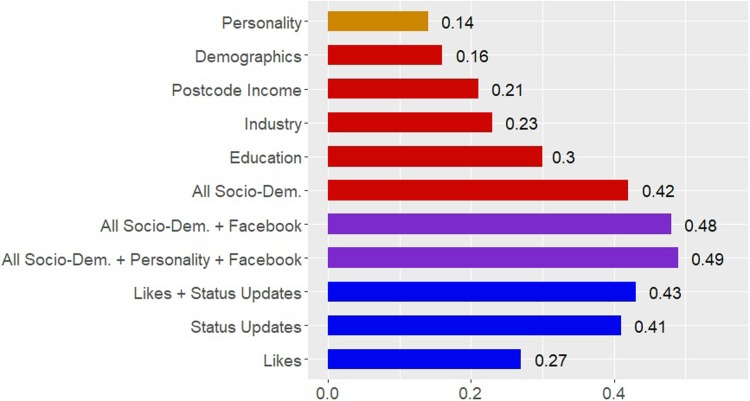
Information about a person's income can be useful in several business-related contexts, such as personalized advertising or salary negotiations. However, many people consider this information private and are reluctant to share it. In this paper, we show that income is predictable from the digital footprints people leave on Facebook. Applying an established machine learning method to an income-representative sample of 2,623 U.S. Americans, we found that (i) Facebook Likes and Status Updates alone predicted a person's income with an accuracy of up to r = 0.43, and (ii) Facebook Likes and Status Updates added incremental predictive power above and beyond a range of socio-demographic variables (ΔR2 = 6-16%, with a correlation of up to r = 0.49). Our findings highlight both opportunities for businesses and legitimate privacy concerns that such prediction models pose to individuals and society when applied without individual consent.
关于一个人的收入信息在几个与商业相关的情境中可能是有用的,例如个性化广告或薪资谈判。然而,许多人认为这些信息是隐私,不愿意分享。在本文中,我们表明,收入可以从人们在 Facebook 上留下的数字足迹中预测出来。我们应用一种成熟的机器学习方法对具有代表性的 2623 名美国成年人样本进行分析,发现(i)仅通过 Facebook 点赞和状态更新就可以以高达 r = 0.43 的准确率预测一个人的收入,(ii)Facebook 点赞和状态更新在一系列社会人口统计学变量(ΔR2 = 6-16%,最高相关系数为 r = 0.49)之外提供了额外的预测能力。我们的研究结果既突出了企业的机会,也强调了这些预测模型在未经个人同意的情况下应用时对个人和社会带来的正当隐私担忧。