• 文献检索
  • 文档翻译
  • 深度研究
  • 学术资讯
  • Suppr Zotero 插件Zotero 插件
  • 邀请有礼
  • 套餐&价格
  • 历史记录
应用&插件
Suppr Zotero 插件Zotero 插件浏览器插件Mac 客户端Windows 客户端微信小程序
定价
高级版会员购买积分包购买API积分包
服务
文献检索文档翻译深度研究API 文档MCP 服务
关于我们
关于 Suppr公司介绍联系我们用户协议隐私条款
关注我们

Suppr 超能文献

核心技术专利:CN118964589B侵权必究
粤ICP备2023148730 号-1Suppr @ 2026

文献检索

告别复杂PubMed语法,用中文像聊天一样搜索,搜遍4000万医学文献。AI智能推荐,让科研检索更轻松。

立即免费搜索

文件翻译

保留排版,准确专业,支持PDF/Word/PPT等文件格式,支持 12+语言互译。

免费翻译文档

深度研究

AI帮你快速写综述,25分钟生成高质量综述,智能提取关键信息,辅助科研写作。

立即免费体验

基于集成元路径和奇异值分解的药物-疾病关联预测。

Prediction of drug-disease associations based on ensemble meta paths and singular value decomposition.

机构信息

School of Computer Science, Wuhan University, Wuhan, 430072, People's Republic of China.

Suzhou Institute of Wuhan University, Suzhou, 215123, People's Republic of China.

出版信息

BMC Bioinformatics. 2019 Mar 29;20(Suppl 3):134. doi: 10.1186/s12859-019-2644-5.

DOI:10.1186/s12859-019-2644-5
PMID:30925858
原文链接:https://pmc.ncbi.nlm.nih.gov/articles/PMC6439991/
Abstract

BACKGROUND

In the field of drug repositioning, it is assumed that similar drugs may treat similar diseases, therefore many existing computational methods need to compute the similarities of drugs and diseases. However, the calculation of similarity depends on the adopted measure and the available features, which may lead that the similarity scores vary dramatically from one to another, and it will not work when facing the incomplete data. Besides, supervised learning based methods usually need both positive and negative samples to train the prediction models, whereas in drug-disease pairs data there are only some verified interactions (positive samples) and a lot of unlabeled pairs. To train the models, many methods simply treat the unlabeled samples as negative ones, which may introduce artificial noises. Herein, we propose a method to predict drug-disease associations without the need of similarity information, and select more likely negative samples.

RESULTS

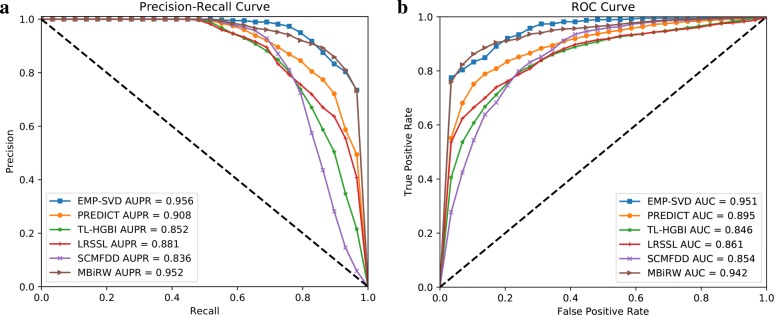
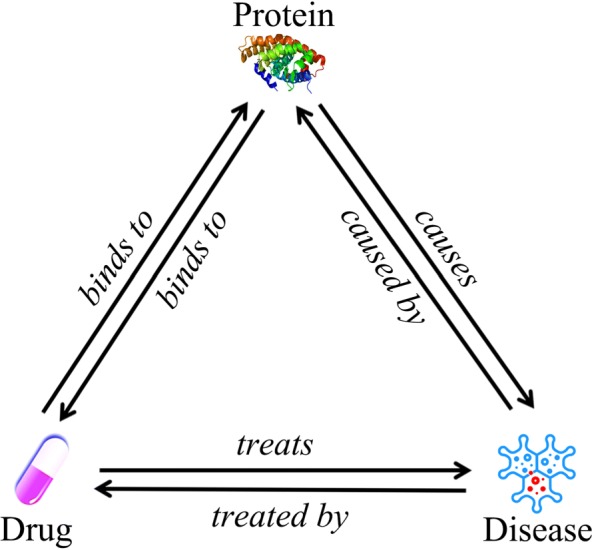
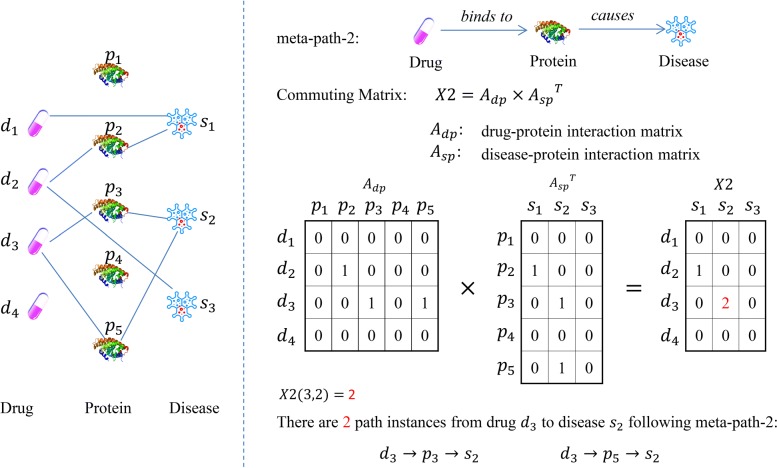
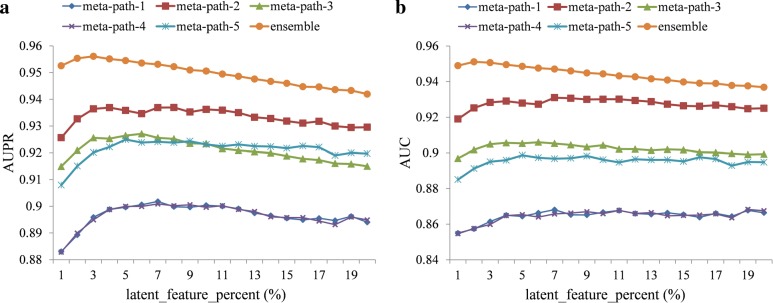
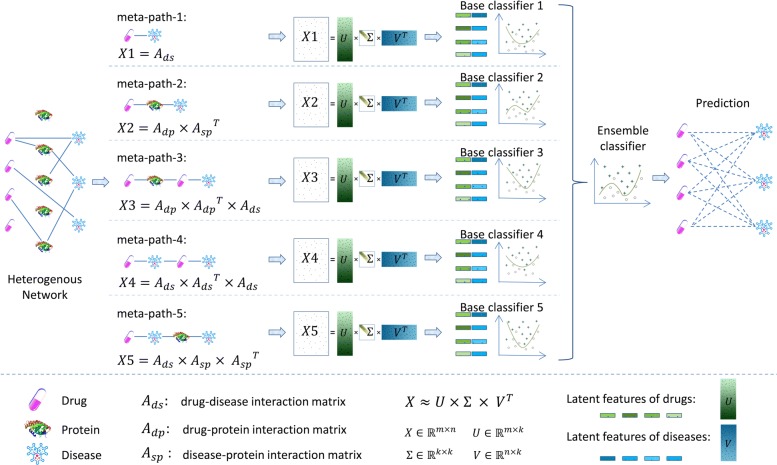
In the proposed EMP-SVD (Ensemble Meta Paths and Singular Value Decomposition), we introduce five meta paths corresponding to different kinds of interaction data, and for each meta path we generate a commuting matrix. Every matrix is factorized into two low rank matrices by SVD which are used for the latent features of drugs and diseases respectively. The features are combined to represent drug-disease pairs. We build a base classifier via Random Forest for each meta path and five base classifiers are combined as the final ensemble classifier. In order to train out a more reliable prediction model, we select more likely negative ones from unlabeled samples under the assumption that non-associated drug and disease pair have no common interacted proteins. The experiments have shown that the proposed EMP-SVD method outperforms several state-of-the-art approaches. Case studies by literature investigation have found that the proposed EMP-SVD can mine out many drug-disease associations, which implies the practicality of EMP-SVD.

CONCLUSIONS

The proposed EMP-SVD can integrate the interaction data among drugs, proteins and diseases, and predict the drug-disease associations without the need of similarity information. At the same time, the strategy of selecting more reliable negative samples will benefit the prediction.

摘要

背景

在药物重定位领域,人们假设相似的药物可能治疗相似的疾病,因此许多现有的计算方法需要计算药物和疾病的相似性。然而,相似性的计算取决于所采用的度量标准和可用的特征,这可能导致相似性得分在一个方法和另一个方法之间差异巨大,并且在面对不完整的数据时无法工作。此外,基于监督学习的方法通常需要正例和负例来训练预测模型,而在药物-疾病对数据中只有一些已验证的相互作用(正例)和大量未标记的对。为了训练模型,许多方法简单地将未标记的样本视为负例,这可能会引入人为噪声。在这里,我们提出了一种无需相似性信息即可预测药物-疾病关联的方法,并选择更可能的负例。

结果

在提出的 EMP-SVD(集成元路径和奇异值分解)中,我们引入了对应于不同类型的交互数据的五条元路径,并为每条元路径生成一个交换矩阵。每个矩阵通过 SVD 分解成两个低秩矩阵,分别用于药物和疾病的潜在特征。特征组合起来表示药物-疾病对。我们通过随机森林为每条元路径构建一个基础分类器,并将五个基础分类器组合成最终的集成分类器。为了训练出一个更可靠的预测模型,我们假设非相关的药物-疾病对没有共同的相互作用蛋白,从未标记的样本中选择更可能的负例。实验表明,所提出的 EMP-SVD 方法优于几种最先进的方法。通过文献调查进行的案例研究发现,所提出的 EMP-SVD 可以挖掘出许多药物-疾病关联,这表明 EMP-SVD 的实用性。

结论

所提出的 EMP-SVD 可以整合药物、蛋白质和疾病之间的交互数据,无需相似性信息即可预测药物-疾病关联。同时,选择更可靠的负例的策略将有利于预测。
https://cdn.ncbi.nlm.nih.gov/pmc/blobs/0301/6439991/cd6bf04dbab3/12859_2019_2644_Fig5_HTML.jpg
https://cdn.ncbi.nlm.nih.gov/pmc/blobs/0301/6439991/383b363f1c4b/12859_2019_2644_Fig1_HTML.jpg
https://cdn.ncbi.nlm.nih.gov/pmc/blobs/0301/6439991/bb0ee3024856/12859_2019_2644_Fig2_HTML.jpg
https://cdn.ncbi.nlm.nih.gov/pmc/blobs/0301/6439991/b8f827a6b8a5/12859_2019_2644_Fig3_HTML.jpg
https://cdn.ncbi.nlm.nih.gov/pmc/blobs/0301/6439991/c6ff146e9e3a/12859_2019_2644_Fig4_HTML.jpg
https://cdn.ncbi.nlm.nih.gov/pmc/blobs/0301/6439991/cd6bf04dbab3/12859_2019_2644_Fig5_HTML.jpg
https://cdn.ncbi.nlm.nih.gov/pmc/blobs/0301/6439991/383b363f1c4b/12859_2019_2644_Fig1_HTML.jpg
https://cdn.ncbi.nlm.nih.gov/pmc/blobs/0301/6439991/bb0ee3024856/12859_2019_2644_Fig2_HTML.jpg
https://cdn.ncbi.nlm.nih.gov/pmc/blobs/0301/6439991/b8f827a6b8a5/12859_2019_2644_Fig3_HTML.jpg
https://cdn.ncbi.nlm.nih.gov/pmc/blobs/0301/6439991/c6ff146e9e3a/12859_2019_2644_Fig4_HTML.jpg
https://cdn.ncbi.nlm.nih.gov/pmc/blobs/0301/6439991/cd6bf04dbab3/12859_2019_2644_Fig5_HTML.jpg

相似文献

1
Prediction of drug-disease associations based on ensemble meta paths and singular value decomposition.基于集成元路径和奇异值分解的药物-疾病关联预测。
BMC Bioinformatics. 2019 Mar 29;20(Suppl 3):134. doi: 10.1186/s12859-019-2644-5.
2
Link Prediction Only With Interaction Data and its Application on Drug Repositioning.仅基于交互数据的链接预测及其在药物重定位中的应用。
IEEE Trans Nanobioscience. 2020 Jul;19(3):547-555. doi: 10.1109/TNB.2020.2990291. Epub 2020 Apr 24.
3
Integration of various protein similarities using random forest technique to infer augmented drug-protein matrix for enhancing drug-disease association prediction.利用随机森林技术整合各种蛋白质相似性,推断增强的药物-蛋白质矩阵,以提高药物-疾病关联预测。
Sci Prog. 2022 Jul-Sep;105(3):368504221109215. doi: 10.1177/00368504221109215.
4
Effectively Identifying Compound-Protein Interactions by Learning from Positive and Unlabeled Examples.通过从正例和无标签样例中学习来有效识别化合物-蛋白质相互作用。
IEEE/ACM Trans Comput Biol Bioinform. 2018 Nov-Dec;15(6):1832-1843. doi: 10.1109/TCBB.2016.2570211. Epub 2016 May 18.
5
Drug Repositioning by Integrating Known Disease-Gene and Drug-Target Associations in a Semi-supervised Learning Model.通过在半监督学习模型中整合已知疾病-基因和药物-靶点关联进行药物重新定位
Acta Biotheor. 2018 Dec;66(4):315-331. doi: 10.1007/s10441-018-9325-z. Epub 2018 Apr 26.
6
Drug-target interaction prediction via class imbalance-aware ensemble learning.通过类不平衡感知集成学习进行药物-靶点相互作用预测。
BMC Bioinformatics. 2016 Dec 22;17(Suppl 19):509. doi: 10.1186/s12859-016-1377-y.
7
Prediction of Drug-Target Interactions Based on Network Representation Learning and Ensemble Learning.基于网络表示学习和集成学习的药物-靶点相互作用预测
IEEE/ACM Trans Comput Biol Bioinform. 2021 Nov-Dec;18(6):2671-2681. doi: 10.1109/TCBB.2020.2989765. Epub 2021 Dec 8.
8
Inverse similarity and reliable negative samples for drug side-effect prediction.用于药物副作用预测的反相似性和可靠负样本。
BMC Bioinformatics. 2019 Feb 4;19(Suppl 13):554. doi: 10.1186/s12859-018-2563-x.
9
Computational drug repositioning using low-rank matrix approximation and randomized algorithms.基于低秩矩阵逼近和随机算法的计算药物重定位。
Bioinformatics. 2018 Jun 1;34(11):1904-1912. doi: 10.1093/bioinformatics/bty013.
10
Computational drug repositioning using meta-path-based semantic network analysis.使用基于元路径的语义网络分析进行药物重新定位计算
BMC Syst Biol. 2018 Dec 31;12(Suppl 9):134. doi: 10.1186/s12918-018-0658-7.

引用本文的文献

1
Bayesian Inference for Drug Discovery by High Negative Samples and Oversampling.基于高负样本和过采样的药物发现贝叶斯推理
Bioinform Biol Insights. 2025 Apr 12;19:11779322251328269. doi: 10.1177/11779322251328269. eCollection 2025.
2
Protein structural domain-disease association prediction based on heterogeneous networks.基于异质网络的蛋白质结构域-疾病关联预测
BMC Genomics. 2025 Apr 10;23(Suppl 6):869. doi: 10.1186/s12864-024-11117-0.
3
Label Transfer for Drug Disease Association in Three Meta-Paths.基于三条元路径的药物-疾病关联标签传递

本文引用的文献

1
Predicting drug-disease associations by using similarity constrained matrix factorization.基于相似性约束矩阵分解预测药物-疾病关联。
BMC Bioinformatics. 2018 Jun 19;19(1):233. doi: 10.1186/s12859-018-2220-4.
2
Predicting drug-disease associations and their therapeutic function based on the drug-disease association bipartite network.基于药物-疾病关联二部网络预测药物-疾病关联及其治疗功能。
Methods. 2018 Aug 1;145:51-59. doi: 10.1016/j.ymeth.2018.06.001. Epub 2018 Jun 4.
3
A novel computational approach for drug repurposing using systems biology.
Evol Bioinform Online. 2024 Sep 13;20:11769343241272414. doi: 10.1177/11769343241272414. eCollection 2024.
4
Fusing graph transformer with multi-aggregate GCN for enhanced drug-disease associations prediction.将图变换与多聚合 GCN 融合,用于增强药物-疾病关联预测。
BMC Bioinformatics. 2024 Feb 20;25(1):79. doi: 10.1186/s12859-024-05705-w.
5
MDSVDNV: predicting microbe-drug associations by singular value decomposition and Node2vec.MDSVDNV:通过奇异值分解和Node2vec预测微生物-药物关联
Front Microbiol. 2024 Jan 8;14:1303585. doi: 10.3389/fmicb.2023.1303585. eCollection 2023.
6
Drug-Disease Association Prediction Using Heterogeneous Networks for Computational Drug Repositioning.基于异构网络的药物-疾病关联预测在计算药物重定位中的应用。
Biomolecules. 2022 Oct 17;12(10):1497. doi: 10.3390/biom12101497.
7
Integrating and formatting biomedical data as pre-calculated knowledge graph embeddings in the Bioteque.在 Bioteque 中整合和格式化生物医学数据作为预先计算的知识图嵌入。
Nat Commun. 2022 Sep 9;13(1):5304. doi: 10.1038/s41467-022-33026-0.
8
Integration of various protein similarities using random forest technique to infer augmented drug-protein matrix for enhancing drug-disease association prediction.利用随机森林技术整合各种蛋白质相似性,推断增强的药物-蛋白质矩阵,以提高药物-疾病关联预测。
Sci Prog. 2022 Jul-Sep;105(3):368504221109215. doi: 10.1177/00368504221109215.
9
Drug Repositioning with GraphSAGE and Clustering Constraints Based on Drug and Disease Networks.基于药物和疾病网络、利用GraphSAGE和聚类约束进行药物重新定位
Front Pharmacol. 2022 May 10;13:872785. doi: 10.3389/fphar.2022.872785. eCollection 2022.
10
Artificial intelligence and machine learning-aided drug discovery in central nervous system diseases: State-of-the-arts and future directions.人工智能和机器学习辅助中枢神经系统疾病药物发现:现状与未来方向。
Med Res Rev. 2021 May;41(3):1427-1473. doi: 10.1002/med.21764. Epub 2020 Dec 9.
一种利用系统生物学进行药物再利用的新计算方法。
Bioinformatics. 2018 Aug 15;34(16):2817-2825. doi: 10.1093/bioinformatics/bty133.
4
Predicting drug-disease interactions by semi-supervised graph cut algorithm and three-layer data integration.基于半监督图割算法和三层数据集成预测药物-疾病相互作用。
BMC Med Genomics. 2017 Dec 28;10(Suppl 5):79. doi: 10.1186/s12920-017-0311-0.
5
A unified frame of predicting side effects of drugs by using linear neighborhood similarity.一种利用线性邻域相似性预测药物副作用的统一框架。
BMC Syst Biol. 2017 Dec 14;11(Suppl 6):101. doi: 10.1186/s12918-017-0477-2.
6
DrugBank 5.0: a major update to the DrugBank database for 2018.DrugBank 5.0:2018 年 DrugBank 数据库的重大更新。
Nucleic Acids Res. 2018 Jan 4;46(D1):D1074-D1082. doi: 10.1093/nar/gkx1037.
7
LRSSL: predict and interpret drug-disease associations based on data integration using sparse subspace learning.LRSSL:基于使用稀疏子空间学习的数据整合来预测和解释药物-疾病关联。
Bioinformatics. 2017 Apr 15;33(8):1187-1196. doi: 10.1093/bioinformatics/btw770.
8
Management of nocturnal enuresis - myths and facts.夜间遗尿的管理——误区与事实
World J Nephrol. 2016 Jul 6;5(4):328-38. doi: 10.5527/wjn.v5.i4.328.
9
Scoring multiple features to predict drug disease associations using information fusion and aggregation.利用信息融合与聚合对多个特征进行评分以预测药物-疾病关联。
SAR QSAR Environ Res. 2016 Aug;27(8):609-28. doi: 10.1080/1062936X.2016.1209241. Epub 2016 Jul 25.
10
Drug repositioning based on comprehensive similarity measures and Bi-Random walk algorithm.基于综合相似性度量和双向随机游走算法的药物重新定位
Bioinformatics. 2016 Sep 1;32(17):2664-71. doi: 10.1093/bioinformatics/btw228. Epub 2016 May 5.