• 文献检索
  • 文档翻译
  • 深度研究
  • 学术资讯
  • Suppr Zotero 插件Zotero 插件
  • 邀请有礼
  • 套餐&价格
  • 历史记录
应用&插件
Suppr Zotero 插件Zotero 插件浏览器插件Mac 客户端Windows 客户端微信小程序
定价
高级版会员购买积分包购买API积分包
服务
文献检索文档翻译深度研究API 文档MCP 服务
关于我们
关于 Suppr公司介绍联系我们用户协议隐私条款
关注我们

Suppr 超能文献

核心技术专利:CN118964589B侵权必究
粤ICP备2023148730 号-1Suppr @ 2026

文献检索

告别复杂PubMed语法,用中文像聊天一样搜索,搜遍4000万医学文献。AI智能推荐,让科研检索更轻松。

立即免费搜索

文件翻译

保留排版,准确专业,支持PDF/Word/PPT等文件格式,支持 12+语言互译。

免费翻译文档

深度研究

AI帮你快速写综述,25分钟生成高质量综述,智能提取关键信息,辅助科研写作。

立即免费体验

人工智能和机器学习辅助中枢神经系统疾病药物发现:现状与未来方向。

Artificial intelligence and machine learning-aided drug discovery in central nervous system diseases: State-of-the-arts and future directions.

机构信息

Department of Genetics and Genomic Sciences, Icahn School of Medicine at Mount Sinai, New York, New York, USA.

Mount Sinai Center for Transformative Disease Modeling, Icahn School of Medicine at Mount Sinai, New York, New York, USA.

出版信息

Med Res Rev. 2021 May;41(3):1427-1473. doi: 10.1002/med.21764. Epub 2020 Dec 9.

DOI:10.1002/med.21764
PMID:33295676
原文链接:https://pmc.ncbi.nlm.nih.gov/articles/PMC8043990/
Abstract

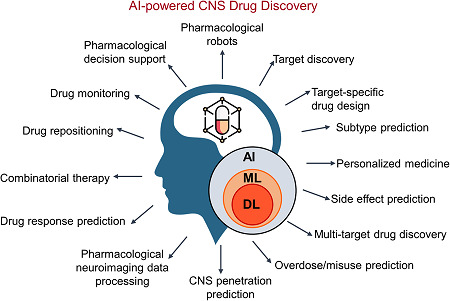
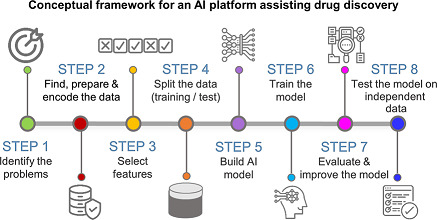
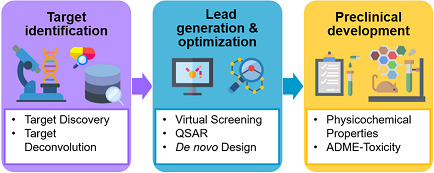
Neurological disorders significantly outnumber diseases in other therapeutic areas. However, developing drugs for central nervous system (CNS) disorders remains the most challenging area in drug discovery, accompanied with the long timelines and high attrition rates. With the rapid growth of biomedical data enabled by advanced experimental technologies, artificial intelligence (AI) and machine learning (ML) have emerged as an indispensable tool to draw meaningful insights and improve decision making in drug discovery. Thanks to the advancements in AI and ML algorithms, now the AI/ML-driven solutions have an unprecedented potential to accelerate the process of CNS drug discovery with better success rate. In this review, we comprehensively summarize AI/ML-powered pharmaceutical discovery efforts and their implementations in the CNS area. After introducing the AI/ML models as well as the conceptualization and data preparation, we outline the applications of AI/ML technologies to several key procedures in drug discovery, including target identification, compound screening, hit/lead generation and optimization, drug response and synergy prediction, de novo drug design, and drug repurposing. We review the current state-of-the-art of AI/ML-guided CNS drug discovery, focusing on blood-brain barrier permeability prediction and implementation into therapeutic discovery for neurological diseases. Finally, we discuss the major challenges and limitations of current approaches and possible future directions that may provide resolutions to these difficulties.

摘要

神经紊乱的数量明显多于其他治疗领域的疾病。然而,开发中枢神经系统 (CNS) 疾病的药物仍然是药物发现中最具挑战性的领域,伴随着漫长的时间线和高淘汰率。随着先进实验技术带来的生物医学数据的快速增长,人工智能 (AI) 和机器学习 (ML) 已经成为在药物发现中提取有意义的见解和改进决策的不可或缺的工具。得益于 AI 和 ML 算法的进步,现在 AI/ML 驱动的解决方案具有前所未有的潜力,可以提高 CNS 药物发现的成功率并加速其进程。在这篇综述中,我们全面总结了 AI/ML 驱动的药物发现工作及其在 CNS 领域的实施。在介绍了 AI/ML 模型以及概念化和数据准备之后,我们概述了 AI/ML 技术在药物发现的几个关键步骤中的应用,包括靶标识别、化合物筛选、命中/先导化合物生成和优化、药物反应和协同预测、从头药物设计和药物再利用。我们回顾了 AI/ML 指导 CNS 药物发现的最新进展,重点介绍了血脑屏障通透性预测及其在神经疾病治疗发现中的应用。最后,我们讨论了当前方法的主要挑战和局限性,以及可能为解决这些困难提供解决方案的未来方向。
https://cdn.ncbi.nlm.nih.gov/pmc/blobs/d078/8246945/77a7d4e53a64/MED-41-1427-g001.jpg
https://cdn.ncbi.nlm.nih.gov/pmc/blobs/d078/8246945/26589c08a2a4/MED-41-1427-g003.jpg
https://cdn.ncbi.nlm.nih.gov/pmc/blobs/d078/8246945/c4d5a67e597d/MED-41-1427-g002.jpg
https://cdn.ncbi.nlm.nih.gov/pmc/blobs/d078/8246945/c97311a1a384/MED-41-1427-g004.jpg
https://cdn.ncbi.nlm.nih.gov/pmc/blobs/d078/8246945/77a7d4e53a64/MED-41-1427-g001.jpg
https://cdn.ncbi.nlm.nih.gov/pmc/blobs/d078/8246945/26589c08a2a4/MED-41-1427-g003.jpg
https://cdn.ncbi.nlm.nih.gov/pmc/blobs/d078/8246945/c4d5a67e597d/MED-41-1427-g002.jpg
https://cdn.ncbi.nlm.nih.gov/pmc/blobs/d078/8246945/c97311a1a384/MED-41-1427-g004.jpg
https://cdn.ncbi.nlm.nih.gov/pmc/blobs/d078/8246945/77a7d4e53a64/MED-41-1427-g001.jpg

相似文献

1
Artificial intelligence and machine learning-aided drug discovery in central nervous system diseases: State-of-the-arts and future directions.人工智能和机器学习辅助中枢神经系统疾病药物发现:现状与未来方向。
Med Res Rev. 2021 May;41(3):1427-1473. doi: 10.1002/med.21764. Epub 2020 Dec 9.
2
Recent trends in artificial intelligence-driven identification and development of anti-neurodegenerative therapeutic agents.人工智能驱动的抗神经退行性治疗药物识别与开发的最新趋势。
Mol Divers. 2021 Aug;25(3):1517-1539. doi: 10.1007/s11030-021-10274-8. Epub 2021 Jul 19.
3
Concepts of Artificial Intelligence for Computer-Assisted Drug Discovery.人工智能在计算机辅助药物发现中的概念。
Chem Rev. 2019 Sep 25;119(18):10520-10594. doi: 10.1021/acs.chemrev.8b00728. Epub 2019 Jul 11.
4
Artificial intelligence and machine-learning approaches in structure and ligand-based discovery of drugs affecting central nervous system.基于结构和配体的影响中枢神经系统药物发现中的人工智能和机器学习方法
Mol Divers. 2023 Apr;27(2):959-985. doi: 10.1007/s11030-022-10489-3. Epub 2022 Jul 11.
5
Exploring the artificial intelligence and machine learning models in the context of drug design difficulties and future potential for the pharmaceutical sectors.探索人工智能和机器学习模型在药物设计难题方面的应用及对制药行业未来的潜在影响。
Methods. 2023 Nov;219:82-94. doi: 10.1016/j.ymeth.2023.09.010. Epub 2023 Sep 29.
6
New avenues in artificial-intelligence-assisted drug discovery.人工智能辅助药物发现的新途径。
Drug Discov Today. 2023 Apr;28(4):103516. doi: 10.1016/j.drudis.2023.103516. Epub 2023 Feb 2.
7
Artificial intelligence to deep learning: machine intelligence approach for drug discovery.人工智能到深度学习:药物发现的机器智能方法。
Mol Divers. 2021 Aug;25(3):1315-1360. doi: 10.1007/s11030-021-10217-3. Epub 2021 Apr 12.
8
Exploring the Artificial Intelligence and Its Impact in Pharmaceutical Sciences: Insights Toward the Horizons Where Technology Meets Tradition.探索人工智能及其在药学科学中的影响:展望技术与传统相遇的未来。
Chem Biol Drug Des. 2024 Oct;104(4):e14639. doi: 10.1111/cbdd.14639.
9
The potential applications of artificial intelligence in drug discovery and development.人工智能在药物发现和开发中的潜在应用。
Physiol Res. 2021 Dec 30;70(Suppl4):S715-S722. doi: 10.33549/physiolres.934765.
10
Current strategies to address data scarcity in artificial intelligence-based drug discovery: A comprehensive review.当前人工智能药物发现中解决数据稀缺问题的策略:全面综述。
Comput Biol Med. 2024 Sep;179:108734. doi: 10.1016/j.compbiomed.2024.108734. Epub 2024 Jul 3.

引用本文的文献

1
Artificial intelligence technologies for enhancing neurofunctionalities: a comprehensive review with applications in Alzheimer's disease research.增强神经功能的人工智能技术:阿尔茨海默病研究应用的综合综述
Front Aging Neurosci. 2025 Aug 15;17:1609063. doi: 10.3389/fnagi.2025.1609063. eCollection 2025.
2
The impact of artificial intelligence on drug discovery for neuropsychiatric disorders.人工智能对神经精神疾病药物研发的影响。
EXCLI J. 2025 Jul 3;24:728-748. doi: 10.17179/excli2025-8378. eCollection 2025.
3
A Multi-Omics Integration Framework with Automated Machine Learning Identifies Peripheral Immune-Coagulation Biomarkers for Schizophrenia Risk Stratification.

本文引用的文献

1
Protein structure prediction beyond AlphaFold.超越阿尔法折叠的蛋白质结构预测。
Nat Mach Intell. 2019 Aug;1(8):336-337. doi: 10.1038/s42256-019-0086-4. Epub 2019 Aug 9.
2
Mol-CycleGAN: a generative model for molecular optimization.Mol-CycleGAN:一种用于分子优化的生成模型。
J Cheminform. 2020 Jan 8;12(1):2. doi: 10.1186/s13321-019-0404-1.
3
Predicting adverse drug reactions of two-drug combinations using structural and transcriptomic drug representations to train an artificial neural network.使用结构和转录组药物表示来训练人工神经网络,预测两种药物组合的不良反应。
一种具有自动化机器学习的多组学整合框架可识别用于精神分裂症风险分层的外周免疫凝血生物标志物。
Int J Mol Sci. 2025 Aug 7;26(15):7640. doi: 10.3390/ijms26157640.
4
Harnessing artificial intelligence for brain disease: advances in diagnosis, drug discovery, and closed-loop therapeutics.利用人工智能应对脑部疾病:诊断、药物研发及闭环治疗方面的进展
Front Neurol. 2025 Jul 28;16:1615523. doi: 10.3389/fneur.2025.1615523. eCollection 2025.
5
From Lab to Clinic: How Artificial Intelligence (AI) Is Reshaping Drug Discovery Timelines and Industry Outcomes.从实验室到临床:人工智能如何重塑药物研发时间表和行业成果。
Pharmaceuticals (Basel). 2025 Jun 30;18(7):981. doi: 10.3390/ph18070981.
6
Protein Catalysis Through Structural Dynamics: A Comprehensive Analysis of Energy Conversion in Enzymatic Systems and Its Computational Limitations.通过结构动力学进行蛋白质催化:酶系统中能量转换的全面分析及其计算局限性
Pharmaceuticals (Basel). 2025 Jun 24;18(7):951. doi: 10.3390/ph18070951.
7
Navigating the microarray landscape: a comprehensive review of feature selection techniques and their applications.探索微阵列领域:特征选择技术及其应用的全面综述
Front Big Data. 2025 Jul 10;8:1624507. doi: 10.3389/fdata.2025.1624507. eCollection 2025.
8
Deep learning enhanced deciphering of brain activity maps for discovery of therapeutics for brain disorders.深度学习增强了对大脑活动图谱的解读,以发现脑部疾病的治疗方法。
iScience. 2025 Jun 10;28(7):112868. doi: 10.1016/j.isci.2025.112868. eCollection 2025 Jul 18.
9
Multimodal AI in Biomedicine: Pioneering the Future of Biomaterials, Diagnostics, and Personalized Healthcare.生物医学中的多模态人工智能:开创生物材料、诊断和个性化医疗的未来。
Nanomaterials (Basel). 2025 Jun 10;15(12):895. doi: 10.3390/nano15120895.
10
AI-Driven Drug Discovery: A Comprehensive Review.人工智能驱动的药物发现:全面综述。
ACS Omega. 2025 Jun 6;10(23):23889-23903. doi: 10.1021/acsomega.5c00549. eCollection 2025 Jun 17.
Chem Biol Drug Des. 2021 Mar;97(3):665-673. doi: 10.1111/cbdd.13802. Epub 2020 Oct 16.
4
Pharmaco-fUS for Characterizing Drugs for Alzheimer's Disease - The Case of THN201, a Drug Combination of Donepezil Plus Mefloquine.用于表征阿尔茨海默病药物的药物聚焦超声——以多奈哌齐加甲氟喹的药物组合THN201为例。
Front Neurosci. 2020 Aug 12;14:835. doi: 10.3389/fnins.2020.00835. eCollection 2020.
5
Dexmedetomidine-induced deep sedation mimics non-rapid eye movement stage 3 sleep: large-scale validation using machine learning.右美托咪定诱导的深度镇静模拟非快速眼动睡眠阶段 3:使用机器学习进行大规模验证。
Sleep. 2021 Feb 12;44(2). doi: 10.1093/sleep/zsaa167.
6
Machine learning discriminates a movement disorder in a zebrafish model of Parkinson's disease.机器学习可区分帕金森病斑马鱼模型中的运动障碍。
Dis Model Mech. 2020 Oct 16;13(10):dmm045815. doi: 10.1242/dmm.045815.
7
Predicting functional effects of missense variants in voltage-gated sodium and calcium channels.预测电压门控钠离子和钙离子通道中错义变异的功能影响。
Sci Transl Med. 2020 Aug 12;12(556). doi: 10.1126/scitranslmed.aay6848.
8
Functional ultrasound imaging to study brain dynamics: Application of pharmaco-fUS to atomoxetine.用于研究脑动力学的功能超声成像:药物功能超声成像在托莫西汀中的应用。
Neuropharmacology. 2020 Nov 15;179:108273. doi: 10.1016/j.neuropharm.2020.108273. Epub 2020 Aug 13.
9
Pharmaco-fUS: Quantification of pharmacologically-induced dynamic changes in brain perfusion and connectivity by functional ultrasound imaging in awake mice.超声药动学成像:清醒状态下小鼠功能超声成像定量检测脑灌注和连接功能的药物诱导动态变化
Neuroimage. 2020 Nov 15;222:117231. doi: 10.1016/j.neuroimage.2020.117231. Epub 2020 Aug 12.
10
Pain-CKB, A Pain-Domain-Specific Chemogenomics Knowledgebase for Target Identification and Systems Pharmacology Research.疼痛化学基因组学知识库(Pain-CKB),用于目标识别和系统药理学研究的疼痛领域特异性化学基因组学知识库。
J Chem Inf Model. 2020 Oct 26;60(10):4429-4435. doi: 10.1021/acs.jcim.0c00633. Epub 2020 Sep 2.