School of Biological Sciences, Nanyang Technological University Singapore, 60 Nanyang Drive, Singapore, 637551, Singapore.
Lee Kong Chian School of Medicine, Nanyang Technological University Singapore, 11 Mandalay Road, Singapore, 308232, Singapore.
Mol Cancer. 2019 Mar 30;18(1):51. doi: 10.1186/s12943-019-0971-9.
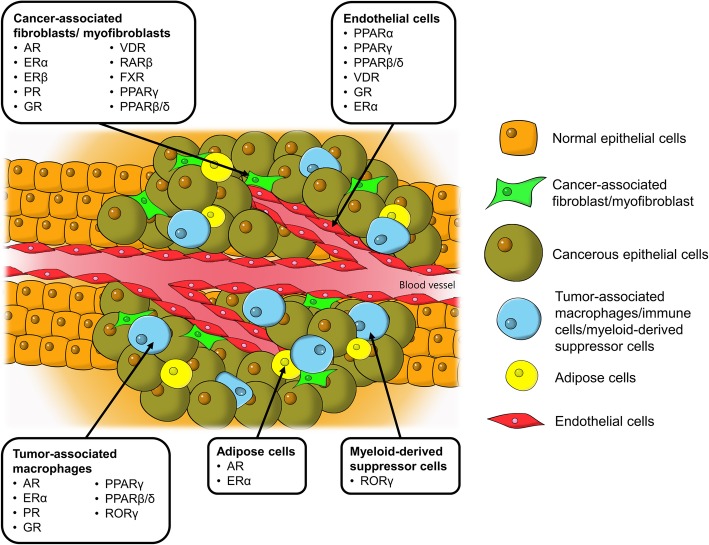
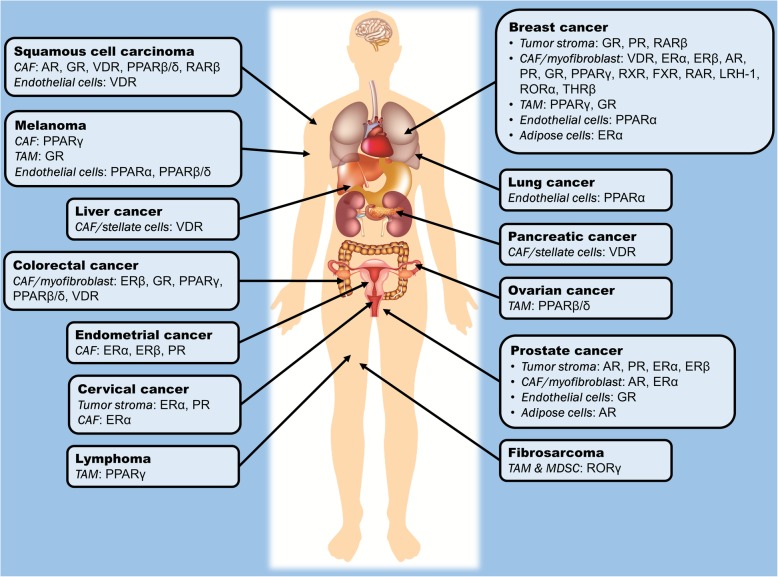
The tumor microenvironment is a complex and dynamic cellular community comprising the tumor epithelium and various tumor-supporting cells such as immune cells, fibroblasts, immunosuppressive cells, adipose cells, endothelial cells, and pericytes. The interplay between the tumor microenvironment and tumor cells represents a key contributor to immune evasiveness, physiological hardiness and the local and systemic invasiveness of malignant cells. Nuclear receptors are master regulators of physiological processes and are known to play pro-/anti-oncogenic activities in tumor cells. However, the actions of nuclear receptors in tumor-supporting cells have not been widely studied. Given the excellent druggability and extensive regulatory effects of nuclear receptors, understanding their biological functionality in the tumor microenvironment is of utmost importance. Therefore, the present review aims to summarize recent evidence about the roles of nuclear receptors in tumor-supporting cells and their implications for malignant processes such as tumor proliferation, evasion of immune surveillance, angiogenesis, chemotherapeutic resistance, and metastasis. Based on findings derived mostly from cell culture studies and a few in vivo animal cancer models, the functions of VDR, PPARs, AR, ER and GR in tumor-supporting cells are relatively well-characterized. Evidence for other receptors, such as RARβ, RORγ, and FXR, is limited yet promising. Hence, the nuclear receptor signature in the tumor microenvironment may harbor prognostic value. The clinical prospects of a tumor microenvironment-oriented cancer therapy exploiting the nuclear receptors in different tumor-supporting cells are also encouraging. The major challenge, however, lies in the ability to develop a highly specific drug delivery system to facilitate precision medicine in cancer therapy.
肿瘤微环境是一个复杂而动态的细胞群落,包括肿瘤上皮细胞和各种肿瘤支持细胞,如免疫细胞、成纤维细胞、免疫抑制细胞、脂肪细胞、内皮细胞和周细胞。肿瘤微环境与肿瘤细胞之间的相互作用是免疫逃逸、生理坚韧以及恶性细胞局部和全身侵袭的关键因素。核受体是生理过程的主要调节剂,已知在肿瘤细胞中发挥促癌/抑癌作用。然而,核受体在肿瘤支持细胞中的作用尚未得到广泛研究。鉴于核受体具有良好的成药性和广泛的调节作用,了解它们在肿瘤微环境中的生物学功能至关重要。因此,本综述旨在总结核受体在肿瘤支持细胞中的作用及其对肿瘤增殖、免疫逃避、血管生成、化疗耐药和转移等恶性过程的影响的最新证据。基于主要来自细胞培养研究和少数体内动物癌症模型的发现,VDR、PPARs、AR、ER 和 GR 在肿瘤支持细胞中的功能得到了较好的描述。其他受体,如 RARβ、RORγ 和 FXR 的证据虽然有限,但很有前途。因此,肿瘤微环境中的核受体特征可能具有预后价值。利用不同肿瘤支持细胞中的核受体进行肿瘤微环境导向的癌症治疗的临床前景也令人鼓舞。然而,主要的挑战在于开发高度特异性的药物输送系统,以促进癌症治疗中的精准医学。