Christensen Ian, Lu Bo, Yang Ning, Huang Kevin, Wang Ping, Tian Ning
Department of Ophthalmology & Visual Sciences, University of Utah School of Medicine, Salt Lake City, UT, United States.
VA Salt Lake City Health Care System, Salt Lake City, UT, United States.
Front Neurosci. 2019 Mar 15;13:219. doi: 10.3389/fnins.2019.00219. eCollection 2019.
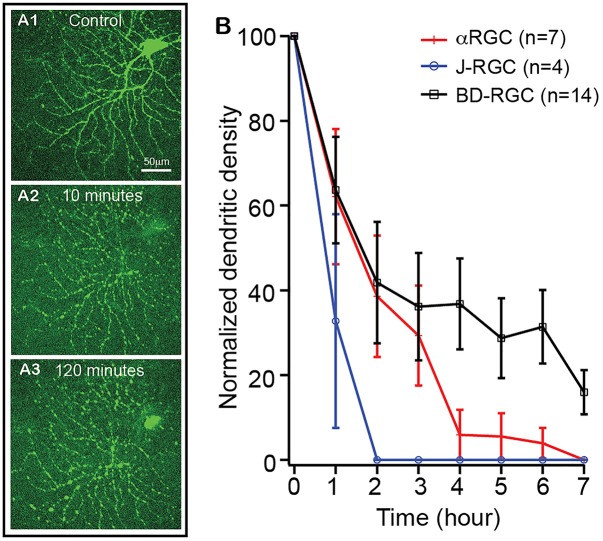
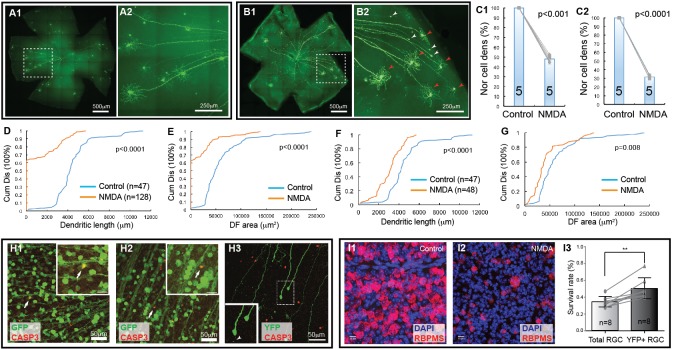
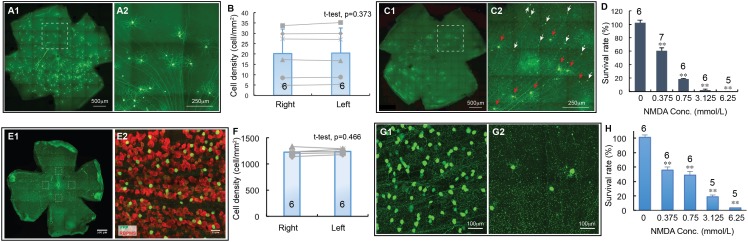
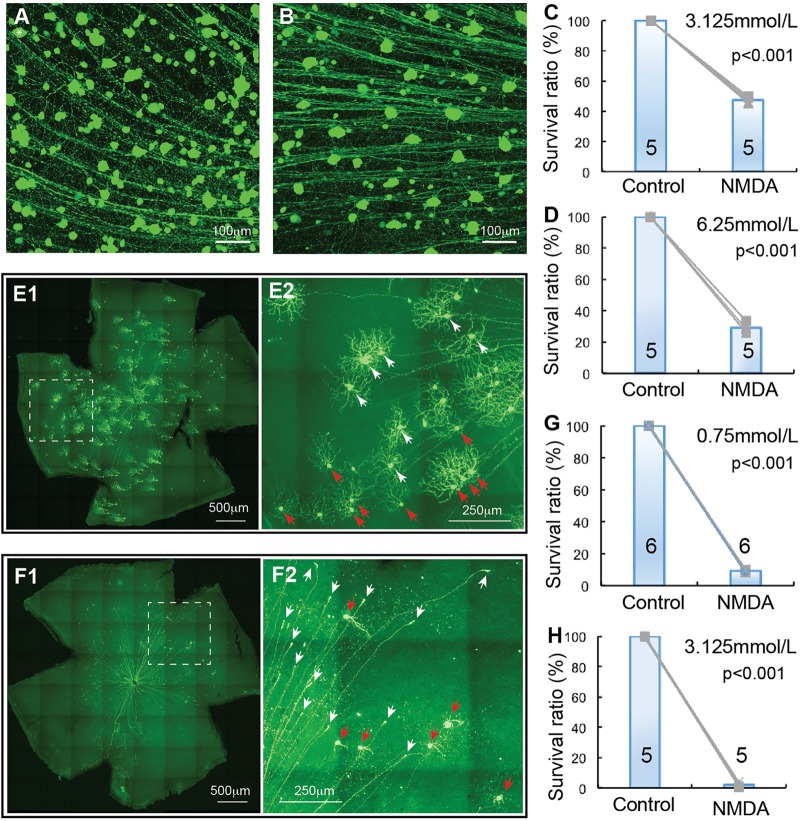
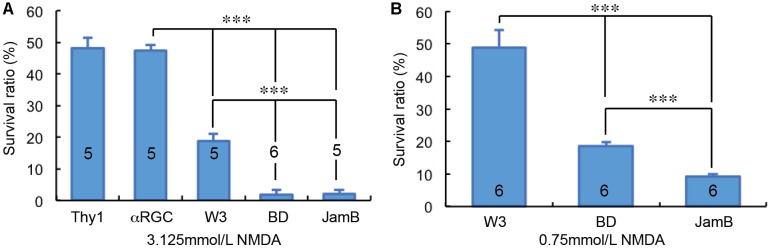
Retinal ganglion cells (RGCs) are the only output neurons that conduct visual signals from the eyes to the brain. RGC degeneration occurs in many retinal diseases leading to blindness and increasing evidence suggests that RGCs are susceptible to various injuries in a type-specific manner. Glutamate excitotoxicity is the pathological process by which neurons are damaged and killed by excessive stimulation of glutamate receptors and it plays a central role in the death of neurons in many CNS and retinal diseases. The purpose of this study is to characterize the susceptibility of genetically identified RGC types to the excitotoxicity induced by -methyl-D-aspartate (NMDA). We show that the susceptibility of different types of RGCs to NMDA excitotoxicity varies significantly, in which the αRGCs are the most resistant type of RGCs to NMDA excitotoxicity while the J-RGCs are the most sensitive cells to NMDA excitotoxicity. These results strongly suggest that the differences in the genetic background of RGC types might provide valuable insights for understanding the selective susceptibility of RGCs to pathological insults and the development of a strategy to protect RGCs from death in disease conditions. In addition, our results show that RGCs lose dendrites before death and the sequence of the morphological and molecular events during RGC death suggests that the initial insult of NMDA excitotoxicity might set off a cascade of events independent of the primary insults. However, the kinetics of dendritic retraction in RGCs does not directly correlate to the susceptibility of type-specific RGC death.
视网膜神经节细胞(RGCs)是唯一将视觉信号从眼睛传导至大脑的输出神经元。RGCs变性发生于许多导致失明的视网膜疾病中,越来越多的证据表明,RGCs易以特定类型的方式受到各种损伤。谷氨酸兴奋性毒性是一种病理过程,即神经元因谷氨酸受体的过度刺激而受损和死亡,它在许多中枢神经系统和视网膜疾病的神经元死亡中起核心作用。本研究的目的是描述基因鉴定的RGC类型对N-甲基-D-天冬氨酸(NMDA)诱导的兴奋性毒性的易感性。我们发现,不同类型的RGCs对NMDA兴奋性毒性的易感性差异显著,其中αRGCs是对NMDA兴奋性毒性最具抗性的RGC类型,而J-RGCs是对NMDA兴奋性毒性最敏感的细胞。这些结果有力地表明,RGC类型的基因背景差异可能为理解RGCs对病理损伤的选择性易感性以及制定在疾病状态下保护RGCs免于死亡的策略提供有价值的见解。此外,我们的结果表明,RGCs在死亡前会失去树突,RGC死亡期间形态和分子事件的顺序表明,NMDA兴奋性毒性的初始损伤可能引发一系列独立于原发性损伤的事件。然而,RGCs中树突回缩的动力学与特定类型RGC死亡的易感性并不直接相关。