Daniel S, Clark A F, McDowell C M
North Texas Eye Research Institute, Department of Pharmacology and Neuroscience, University of North Texas Health Science Center, Fort Worth, Texas United States.
Cell Death Discov. 2018 Jun 28;4:7. doi: 10.1038/s41420-018-0069-y. eCollection 2018.
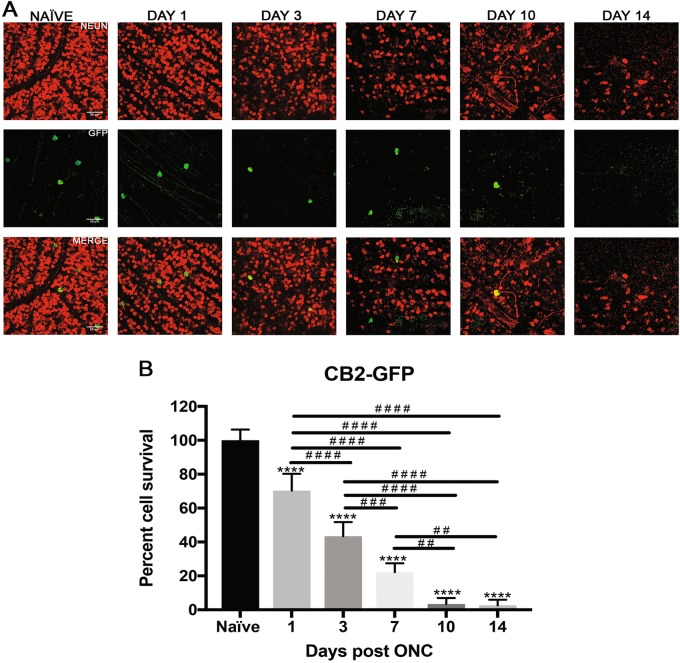
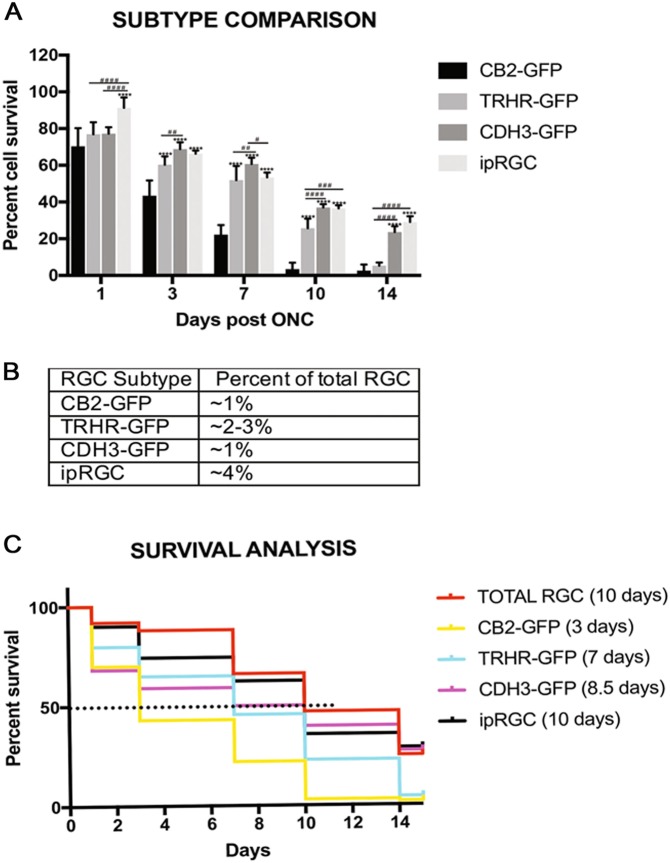
Glaucoma is a neurodegenerative disease with retinal ganglion cell (RGC) loss, optic nerve degeneration and subsequent vision loss. There are about 30 different subtypes of RGCs whose response to glaucomatous injury is not well characterized. The purpose of this study was to evaluate the response of 4 RGC subtypes in a mouse model of optic nerve crush (ONC). In this study, we also evaluated the pattern of axonal degeneration in RGC subtypes after nerve injury. We found that out of the 4 subtypes, transient-Off α RGCs are the most susceptible to injury followed by On-Off direction selective RGCs (DSGC). Non-image forming RGCs are more resilient with ipRGCs exhibiting the most resistance of them all. In contrast, axons degenerate irrespective of their retinal soma after ONC injury. In conclusion, we show that RGCs have subtype specific cell death response to ONC injury and that RGC axons disintegrate in an autonomous fashion undergoing Wallerian degeneration. These discoveries can further direct us towards effective diagnostic and therapeutic approaches to treat optic neuropathies, such as glaucoma.
青光眼是一种神经退行性疾病,伴有视网膜神经节细胞(RGC)丢失、视神经变性及随后的视力丧失。RGC约有30种不同亚型,其对青光眼性损伤的反应尚未得到充分表征。本研究的目的是评估在视神经挤压(ONC)小鼠模型中4种RGC亚型的反应。在本研究中,我们还评估了神经损伤后RGC亚型中轴突变性的模式。我们发现,在这4种亚型中,瞬态关闭α RGC最易受损伤,其次是开-关方向选择性RGC(DSGC)。非成像RGC更具弹性,其中固有光敏视网膜神经节细胞(ipRGC)表现出最强的抵抗力。相比之下,ONC损伤后轴突无论其视网膜胞体如何都会发生变性。总之,我们表明RGC对ONC损伤具有亚型特异性细胞死亡反应,并且RGC轴突以自主方式解体,发生华勒变性。这些发现可以进一步指导我们找到治疗视神经病变(如青光眼)的有效诊断和治疗方法。