Linghu Ke-Gang, Wu Guo-Ping, Fu Ling-Yun, Yang Hong, Li Hai-Zhi, Chen Yan, Yu Hua, Tao Ling, Shen Xiang-Chun
The Department of Pharmacology of Materia Medica (the State Key Laboratory of Functions and Applications of Medicinal Plants, the High Efficacy Application of Natural Medicinal Resources Engineering Center of Guizhou Province, the Key Laboratory of Optimal Utilization of Natural Medicine Resources), School of Pharmaceutical Sciences, Guizhou Medical University, Guiyang, China.
Institute of Chinese Medical Sciences, State Key Laboratory of Quality Research in Chinese Medicine, University of Macau, Macau, China.
Front Pharmacol. 2019 Mar 7;10:178. doi: 10.3389/fphar.2019.00178. eCollection 2019.
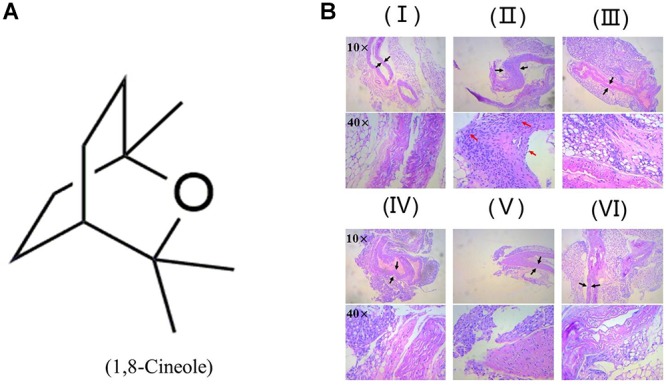
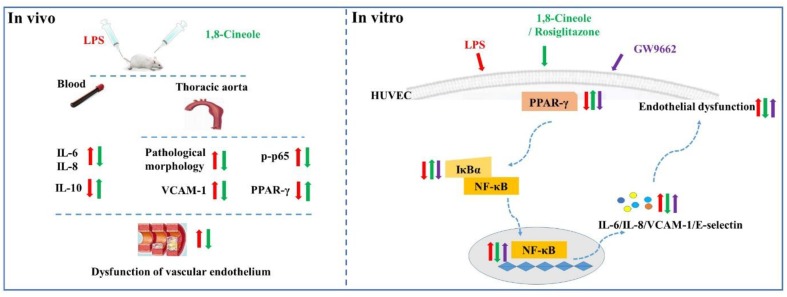
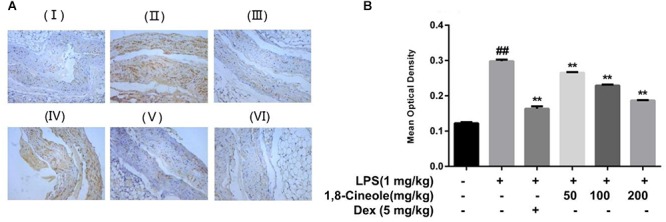
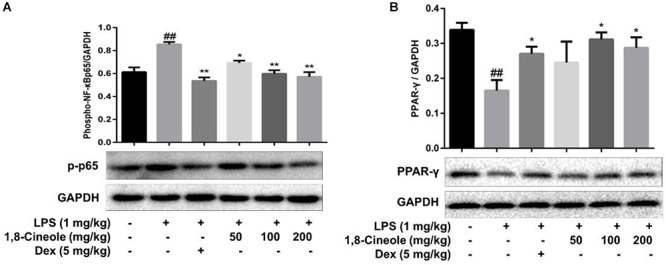
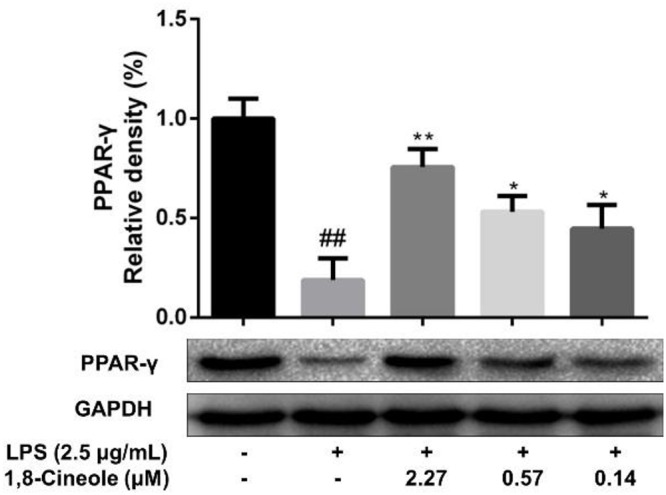
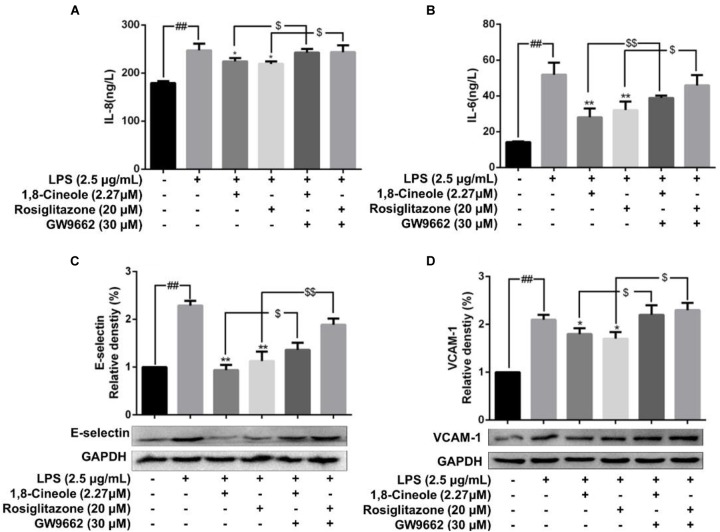
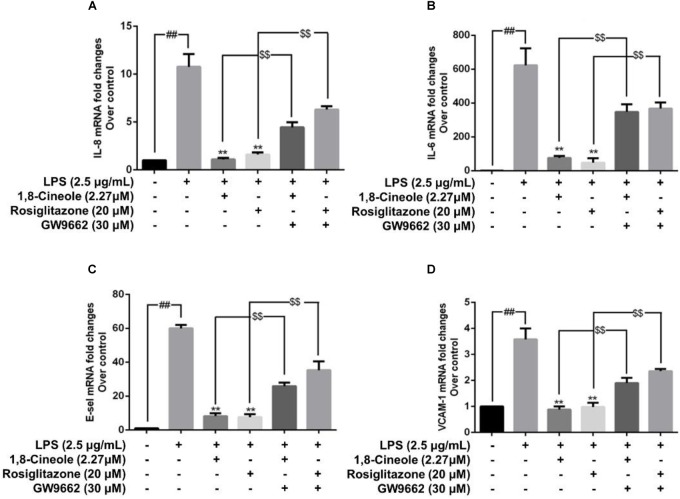
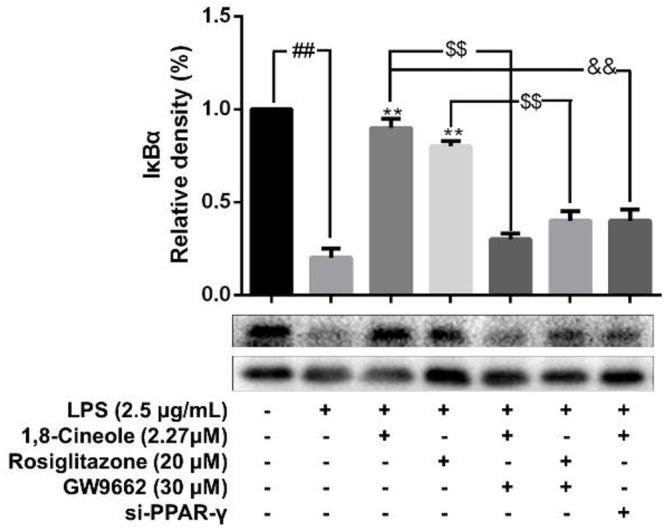
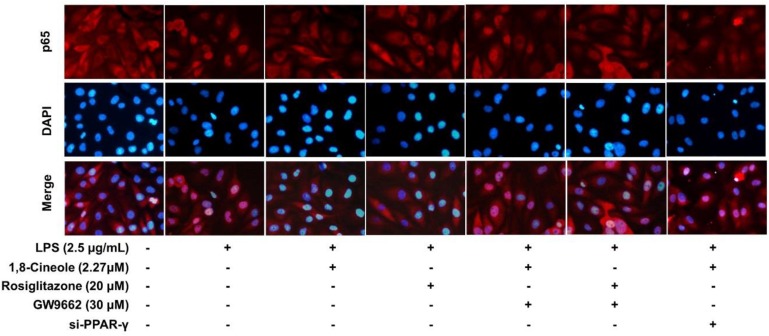
1,8-Cineole (eucalyptol), a monoterpene, has been widely reported for the anti-inflammatory effects. Our previous data confirmed that 1,8-cineole ameliorated the inflammatory phenotype of human umbilical vein endothelial cells (HUVECs) by mediating NF-κB expression . At present, we investigated the protection effects of 1,8-cineole on vascular endothelium in lipopolysaccharide (LPS)-induced acute inflammatory injury mice and the potential mechanisms involved in the protection in HUVECs. Results from enzyme linked immunosorbent assays revealed that 1,8-cineole suppressed the secretion of interleukin (IL)-6 and IL-8 and increased the expression of IL-10 in the serum of LPS-induced mice. 1,8-Cineole reduced the inflammatory infiltration and the expression of vascular cell adhesion molecular 1 (VCAM-1) in the sections of thoracic aorta in LPS-induced acute inflammatory mice. Western blotting indicated that 1,8-cineole significantly decreased the phosphorylation of NF-κB p65 and increased the expression of PPAR-γ in the thoracic aorta tissue. 1,8-Cineole increased the expression of PPAR-γ in LPS-induced HUVECs. 1,8-Cineole and rosiglitazone reduced the protein and mRNA levels of VCAM-1, E-selectin, IL-6, and IL-8 in LPS-induced HUVECs, which could be reversed by the action of GW9662 (inhibitor of PPAR-γ). 1,8-Cineole and rosiglitazone blocked the LPS-induced IκBα degradation and NF-κB p65 nucleus translocation, which could be reversed by the pretreatment of GW9662 or silence of PPAR-γ gene. In conclusion, 1,8-cineole attenuated LPS-induced vascular endothelial cells injury via PPAR-γ dependent modulation of NF-κB.
1,8-桉叶素(桉油精),一种单萜类化合物,其抗炎作用已被广泛报道。我们之前的数据证实,1,8-桉叶素通过介导核因子κB(NF-κB)的表达改善了人脐静脉内皮细胞(HUVECs)的炎症表型。目前,我们研究了1,8-桉叶素对脂多糖(LPS)诱导的急性炎症损伤小鼠血管内皮的保护作用以及在HUVECs中保护作用的潜在机制。酶联免疫吸附测定结果显示,1,8-桉叶素抑制了LPS诱导小鼠血清中白细胞介素(IL)-6和IL-8的分泌,并增加了IL-10的表达。1,8-桉叶素减少了LPS诱导的急性炎症小鼠胸主动脉切片中的炎症浸润和血管细胞黏附分子1(VCAM-1)的表达。蛋白质印迹法表明,1,8-桉叶素显著降低了胸主动脉组织中NF-κB p65的磷酸化水平,并增加了过氧化物酶体增殖物激活受体γ(PPAR-γ)的表达。1,8-桉叶素增加了LPS诱导的HUVECs中PPAR-γ的表达。1,8-桉叶素和罗格列酮降低了LPS诱导的HUVECs中VCAM-1、E-选择素、IL-6和IL-8的蛋白质和mRNA水平,而GW9662(PPAR-γ抑制剂)的作用可逆转这种降低。1,8-桉叶素和罗格列酮阻断了LPS诱导的IκBα降解和NF-κB p65核转位,而GW9662预处理或PPAR-γ基因沉默可逆转这种阻断。总之,1,8-桉叶素通过PPAR-γ依赖的NF-κB调节减轻了LPS诱导的血管内皮细胞损伤。