University of New Hampshire, Department of Psychology, Durham, NH, United States of America.
University of Pittsburgh, School of Computing and Information, Pittsburgh, PA, United States of America.
PLoS One. 2019 Apr 1;14(4):e0213891. doi: 10.1371/journal.pone.0213891. eCollection 2019.
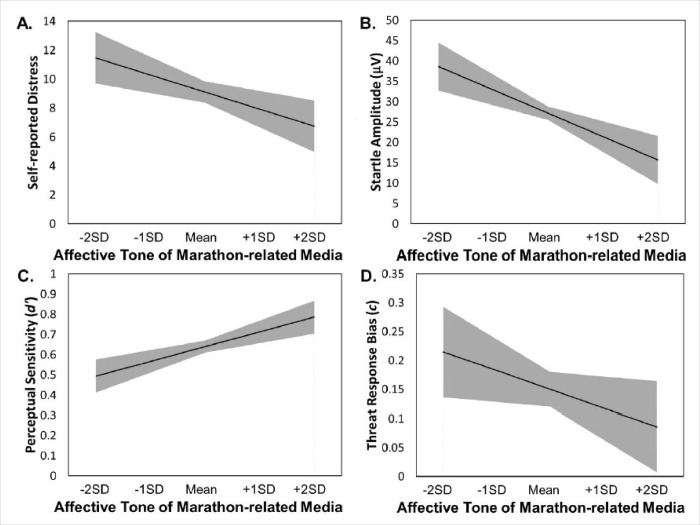
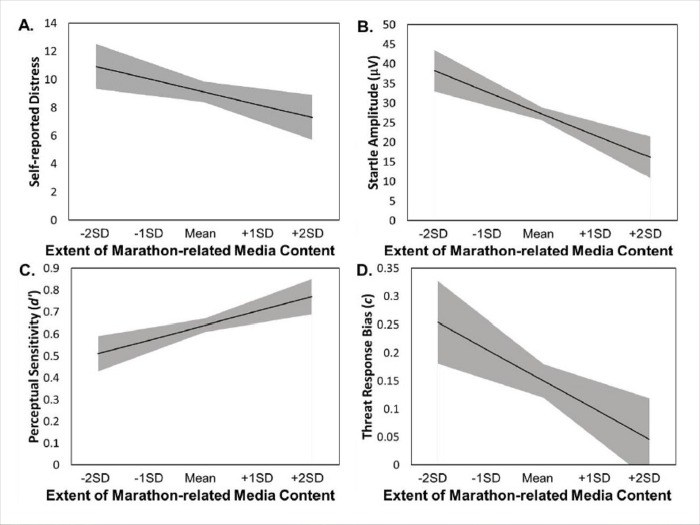
Exposure to media coverage of mass violence has been shown to predict poorer mental health symptomology. However, it is unknown whether such media coverage can have ubiquitous effects on average community members, extending to biological and perceptual processes that underlie everyday decision making and behavior. Here, we used a repeated-measures design over the first anniversary of the Boston Marathon bombings to track participants' self-reported distress, their eye blink startle reactivity while viewing images of the bombings, and their ability to perceptually distinguish armed from unarmed individuals in a behavioral shooting task. We leveraged a computational linguistics method in which we sampled news content from the sources our participants most commonly self-reported reading, and then quantified both the extent of news coverage about the marathon and the affective tone of that news coverage. Results revealed that participants experienced greater current distress, greater physiological reactivity to threats, and poorer perceptual sensitivity when recent news coverage of the marathon contained more affectively negative words. This is the first empirical work to examine relationships between the media's affective tone in its coverage of mass violence and individuals' threat perception and physiological threat reactivity.
媒体对大规模暴力事件的报道会对心理健康产生不良影响,这已得到证实。然而,目前尚不清楚这种媒体报道是否会对普通社区成员产生普遍影响,是否会延伸到日常生活决策和行为背后的生物和感知过程。在这里,我们在波士顿马拉松爆炸案发生一周年之际,采用重复测量设计,跟踪参与者自我报告的困扰程度、观看爆炸案图像时的眨眼惊跳反应,以及在行为射击任务中感知区分武装和非武装个体的能力。我们利用一种计算语言学方法,从参与者最常报告阅读的来源中抽取新闻内容,然后量化关于马拉松的新闻报道的范围和新闻报道的情感基调。结果表明,当最近关于马拉松的新闻报道包含更多情感上负面的词语时,参与者会感到更大的当前困扰、对威胁更大的生理反应,以及较差的感知敏感性。这是首次实证研究考察媒体对大规模暴力事件的报道的情感基调与个体的威胁感知和生理威胁反应之间的关系。