School of Physics and Information Technology, Shaanxi Normal University, Xi'an 710062, China; Beijing Computational Science Research Center, 100193 Beijing, China; and Robert Koch-Institute, Nordufer 20, 13353 Berlin, Germany.
Phys Rev E. 2019 Feb;99(2-1):022308. doi: 10.1103/PhysRevE.99.022308.
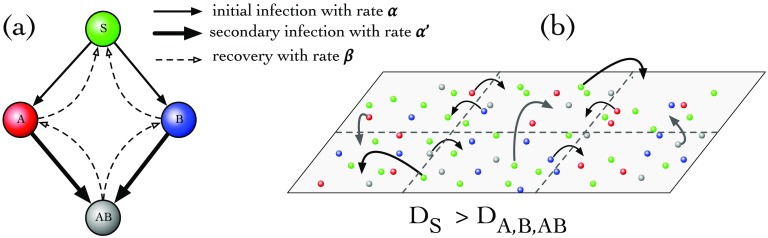
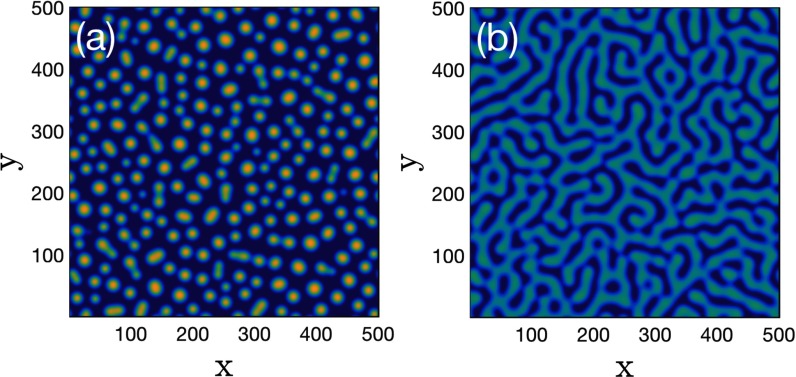
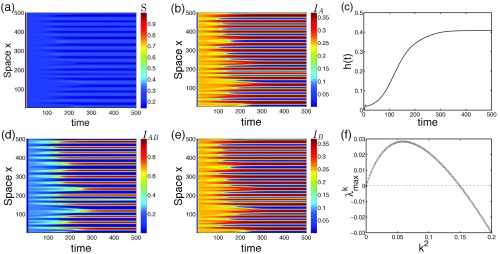
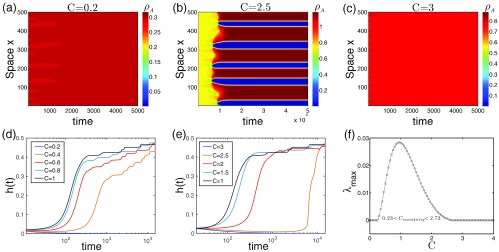
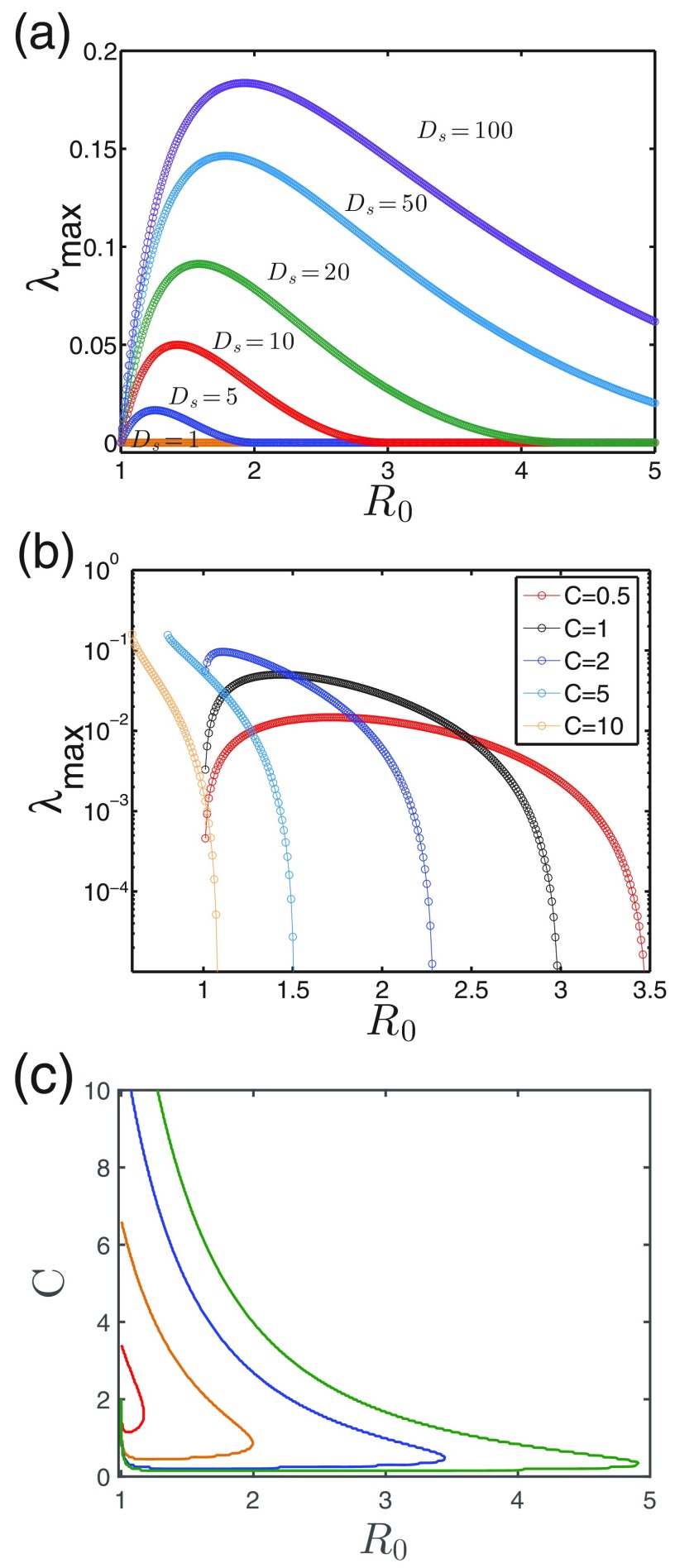
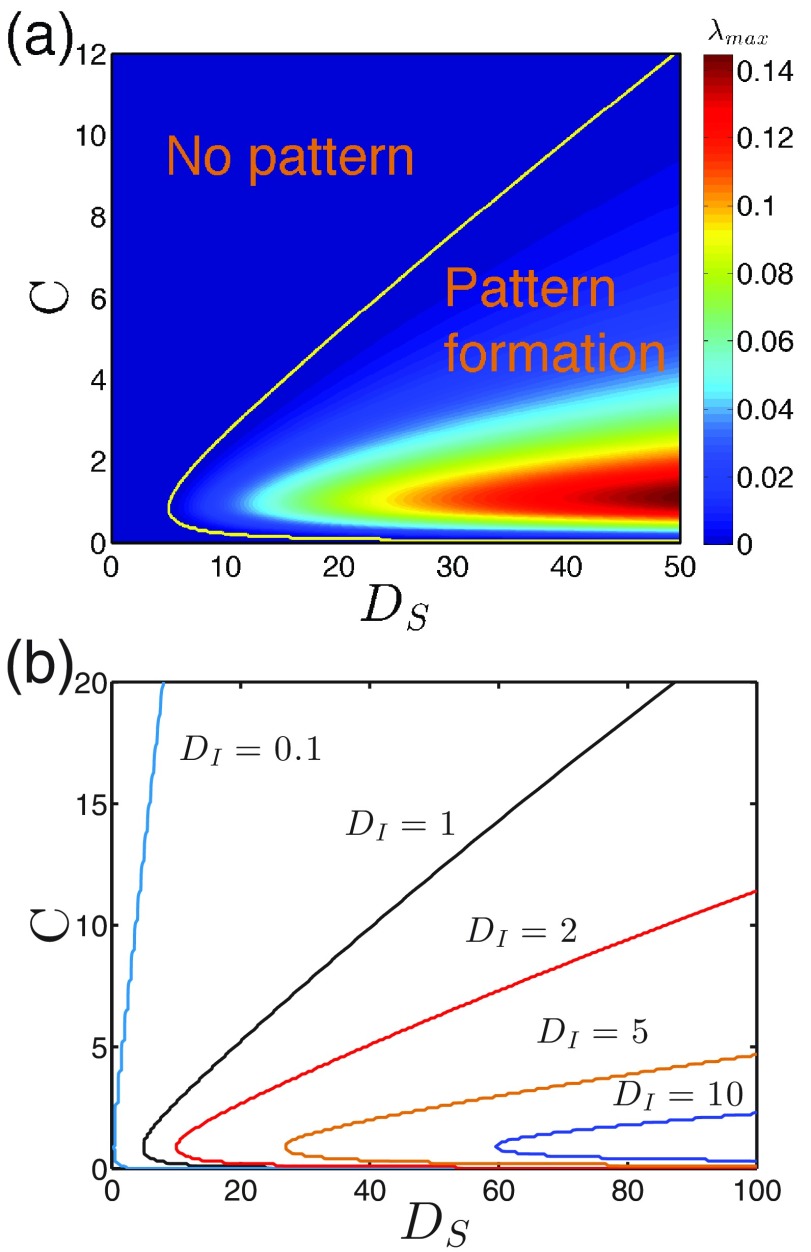
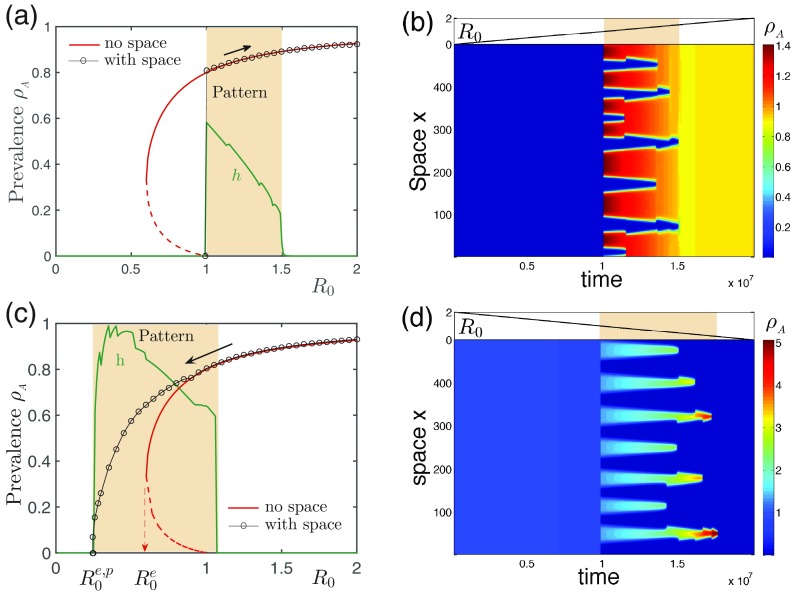
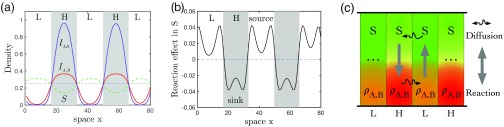
The spread of infectious diseases, rumors, fashions, and innovations are complex contagion processes, embedded in network and spatial contexts. While the studies in the former context are intensively expanded, the latter remains largely unexplored. In this paper, we investigate the pattern formation of an interacting contagion, where two infections, A and B, interact with each other and diffuse simultaneously in space. The contagion process for each follows the classical susceptible-infected-susceptible kinetics, and their interaction introduces a potential change in the secondary infection propensity compared to the baseline reproduction number R_{0}. We show that the nontrivial spatial infection patterns arise when the susceptible individuals move faster than the infected and the interaction between the two infections is neither too competitive nor too cooperative. Interestingly, the system exhibits pattern hysteresis phenomena, i.e., quite different parameter regions for patterns exist in the direction of increasing or decreasing R_{0}. Decreasing R_{0} reveals remarkable enhancement in contagion prevalence, meaning that the eradication becomes difficult compared to the single-infection or coinfection without space. Linearization analysis supports our observations, and we have identified the required elements and dynamical mechanism, which suggests that these patterns are essentially Turing patterns. Our work thus reveals new complexities in interacting contagions and paves the way for further investigation because of its relevance to both biological and social contexts.
传染病、谣言、时尚和创新的传播是复杂的传染过程,嵌入在网络和空间背景中。尽管前者的研究得到了深入扩展,但后者在很大程度上仍未得到探索。在本文中,我们研究了一种相互作用的传染病的模式形成,其中两种传染病 A 和 B 相互作用并在空间中同时扩散。每种传染病的传染过程都遵循经典的易感-感染-易感动力学,它们之间的相互作用与基本再生数 R_{0}相比引入了二次感染倾向的潜在变化。我们表明,当易感个体的移动速度快于感染个体,并且两种感染之间的相互作用既不是竞争太激烈也不是合作太紧密时,就会出现非平凡的空间感染模式。有趣的是,系统表现出模式滞后现象,即对于增加或减少 R_{0}的方向,存在着非常不同的模式参数区域。R_{0}的减少显著增强了传染病的流行程度,这意味着与单感染或无空间的混合感染相比,传染病的根除变得更加困难。线性化分析支持我们的观察结果,我们已经确定了所需的元素和动力学机制,这表明这些模式本质上是图灵模式。因此,我们的工作揭示了相互作用的传染病中的新复杂性,并为进一步研究铺平了道路,因为它与生物和社会背景都有关联。