Irimia Andrei, Maher Alexander S, Rostowsky Kenneth A, Chowdhury Nahian F, Hwang Darryl H, Law E Meng
USC Leonard Davis School of Gerontology, Ethel Percy Andrus Gerontology Center, University of Southern California, Los Angeles, CA, United States.
Department of Radiology, Keck School of Medicine of USC, University of Southern California, Los Angeles, CA, United States.
Front Neuroinform. 2019 Mar 18;13:9. doi: 10.3389/fninf.2019.00009. eCollection 2019.
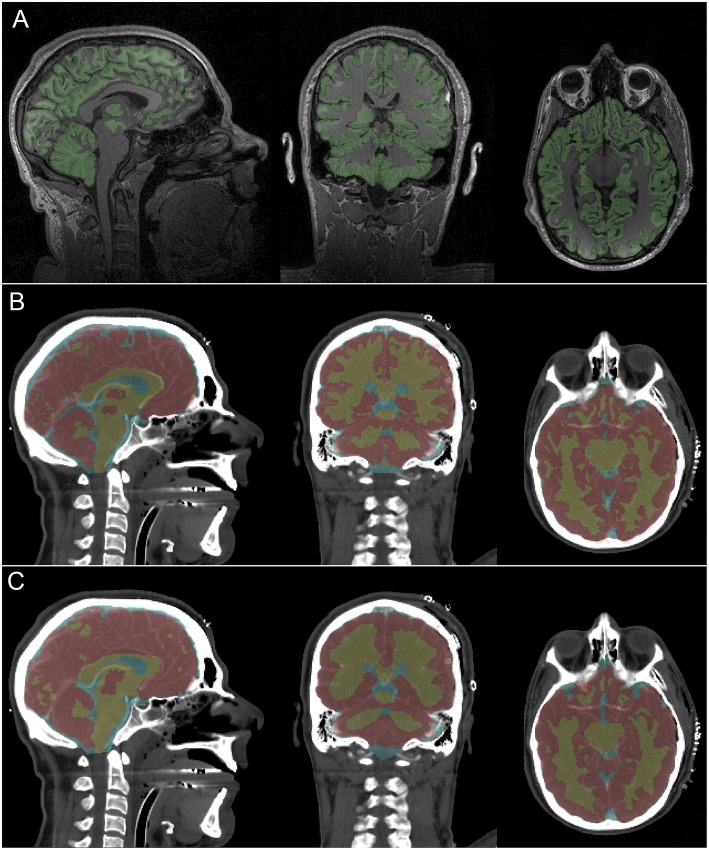
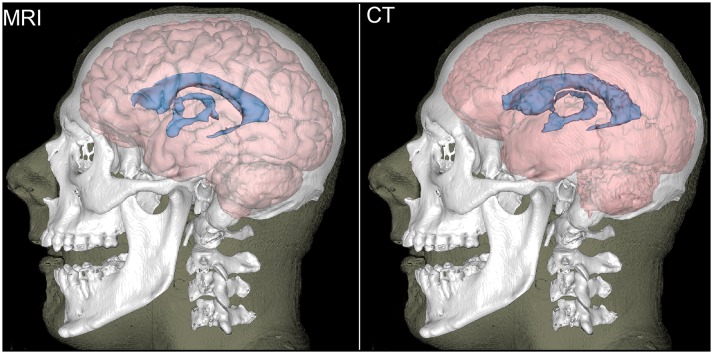
When properly implemented and processed, anatomic -weighted magnetic resonance imaging (MRI) can be ideal for the noninvasive quantification of white matter (WM) and gray matter (GM) in the living human brain. Although MRI is more suitable for distinguishing GM from WM than computed tomography (CT), the growing clinical use of the latter technique has renewed interest in head CT segmentation. Such interest is particularly strong in settings where MRI is unavailable, logistically unfeasible or prohibitively expensive. Nevertheless, whereas MRI segmentation is a sophisticated and technically-mature research field, the task of automatically classifying soft brain tissues from CT remains largely unexplored. Furthermore, brain segmentation methods for MRI hold considerable potential for adaptation and application to CT image processing. Here we demonstrate this by combining probabilistic, atlas-based classification with topologically-constrained tissue boundary refinement to delineate WM, GM and cerebrospinal fluid (CSF) from head CT images. The feasibility and utility of this approach are revealed by comparison of MRI-only vs. CT-only segmentations in geriatric concussion victims with both MRI and CT scans. Comparison of the two segmentations yields mean Sørensen-Dice coefficients of 85.5 ± 4.6% (WM), 86.7 ± 5.6% (GM) and 91.3 ± 2.8% (CSF), as well as average Hausdorff distances of 3.76 ± 1.85 mm (WM), 3.43 ± 1.53 mm (GM) and 2.46 ± 1.27 mm (CSF). Bootstrapping results suggest that the segmentation approach is sensitive enough to yield WM, GM and CSF volume estimates within ~5%, ~4%, and ~3% of their MRI-based estimates, respectively. To our knowledge, this is the first 3D segmentation approach for CT to undergo rigorous within-subject comparison with high-resolution MRI. Results suggest that (1) standard-quality CT allows WM/GM/CSF segmentation with reasonable accuracy, and that (2) the task of soft brain tissue classification from CT merits further attention from neuroimaging researchers.
当正确实施和处理时,解剖加权磁共振成像(MRI)对于活体人类大脑中白质(WM)和灰质(GM)的无创定量分析可能是理想的。尽管MRI比计算机断层扫描(CT)更适合区分GM和WM,但后一种技术在临床上的日益广泛应用重新引发了人们对头部CT分割的兴趣。在无法获得MRI、在后勤上不可行或成本过高的情况下,这种兴趣尤为强烈。然而,虽然MRI分割是一个复杂且技术成熟的研究领域,但从CT自动分类软脑组织的任务在很大程度上仍未得到探索。此外,MRI的脑部分割方法在适应和应用于CT图像处理方面具有相当大的潜力。在这里,我们通过将基于图谱的概率分类与拓扑约束的组织边界细化相结合,从头部CT图像中勾勒出WM、GM和脑脊液(CSF),从而证明了这一点。通过对同时进行MRI和CT扫描的老年脑震荡患者仅MRI分割与仅CT分割的比较,揭示了这种方法的可行性和实用性。两种分割的比较产生的平均索伦森 - 戴斯系数分别为85.5±4.6%(WM)、86.7±5.6%(GM)和91.3±2.8%(CSF),以及平均豪斯多夫距离分别为3.76±1.85毫米(WM)、3.43±1.53毫米(GM)和2.46±1.27毫米(CSF)。自展结果表明,分割方法足够灵敏,分别能产生WM、GM和CSF体积估计值,其与基于MRI的估计值的偏差分别在约5%、约4%和约3%以内。据我们所知,这是第一种用于CT的3D分割方法,可与高分辨率MRI进行严格的个体内比较。结果表明:(1)标准质量的CT能够以合理的准确性进行WM/GM/CSF分割;(2)从CT进行软脑组织分类的任务值得神经影像学研究人员进一步关注。