Oser Sean M, Stuckey Heather L, Parascando Jessica A, McGinley Erin L, Berg Arthur, Oser Tamara K
Department of Family and Community Medicine, Penn State College of Medicine, Hershey, PA, United States.
Department of Internal Medicine, Penn State College of Medicine, Hershey, PA, United States.
JMIR Diabetes. 2019 Apr 2;4(2):e13634. doi: 10.2196/13634.
Of the estimated 23.1 million individuals diagnosed with diabetes, approximately 5% have type 1 diabetes (T1D). It has been proposed that this number will triple by 2050. With increases in technology use and resources available, many individuals are using insulin pumps and continuous glucose monitors (CGMs) to help manage their T1D. They are also using online resources such as social media to find more information and advice based on real-life experiences from peers. Blogs are a particular social media modality often used by people with T1D but have not been widely investigated.
The purpose of this study was to assess glycated hemoglobin (HbA) differences between blog readers and blog nonusers in a population of adults with T1D. This study also looked at differences in technology use in these two groups, as well as HbA differences in blog use and technology subgroups.
Participants were recruited both by mail and by online T1D-themed blog postings. Respondents completed a secure online eligibility assessment and were asked questions related to their T1D, blog and internet use, and insulin pump and CGM use. Demographics were also collected. Differences between blog readers and blog nonusers were tested via chi-square and t tests. Mann-Whitney U tests, Fisher exact tests, and analyses of variance (ANOVA) were used to test for differences in self-reported HbA between groups and subgroups.
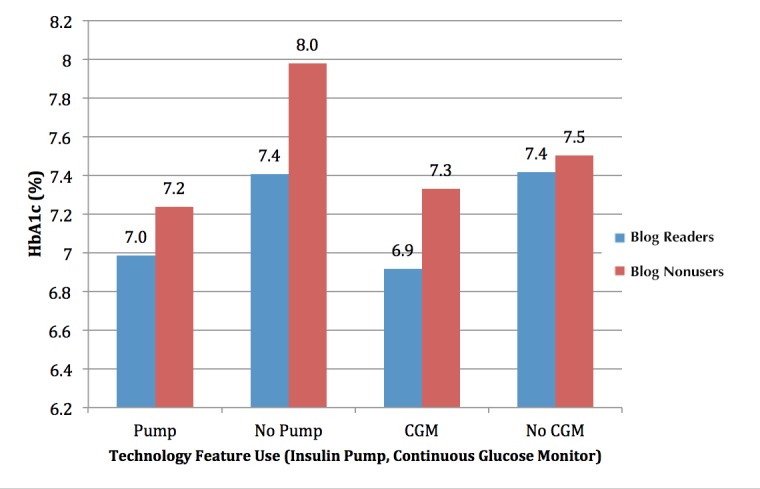
A total of 282 eligible participants completed the survey (214 blog readers, 68 blog nonusers). Average duration of diabetes was 21.2 years, 77.7% (219/282) were female, 81.2% (229/282) used an insulin pump, 66.3% (187/282) used a CGM, and 95.7% (270/282) were white. HbA was lower for blog readers (7.0%) than blog nonusers (7.5%), P=.006; for insulin pump users (7.0%) than multiple daily injections (7.7%), P=.001; and for CGM users (7.0%) than CGM nonusers (7.5%), P=.001. After adjusting for significant covariates, the association between blog use and HbA remained significant (P=.04). ANOVA modeling also demonstrated significant differences in HbA between blog users and nonusers among subgroups by pump use and CGM use (P<.001).
These results suggest that reading blogs is associated with lower HbA values. While association does not prove causation, blog readers have the benefit of learning information from peers and having 24/7 access to a community of individuals with similar daily life struggles, where they are able to ask questions and seek advice.
在估计的2310万糖尿病确诊患者中,约5%患有1型糖尿病(T1D)。有人提出,到2050年这个数字将增至三倍。随着技术使用和可用资源的增加,许多患者使用胰岛素泵和持续葡萄糖监测仪(CGM)来帮助管理他们的T1D。他们还利用社交媒体等在线资源,根据同龄人真实生活经历来获取更多信息和建议。博客是T1D患者经常使用的一种特定社交媒体形式,但尚未得到广泛研究。
本研究旨在评估成年T1D患者群体中博客读者与非博客读者之间糖化血红蛋白(HbA)的差异。本研究还考察了这两组在技术使用方面的差异,以及博客使用和技术亚组中的HbA差异。
通过邮件和以T1D为主题的在线博客帖子招募参与者。受访者完成一项安全的在线资格评估,并被问及与他们的T1D、博客和互联网使用以及胰岛素泵和CGM使用相关的问题。还收集了人口统计学信息。通过卡方检验和t检验来检测博客读者与非博客读者之间的差异。使用曼-惠特尼U检验、费舍尔精确检验和方差分析(ANOVA)来检验组间和亚组间自我报告的HbA差异。
共有282名符合条件的参与者完成了调查(214名博客读者,68名非博客读者)。糖尿病平均病程为21.2年,77.7%(219/282)为女性,81.2%(229/282)使用胰岛素泵,66.3%(187/282)使用CGM,9�.7%(270/282)为白人。博客读者的HbA(7.0%)低于非博客读者(7.5%),P = 0.006;胰岛素泵使用者的HbA(7.0%)低于多次每日注射者(7.7%),P = 0.001;CGM使用者的HbA(7.0%)低于非CGM使用者(7.5%),P = 0.001。在对显著协变量进行调整后,博客使用与HbA之间的关联仍然显著(P = 0.04)。方差分析模型还显示,按泵使用和CGM使用划分的亚组中,博客使用者与非使用者之间的HbA存在显著差异(P < 0.001)。
这些结果表明,阅读博客与较低的HbA值相关。虽然关联并不证明因果关系,但博客读者能够从同龄人那里学习信息,并能全天候接触到有着相似日常生活困扰的群体,在那里他们可以提问和寻求建议。